

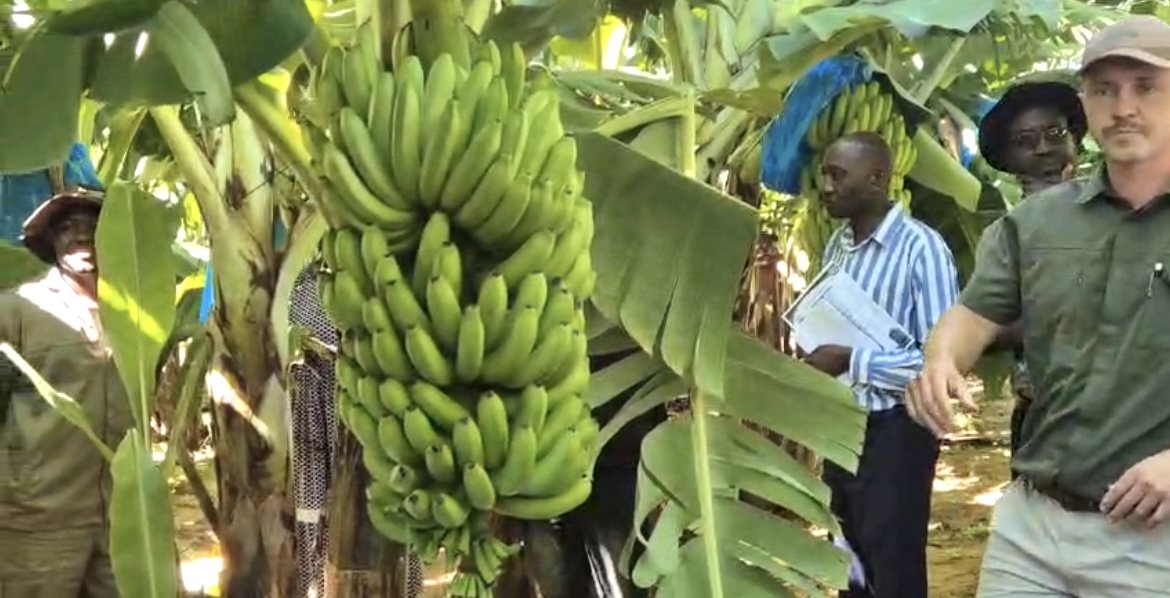

ETUNDA – The Namibian Agronomic Board has launched its first harvest demonstration and information day for the Etunda banana trial research project in the Omusati region.
This marks a major step towards local banana production in Namibia.
The project, which started with plantations in January last year, has now reached a significant milestone, with most of the bananas ripe for harvest.
During the farmers’ information-sharing event at Etunda, ripe bananas were harvested and transported to a cold storage facility, where they will undergo a controlled ripening process before being released into the market.
Speaking at the event, Namibian Agronomic Board (NAB) CEO Fidelis Mwazi said the project aims to assess whether the Omusati region is suitable for large-scale banana production due to its frost-free conditions.
He explained that Namibia currently imports around 7 000 metric tonnes of bananas annually, a situation that has prompted the board to explore local production to reduce imports and strengthen domestic food supply.
“The seedlings used in this project were sourced through tissue culture from the laboratory of AvaGro, one of our key partners in the research and development process,” he said.
Mwazi added that the encouraging harvest results demonstrate the potential of banana farming in the country and could create future opportunities for local farmers.
Meanwhile, AvaGro Chief Operating Officer Hugo Raath said the banana plants harvested at Etunda started their journey in a laboratory, where they were multiplied under controlled conditions before being transferred to nurseries for further growth.
“The seedlings were brought to Etunda in January last year after the land had been prepared. Today, we are seeing the results of that process through these promising harvests,” he said.
Raath noted that similar trials were conducted in other regions, but Etunda has produced some of the most promising results due to its suitable soil and environmental conditions. He further said researchers will continue collecting data after the harvest as part of ongoing studies aimed at expanding banana production in Namibia.
“Producing bananas through laboratory propagation ensures disease-free plants for local farmers, which is important for sustainable banana production in the country,” he said.
-vkaapanda@nepc.com.na