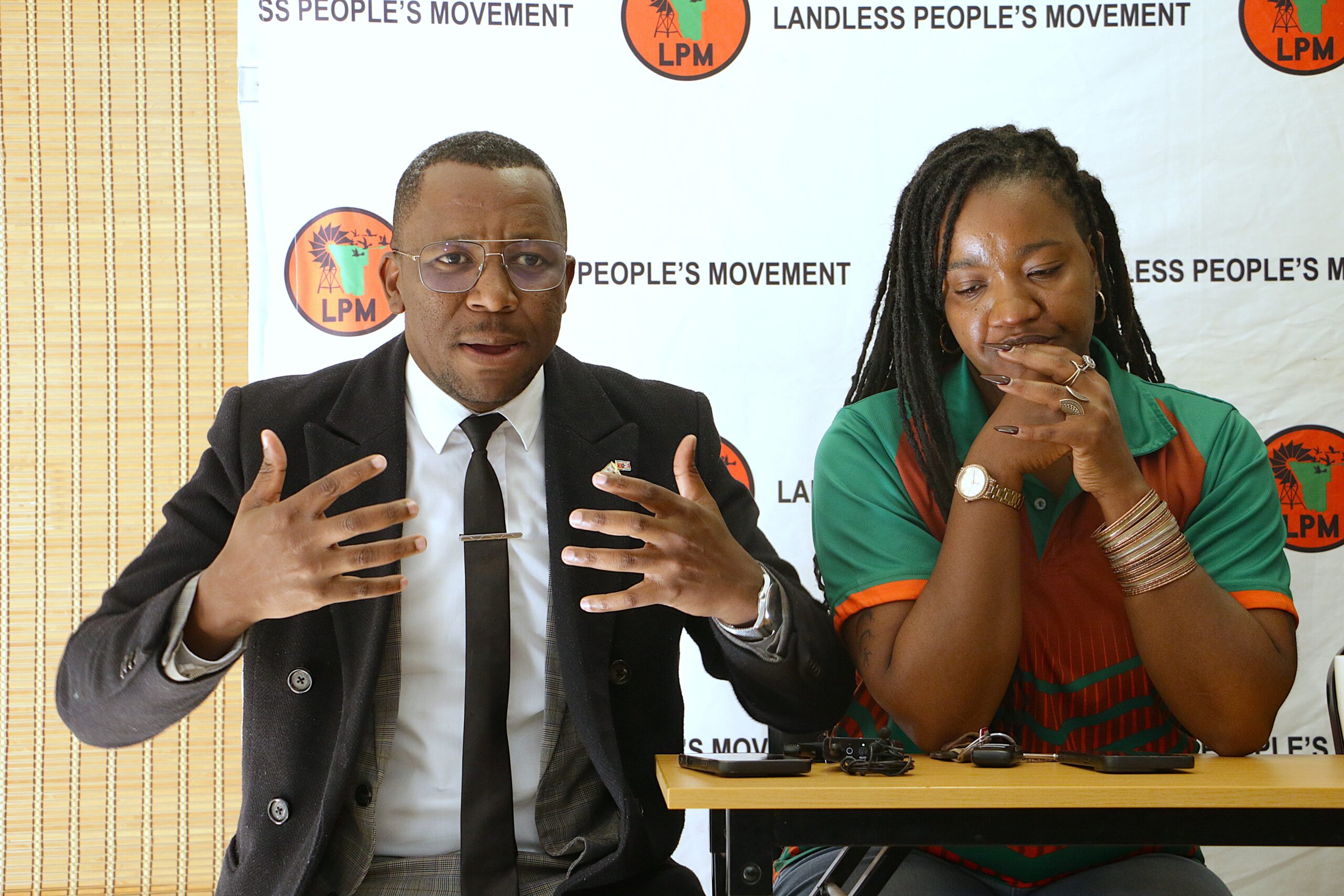

Lahja Nashuuta
The government has defended its decentralisation policy, stating that most functions have already been decentralised to all regional councils.
Diametrically opposed to this position is the Landless People’s Movement (LPM), which dismissed the government’s decentralisation efforts as nothing more than an electioneering tactic, accusing the ruling party of talking about decentralisation while tightening central control.
However, urban and rural development minister James Sankwasa defended the government’s track record. He said many functions have already been decentralised to the regions, but admitted that proper and urgent implementation is still needed.
He made the assurance during the commemoration of Africa Day of Decentralisation, Local Governance and Local Development in Gobabis over the weekend.
In his speech delivered by his deputy EvelynǃNawases-Taeyele, Sankwasa said, “Over the years, we have progressively worked towards empowering our regional councils and local authorities through legislative reforms, capacity building and fiscal resources so they can deliver essential public services to their communities”.
The minister stressed that decentralisation is rooted in Namibia’s Constitution, specifically Chapter 12.
It is supported by the Regional Councils and Local Authorities Acts.
He said these laws give regional and local governments the powers they need to plan and develop their areas.
“Government recognises the importance of participatory democracy and people-centred development. Since independence, we have prioritised creating an enabling environment that favours inclusive development and public participation in governance,” he stated.
While highlighting progress in legislation, training and financial support for local authorities, Sankwasa admitted that serious challenges remain.
He said accountability is still a major concern, with some councils struggling to manage resources effectively.
“I appeal to all officials at regional and local levels to guard against wasteful spending, abuse of State resources and any form of corruption. We must put public interest above personal interest,” he stated.
To address this challenge, Sankwasa urged the electorates to elect leaders with the right skills who understand budgeting, financial management and local economic development.
“Local institutions must manage resources effectively and transparently. This starts with electing credible leaders who understand budgeting, financial management and local economic development,” he said.
The minister urged councils to respond quickly to community needs, deliver quality services without discrimination and ensure historically marginalised voices are included in decision-making.
“No region, town or community should be left behind. Development must be shared fairly across the country,” he said.
LPM
Meanwhile, the LPM criticised the government’s talk about decentralisation, stating that unless power and resources are genuinely transferred to local authorities, the policy is meaningless.
LPM City of Windhoek councillor Ivan Skrywer, who spoke to New Era shortly after the commemoration, accused the government of lacking genuine intention to decentralise power.
He accused them of using the topic as an election campaign tool.
Skrywer highlighted contradictions within government statements, particularly pointing to the minister’s remarks during the event.
“Sankwansa questioned Namibia’s progress on decentralisation by asking, ‘where are we as Namibians in the equation of decentralisation?’ but also conceded that “the more we talk about decentralisation, the more we centralise.
“This admission exposes the hollow nature of the government’s claims. They have the power and instruments to decentralise but choose instead to retain control centrally,” Skrywer said.
He criticised the minister as being more interested in self-promotion than genuine reform, calling his public questioning of decentralisation progress “a calculated act for publicity”.
He further accused the government of backtracking on decentralisation through recent proposed amendments to the Regional Councils Act, which LPM argues aim to restrict the autonomy of elected regional and local representatives, effectively reversing gains made towards devolved power.
More so, Skrywer argued that corruption and mismanagement are largely driven by central government officials rather than local councillors.
“Blaming councillors for corruption is misleading. Real corruption occurs in the higher echelons, where actual power resides,” he noted.
LPM also criticised recent proposed amendments to the Regional Councils Act to have the chairperson of the councils endorsed by the governor as a sign of weakening local councils and handing more power back to the central government.
“How can an appointed governor be superior to the elected councillor? In fact, we as LPM demand that the chairperson, who is an elected leader, must serve as the governor,” Skrywer said.
He argued that corruption is often exaggerated at the local level.
“Most corruption happens at the national level in ministries, State-owned companies and large projects, where the real budgets are controlled,” he said.
Photo: Heather Erdmann