

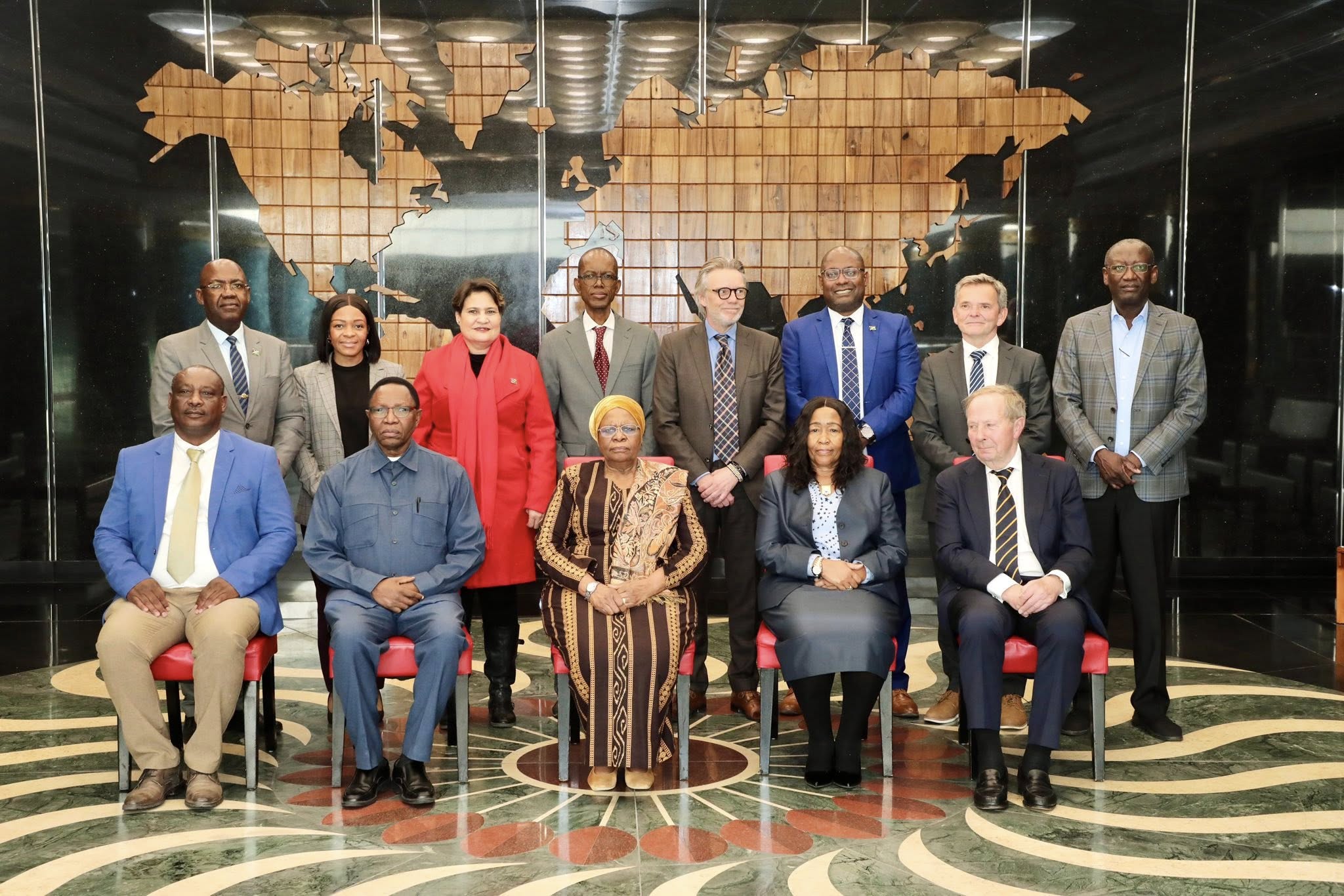

President Netumbo Nandi-Ndaitwah has called for strong job creation, local ownership and sustainable implementation as government considers a major proposal to establish Africa’s first large-scale salmon farming industry in Namibia.
This follows a meeting with a delegation from Namibia Atlantic Salmon Holdings (NASH), which presented plans to develop a fully integrated salmon industry along the country’s coastline yesterday at State House.
The proposed project will include hatchery production, offshore farming and onshore value addition, positioning Namibia as a new player in the global aquaculture sector while contributing to economic diversification.
During the meeting, the President stressed that the project must deliver tangible benefits to Namibians, particularly in employment creation.
“So, the jobs are now…?” she asked, as she tried to get clarity on how employment would be created across the value chain.
The delegation explained that while fish farming itself is not labour-intensive, significant employment opportunities would arise in processing, logistics, feed production, equipment supply and other support industries linked to the sector. The project is expected to produce up to 51 000 tonnes of salmon under its initial licence, with long-term potential for expansion as demand for the product continues to grow globally.
Industry experts in the delegation indicated that global salmon production has expanded significantly over the past decades, with demand continuing to outpace supply, creating an opportunity for new production regions such as Namibia.
They noted that Namibia’s coastal waters offer suitable temperatures and conditions for salmon farming, making it one of the few viable locations globally for such an industry.
However, the President cautioned that expansion must be carefully managed.
“Please do everything right,” she said, in response to projections that Namibia could host multiple salmon producers in the future.
She also raised questions about the technical aspects of the project, including production timelines and reliance on imported inputs.
“From the time everything arrives in the hatchery to the time the fish is on the table, how long does it take again?” she asked.
The delegation said the production cycle takes about two years, from imported eggs to harvest-ready fish, with eggs expected to be sourced from specialised suppliers in countries such as Norway and Iceland.
The meeting also highlighted the central role of the Namibia Industrial Development Agency in ensuring Namibian participation in the project.
NIDA Acting Chief Executive Officer Philip Namundjebo said the agency is structuring the investment to maximise local ownership.
“We are looking at 60% for NIDA, and then NIDA can hold that in order to allow other parties to take part,” he said.
Namundjebo added that engagements with banks, asset managers and individual investors have shown strong interest in participating in the project.
“The idea is that this is not only the project, but it’s the industry. Within that industry, you want a lot of locals to be able to take part,” he said.
He further revealed that NIDA is working to establish an industrial fund to support large-scale projects, noting that financing remains a major gap in Namibia’s industrialisation efforts.
“We talk about industries, but there is no funding geared towards the industry,” he said.
According to the delegation, the project is expected to stimulate significant economic activity beyond direct employment, including opportunities in fish processing, transport, manufacturing of equipment and potentially local production of fish feed.
Plans are also in place to prioritise local skills development, with proposals to train Namibians through partnerships with international institutions and industry players.
The salmon will initially be marketed within Namibia and the Southern African region, before expanding to other markets, including the Middle East and Asia.
Government is expected to further assess the proposal, with key considerations including environmental sustainability, regulatory frameworks, and long-term economic benefits.