

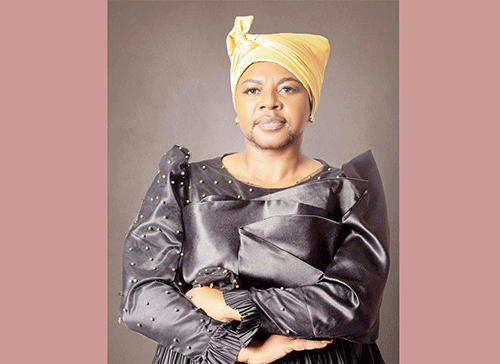

Zebaldt Ngaruka
GOBABIS – As Namibia celebrated its 36th independence anniversary, netball legends viewed that more still needed to be done in terms of netball development in the country.
Despite its status, which indicates a strong focus on professionalising sport, the spotlight of Netball Namibia (NN) is strengthening regional structures and aiming for higher international standards.
Namibia’s national team, called the Debmarine Desert Jewels, improved its standing following a tremendous performance at the 2024 Africa Netball Cup and reached the top 15 in the world netball ranking.
New Era Sports spoke to some netball legends who shed light on the development of netball in the country 36 years after independence.
Rebekka /Gôagoses, former NN president and current president of Netball Africa (NA), said netball in Namibia has come a long way, but there is still room to grow.
“Over the 36 years, we have seen progress in participation and competitiveness, but challenges like infrastructure, funding and grassroots development persist,” said /Gôagoses.
The netball guru said the national team showed some notable successes, but sustainability is a key.
She recommended a huge investment in grassroots programmes, improved coaching and umpiring standards, and secure, consistent funding.
“We also need better infrastructure like netball courts, equipment, and facilities that will boost participation and performance,” she said.
/Gôagoses further said sport development in Namibia needs a holistic approach and the government must invest in the infrastructure.
The athletes, she said, must be supported holistically, and more emphasis must be given to sport science.
“Collaboration between government, the private sector, and communities is crucial to nurture talent and make sport a career path,” she added.
Another netball stalwart, Jatjinda Kambatuku, who played for the national team and abroad, said she has seen the game grow through passion rather than structure.
Kambatuku, who witnessed the game for 36 years, said that netball has always lived in the hearts of the people, especially young girls. “From my experience, we have had incredible talent over the years. We had players who could have gone much further if they had consistent support, proper coaching, and exposure,” she said.
The legend who also played Black Africa and her native Aminuis All-Stars added that most of her generation’s players relied on self-discipline and love for the sport rather than a clear development pathway.
“There were moments where you could see progress, but it often didn’t last because there were no pathways,” said Kambatuku, who is one of the country’s renowned goal shooters. On her recommendations, the legend suggested grassroots development as the key to success for NN.
“We need to invest more in schools and local communities because that’s where most of us started. If young players are given proper coaching and regular competition early on, it builds confidence and skill,” she said.
Kambatuku said he observed that many players struggle not only because they lack talent, but also because they are not guided properly.
She also called for clear pathways from the school level to the national level, and too many players fall through the cracks because they don’t know what the next step is.
“There must be a stronger support system, whether it’s sponsorship, facilities or even just recognition. When players feel valued, they give more to the sport,” she said.
Meanwhile, Mechitilde Mupiri, former national team goals shooter or attacker, views that the country’s netball is in the right direction as players are being paid (as little as it is) compared to their era.
“We were not getting any cent; we played because we loved the game. Now games are being broadcast, which makes expansion and exposure for the players better,” she said, adding that players can be signed by professional teams and make a living from netball.
However, Mupiri said more can still be done for development, especially infrastructure and attraction of more sponsorships.
“Good infrastructure will mean we can host other countries and give the girl child more experience,” she said.
Mupiri, who also played for Black Africa and Cuca Tops, added that some sporty kids come from bad or poor backgrounds, and if sport is professionalised, it can assist with their school, decrease crime and develop the country. –zngaruka@gmail.com