

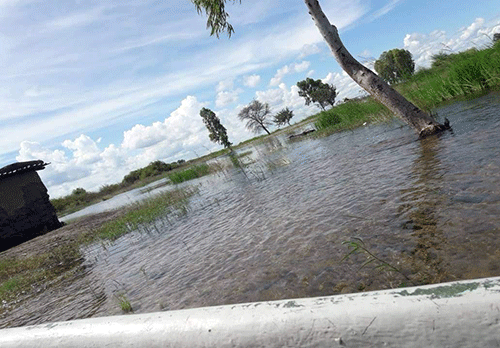

KATIMA MULILO – Heavy rainfall over the past few months has once again exposed the vulnerability of farmers in Zambezi’s Kabbe South constituency. It is a flood-prone area, where crop farmers, schoolchildren and motorists continue to grapple with seasonal water channels.
In an interview with New Era, Kabbe South constituency councillor Raymond Sezuni said, while the floods are not yet at their peak, some communities are already feeling the impact.
“Kabbe South is a flood-prone area. August and September are the ploughing season, and December and January are usually the harvesting months. Because of the weather changes, some farmers planted too early, and now the rains have been too much,” Sezuni said.
He said excessive rainfall has left several ploughed fields waterlogged, forcing some farmers to harvest green maize prematurely to avoid total losses. “Some of the ploughed fields are full of water. Some farmers had to harvest their maize while still green,” he said.
He added that “Year in and year out, that is the normal process that happens”.
Despite the crop challenges, Sezuni noted that livestock in the area are currently coping well.
“The floodplains have better grazing areas. For now, there is no major change because the water is mainly in the channels and not covering the grazing land,” he said.
Muzii cut off
Although floodwaters are beginning to recede in some areas, Muzii village has become inaccessible by vehicle.
“Most of the channels were full of rainwater and are now drying up. But in places like Muzii, it is no longer accessible because the flood has started flowing,” Sezuni said.
Motorists are unable to reach Muzii, leaving residents dependent on canoes and personal boats for transportation.
On access to essential services, Sezuni said schools remain open, though learners in some areas must cross water channels using canoes.
“In Muzii, children use canoes to cross the channels to get to school. Other schools are not that much affected,” he explained.
The constituency has only one operational clinic in the floodplains at Itomba, while the Muzii clinic is still under construction.
“The only accessible clinic is Itomba. People use canoes and personal boats for ferrying patients and ordinary people from one point to another,” he said. However, social grant pay points have not yet been affected. “For now, the flood hasn’t covered most of the places, so the paying points are still operating,” Sezuni added.
Infrastructure remains a major concern in Kabbe South.
The councillor acknowledged that many internal roads are not formally constructed. “We have not programmed the roads within the floodplain itself. Those roads were not opened yet. They are not constructed,” he said, noting that communities rely on self-made routes.
Wildlife
On whether flooding has increased wildlife movement into communities, Sezuni downplayed concerns.
“Most of the animals migrate to upper lands and into Botswana.
“Only a few remain,” he said.
“It is not really a challenge unless they are provoked. They have accustomed themselves to living with people,” he added.
Development
Looking ahead, Sezuni outlined key development priorities for his tenure. “I want to see the road stretching from Kasika joining up to Nakabolelwa,” he said. He also prioritised constructing proclaimed roads connecting schools and ensuring access to clean drinking water. “I want to make sure that no one in Kabbe South should still drink water straight from the river or from wells,” he stressed.
Electrification is another target. Sezuni said schools in Muzii and Mpukano still lack electricity. “Those are the only remaining schools without electricity. We need to connect them,” he said, adding that electricity was recently commissioned in Itomba and Nsundwa.
Impalila
Sezuni also recently visited Impalila Island to address community concerns related to optic fibre infrastructure passing through local fields.
“The optic fibre is meant to link two military bases and passes through people’s fields. We needed to engage the community and explain the importance of connectivity,” he said.
He added that, while roads and the clinic on Impalila are functioning well, some areas still require improved ablution facilities and additional water points. As the rainy season continues, residents of Kabbe South remain cautiously watchful, navigating familiar seasonal floods while hoping for long-term infrastructure solutions to reduce their vulnerability.