


Lahja Nashuuta
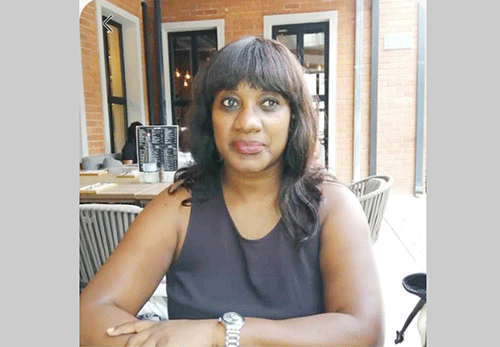
Hileni Kulaumone Kapepo is an experienced Namibian educator, committed to teaching children throughout her career.
She has been part of the education sector since 1999, beginning her journey as a passionate young teacher in the public service.
After graduating with Diploma in Education from the then-Windhoek College of Education, now the University of Namibia Khomasdal Campus, she began a career that lasted more than 20 years.
Reflecting on her early years as a student, Kapepo recalls the financial challenges she faced.
“As a young student, who did not come from an affluent background, I worked odd jobs during school holidays to supplement my parents’ meagre income. This also ensured that I had pocket money when I returned to the hostel, allowing me to buy cosmetics and snacks without placing additional strain on my parents, who had many mouths to feed,” she narrated.
Asked why she chose to join the public service and whether it had always been her dream, Kapepo said teaching was her lifelong calling.
“It has always been my dream to become a teacher. I looked forward to joining the fraternity and educating our children in an independent Namibia,” she said.
Kapepo further revealed that her studies were funded by the government, a gesture she viewed as both an opportunity and a responsibility. She said this motivated her to give back by serving in State-owned schools.
Roles and responsibilities
As a senior education officer (SEO) in the Khomas region, Kapepo oversees English and Afrikaans language instruction in schools.
Her main responsibilities involve guiding and supporting teachers to improve their teaching methods and classroom management.
“My responsibilities involve assisting teachers to implement the syllabus effectively, spearheading workshops where teaching strategies for learners at different levels are shared, providing induction for novice teachers and heads of departments, and facilitating the participation of teachers in the National Institute for Educational Development curriculum panels,” she stated.
She also oversees continuous professional development by conducting needs analyses, disseminating relevant teaching materials, visiting schools and modelling lessons where necessary. In addition, Kapepo coordinates regional spelling bee and manages the regional debating team.
Challenges and rewards
Like many public servants, Kapepo faces challenges in her work, particularly the sheer number of schools under her supervision.
“I am currently responsible for 91 schools. While I engage with many stakeholders regularly to ensure effective teaching and learning, the large number of schools can at times make it challenging to reach everyone,” she said.
Despite this, she finds great fulfilment in seeing the impact of teachers’ dedication on learners’ performance.
“What gives me immense joy is witnessing learners’ marks improve due to the extra effort teachers put in. Teachers are often undervalued and do not always receive the credit they deserve. It takes a dedicated teacher to manage classes of up to 50 learners and still produce excellent results,” she said.
She noted that the Khomas region’s rise from eighth position to fourth is a testament to the hard work and commitment of teachers.
“This achievement is the result of an impeccable labour of love performed by our teachers,” Kapepo added.
Contribution
When asked how her expertise benefits public service and her ministry specifically, Kapepo emphasised improved service delivery and better learner outcomes.“Quality service delivery improves, teachers feel supported, more learners become literate and better pass rates are recorded. Learners’ emotional and psychological well-being also improves, as they become more knowledgeable, while social challenges, such as bullying, are reduced,” she said.
She acknowledged that preparing novice teachers for real classroom scenarios can be challenging at first, but she described the process as deeply rewarding once they gain confidence and competence.
Kapepo praised teamwork within government, particularly in the education sector.
“One never feels alone. We work hand-in-hand as educators to ensure schools operate effectively and that no one is left behind,” she said.
Public perceptions
Addressing public misconceptions about the effectiveness of public servants, Kapepo expressed concern about negative stereotypes.
“It is unfortunate that such views exist, often from an uninformed perspective. In any institution, you will find both productive individuals and those who underperform. In this line of work, it is impossible not to deliver when so many people rely on you,” she said.
She urged the public to support initiatives that promote positive change rather than perpetuating negative narratives.
When asked how long she plans to remain in the public service, Kapepo said she has no fixed timeline.
“I currently have no time frame. I enjoy my work and the positive impact it has on our education system. For me, the sky is the limit,” she said.
– lnashuuta@nepc.com.na