

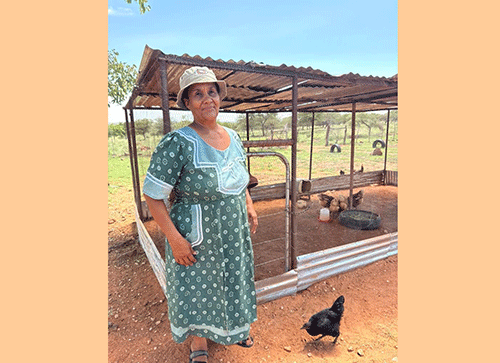

FRANSFONTEIN – Seven kilometres outside Fransfontein, in Tsaurob, lives Ingrid Heigan and her two children.
For the past seven years, it is where she has slowly built a better life for her family, starting with just seven goats.
She is a single mother, and the goats were her only source of income.
“At first, my kraal was small. But I believed if I worked hard, it would grow,” Heigan said.
A big change came in 2020.
Through the Environmental Investment Fund (EIF) and its Improving Rangeland and Ecosystem Management (IREMA) programme, she received 21 goats.
For her, this was more than just livestock. It was a life-changing moment.
“This help meant a lot to me as a woman farmer without a husband. I feed my two children from these goats. When I started, I didn’t have many, but these goats boosted my kraal,” she said.Heigan followed the agreement and paid back goats to the ministry of agriculture as required.
The agreement requires beneficiaries to hand over the same number of livestock after a production cycle.
This means that while they keep half the amount, the other half is given to the next beneficiary.
The revolving arrangement continues, benefitting more needy farmers in the process. At the same time, her own herd kept growing.
Today, she owns more than 90 goats. Haigen said the goat market is good.
Depending on size, one goat can sell for about N$1 500.
“We make money from it. I am very thankful for the help I received from EIF,” she said.
She does not work alone. She lives with her two children and a man who helps look after the goats at the homestead. Her children are also involved in the farming work and learned from a young age how to care for livestock.
Future
Now, Ingrid is looking ahead.
With her goats doing well, she wants to start poultry farming to support her family even more.
She has already attended a one-day poultry training through AgriBank and hopes to apply for funding or a subsidy.
Now, she has four chickens but has big plans.
“I want to grow step by step. Just like I did with my goats,” she said. Her son, Ronaldo Heigan, said watching his mother’s journey has been inspiring.
“Seeing her grow from seven goats to over 90 is great,” Ronaldo said. “We survive from this. We don’t go to bed on an empty stomach,” he said. Ronaldo said he attends livestock training in Fransfontein.
“I’m proud to say we now do our own vaccinations and take good care of our animals,” he said.
He added that growing up on the farm has been a memorable experience and something he truly enjoys.
Flipside
It is a tale of two farmers.
While one has made significant strides, the other has counted more losses than victories.
Within the same area, Seth Murorua (51) started in 2017 with three goats. He was assisted in 2024 during the drought period when he lost several goats.
He received 21 goats as part of the scheme. Murorua said the EIF came to rescue him during the time he needed to be assisted.
“I’m really grateful to the government and EIF for this gesture,” he said.
EIF spokesperson Romeo Muyunda said the Fund successfully concluded a transformative five-year climate change adaptation project that has significantly strengthened the resilience of smallholder farmers and rural communities in the drought-prone areas of Sesfontein, Fransfontein and Warmquelle in the Kunene region.
The project, titled ‘Improving Rangeland and Ecosystem Management Practices of Smallholder Farmers under Conditions of Climate Change in Sesfontein, Fransfontein and Warmquelle Areas of the Republic of Namibia’, IREMA was implemented in partnership with the Ministry of Agriculture, Fisheries, Water and Land Reform and approved by the Green Climate Fund (GCF) Board on 1 March 2018.
“With a total financing envelope of US$10 million, equivalent to approximately N$164 million, the initiative represents one of Namibia’s most significant investments in community-based climate change adaptation and rural resilience. Over its five-year implementation period, the project delivered lasting environmental, social and economic benefits, substantially enhancing the adaptive capacity of vulnerable communities exposed to climate variability and recurrent drought,” he said.
The project was designed to enhance resilience to climate change through investments in integrated drought early warning systems, strengthened institutional and community capacity in drought risk management and direct support to communities to implement innovative and sustainable adaptation measures.
“The project achieved far-reaching impact, benefitting an estimated 68 600 people, including 15 347 direct beneficiaries and 53 253 indirect beneficiaries, significantly exceeding the original target of 21 000 people. This extensive reach underscores the effectiveness of the interventions and reflects the strong collaboration between EIF, government partners and beneficiaries communities,” he said.
Across the target areas, more than 10 000 smallholder farmers directly benefitted from climate adaptation interventions, with particular emphasis placed on supporting marginalised and vulnerable groups.
Community gardens and green schemes were established and rehabilitated, contributing to improved household food security and income generation.
“As part of this effort, 16 hectares of the Fransfontein community horticulture gardens were rehabilitated and brought fully under production, directly supporting 90 households and indirectly benefitting a further 390 households through improved access to fresh produce and income opportunities,” he said.