
Namibia is considered one of the most unequal countries in the world, ranking second only to South Africa in terms of global income inequality. This high level of inequality is a persistent challenge for Namibia, as it impacts various aspects of society, given that poverty is multidimensional.
The multidimensional nature of poverty is caused by the undue affluence of a relatively few with a significant wealth gap. This reality remains a persistent challenge, requiring a sustained commitment and innovative solutions.
As Africans, we are boasting with the Ubuntu philosophy, which is a philosophy that emphasises the interconnectedness of humanity, encapsulated in the saying “I am because we are,” highlighting the importance of community and shared responsibility. As Christians, we are following the directives of Jesus as expressed in Matthew 25 to be workers who are in solidarity with the unemployed, hungry, homeless, sick, and marginalised.
In short, it highlights the unbreakable link between sustainability, social, political, and economic justice, and participation in a democratic process. In other words, the spirit of Ubuntu means not the practice of storing up your riches only for yourself and your family, but instead sharing them with all other families.
Take, as an example, the story from Luke 12, verses 18-19. “Then the rich man said, ‘This is what I’ll do. I will tear down my barns and build bigger ones, and there I will store my surplus grain.’ And I’ll say to myself, ‘You have plenty of grain laid up for many years. Take life easy; eat, drink, and be merry’.”
The wealthy farmer thinks that he does not need to fear a shortage of harvests for many years. Instead of sharing his blessings with his neighbours, he decides to store the crops as a security for an early retirement and a life of ease. So, he tore down his old barns and built new and bigger ones. The treasure in the barns would be his lifelong security.
He is completely self-centred and separated from others by his love for earthly possessions. He falsely assumes that human life can be measured and secured by wealth and regards his life and property as his own. However, as human beings, we are living on this earth to be interdependent; to live in interdependence and fellowship with one another.
By his actions, this man denies the principle of sharing, which is well illustrated in the following story:
“There once was a wealthy man who was a staunch churchgoer and a deeply committed Christian. He supported most of the local church’s activities. And then, for no apparent reason, he stopped attending church and became just a hanger-on. His pastor visited him one wintry evening.
He found him sitting before a splendid fire with red glowing coals, radiating lovely warmth around the room. The pastor sat quietly with his former parishioner, gazing into the fire. Then the pastor stooped with the tongs, removed one of the red, glowing coals from the fire, and placed it on the pavement. The inevitable happened. That glowing coal gradually lost its heat and turned in a while into a grey lump of cold ashes.
The pastor did not say a word. He got up and walked away. On the following Sunday, the wealthy man turned up in church.
A solitary person is a contradiction in terms. As human beings, we are meant to live in harmony and share with our fellow human beings and with the rest of creation. Artificial barriers are contradictory to the Namibian Constitution, Article 10, which states: No person may be discriminated against on the grounds of sex, race, colour, ethnic origin, religion, creed, or social or economic status.
It means we are here on earth to promote and implement the fundamental aspects of being human, as well as human development. Our souls can only relax, eat, drink, and be merry here on earth in the context of sharing.
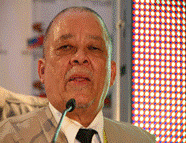
*Professor Paul John Isaak is a former Chief Electoral Officer at the Electoral Commission of Namibia, former Professor at the University of Namibia, and former Rector of Paulinum Seminary.