


Loide Jason
Marythar Kambinda
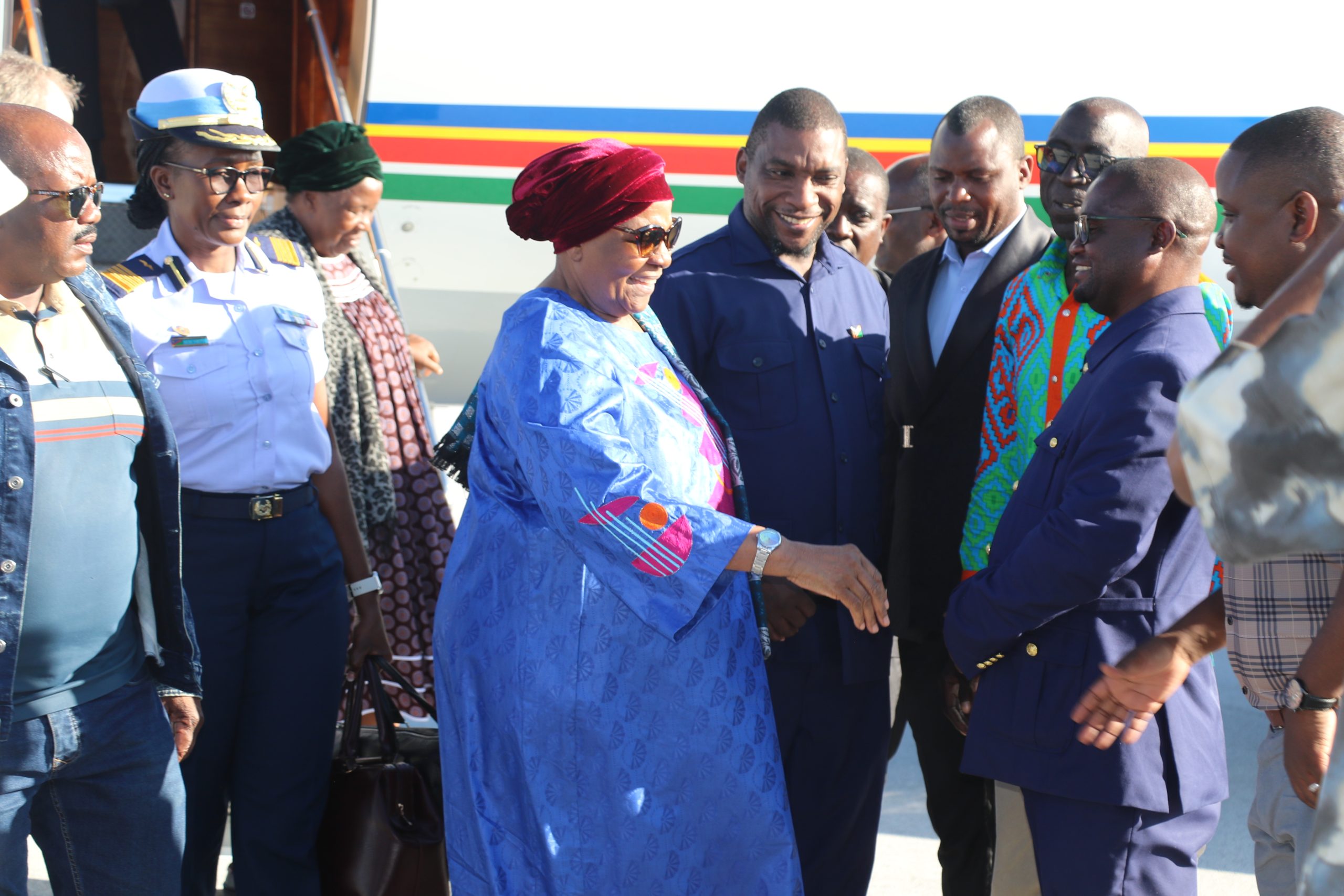
Katima Mulilo – President Netumbo Nandi-Ndaitwah has assessed the worsening flood situation in the Zambezi region, where water levels have surged to a concerning 6.88 metres—well above figures recorded in previous years.
During her visit, the President received a high-level briefing from the Zambezi Regional Council’s director of planning and rural development, Beaven Walubita, who outlined the scale of devastation and its impact on communities.
Walubita revealed that Kabbe North and Kabbe South constituencies are the hardest hit, with an estimated 75% and 65% of land inundated, respectively. Critical public infrastructure, including schools, health facilities and police stations, has been severely affected, with several buildings surrounded by floodwaters.
The President later toured Luhonono, a key docking point for flood-prone areas, to observe the situation on the ground.
The education sector has been among the worst affected. Muzii Combined School, Nankuntwe Combined School and Mpukano Primary School have been temporarily closed and are set to be relocated to higher ground.
“Preparations are underway to facilitate this transition, including the provision of tents, transport and food for both learners and educators,” Walubita said.
Authorities are also considering deploying the ferry Kapelwa Kabajani to assist with transporting learners, pending support from the Office of the Prime Minister.
Efforts to relocate affected residents are ongoing, although some communities remain reluctant to move. A relocation site has been established in Sibbinda constituency, where several displaced households have already been resettled. Relief items such as tents, mattresses, blankets and food are being distributed. However, concerns have emerged over the suitability of some food aid. While 864 bags of rice have been delivered, many beneficiaries have expressed a preference for maize meal, prompting calls for local procurement to better meet community needs.
Humanitarian support has been reinforced by the Namibia Red Cross Society, which has provided blankets and kitchen utensils to affected households across Kabbe North, Kabbe South and Sibbinda.
Flooding has also disrupted access to healthcare services. To mitigate health risks, authorities are distributing 25 000 water purification tablets and 2 000 mosquito nets, prioritising vulnerable groups such as pregnant women, young children and malaria-affected households. Mobile health outreach services have been introduced to reach isolated communities. Walubita highlighted urgent nehighlights urgent humanitarian prioritieseds, including additional shelter materials, food supplies and fuel for rescue and transportation operations. The President’s visit underscores government’s commitment to closely monitor the crisis and ensure a coordinated response to assist affected communities.
Meanwhile, education minister Sanet Steenkamp has warned that the floods are significantly disrupting schooling, with at least 587 learners in the Zambezi region already affected. “We know that more than 587 learners are affected at this moment in Zambezi region,” she said yesterday. She noted that the situation remains fluid, with rising water levels isolating communities and making schools inaccessible.
“For most of the schools, it is now a matter of relocation. If relocation cannot take place, it means that children do not have access to schools,” she said. The disruptions threaten the country’s mandatory 196 teaching days, raising concerns about syllabus completion.
“If learners cannot attend school, those are teaching days lost — and every lost day must be compensated for,” Steenkamp said.
While assessments are ongoing, some learners have already been cut off by flooded routes and rivers. Safety, she stressed, remains the top priority.
“We cannot allow children and teachers to cross flood plains. They must remain safe,” she said. Government, through the Office of the Prime Minister, has begun interventions in the hardest-hit areas, including providing mattresses, food supplies and facilitating relocation.
The flooding has forced authorities to consider urgent measures, including relocating schools or temporarily suspending classes where access is unsafe.
“If it becomes unsafe, we will not allow children and teachers to cross flood plains. They must remain safe, even if it means schools are temporarily closed,” she said.