


Dalene Kooper
The Namibian government supported an international exchange programme initiative launched by the University of Namibia alongside its partner universities to improve quality education and graduate employability, research opportunities and international cooperation.
The partner universities on the project are Unam, Namibia University of Science and Technology, International University of Management, Welwitchia University, Nanso, and the education ministry.
The European partner universities are the University of Saarlandes in Germany and the University of Alicante in Spain.
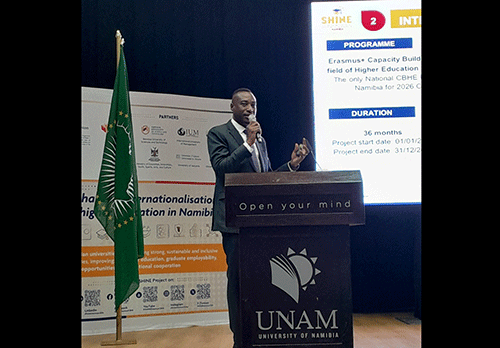
The initiative, called the Sustainable Strategies in Higher Education Internationalisation Towards Excellence in Namibia (SHINE) programme, was launched at Unam’s Hage Geingob campus last week.
Project coordinator Romanus Shivoro introduced the programme and stated its importance and benefits.
“This programme will boost Namibia’s global competitiveness, build skills and capacity for students, staff and institutions, making Namibian graduates employable through global exposure and competencies,” Shivoro said.
He remarks that this project will modernise and harmonise the higher-education systems in the country while promoting equity by reaching all campuses and empowering students. The project aims to support Namibian universities in developing sustainable and inclusive international exchange efforts.
In a speech read on her behalf, minister of education Sanet Steenkamp said that this project is a strategic alliance that will contribute to the academic and economic future of the country.
“As a minister I view the SHINE project as one of the means towards the execution of the national development plan. In a global economy driven by the fourth industrial revolution, knowledge is our most valuable currency. For Namibia to thrive, our higher education system must move from the periphery of global discourse to its very centre,” Steenkamp said.
In government’s efforts to improve exchange programmes. She shared that the SADC member states are encouraged to reserve 5% of admission for students from the SADC region, adding that this project will be anchored in the African Union’s Agenda 2063.
The minister noted the acronym ‘SHINE’ is a promise to the Namibian youth.
“It is a promise that we will brighten the futures of our youth, improve the quality of our degrees and ensure Namibia is recognised as a hub of academic excellence in southern Africa and beyond,” she said.
The project funded by the European Union under the Erasmus+ capacity-building field of higher education is expected to run for 36 months, beginning in January 2026 and ending in December 2028.