

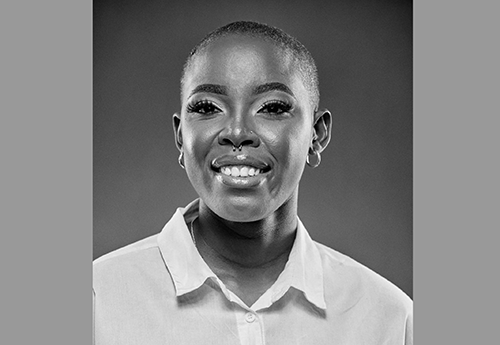

With some of the articles I have written over the years, I have often received backlash from men who didn’t quite understand my full stance on the matters at hand. They particularly felt that I always portray them in a negative light. I would like to reiterate that I do not write to attack men. I write to interrogate systems and experiences that continue to shape women’s lives in ways we do not always speak about openly.
I am often in a position where women share their stories with me. Some are experiences I have witnessed firsthand. When I wrote about giving our mothers grace and remembering that before she was ‘meme’, she was just a girl trying to survive, it stirred conversation. In one particular discussion that stayed with me, someone pointed out that in many cases, our mothers truly had no choice. They were operating within strict traditional structures where obedience was not a suggestion, but an expectation tied to survival. That conversation moved into something we do not talk about enough: food.
Since the beginning of time, food has been used as a weapon of war. It does sound dramatic to say food can be weaponised, but historically, food has always been used as a tool of control. Nations have starved enemies into submission. Empires have cut off supply routes to force surrender. Hunger has long been a strategy of power, and in many households, that same logic quietly exists where it is used to bring order and maintain power. Think of it this way, as the head of the house, the man determines order and provision is seen as authority. If expectations are not met and there is perceived ‘disobedience’, the consequences may not always be physical, but they can be structural. A woman may cook but eat last and/ or eat less. In extreme cases, children feel that the tension of withheld provision and support becomes conditional. Food, which traditionally symbolises life and care, becomes a reminder of hierarchy.
This is not about painting all men as villains. It is about recognising how power can show up in ordinary routines. In some homes, money is controlled tightly, where a man may spend evenings at the neighbour’s drinking palm wine, which later evolved into cuca shop culture, and now perhaps into gambling or simply disengagement from responsibility. Meanwhile, the expectation remains that the woman must stretch what little there is, manage the home, and remain compliant. In the context of millennials, some men withhold financial support from their children as a way of punishing the mother for disrespect or disobedience. That logic reveals how deeply entangled control and provision have become because children have now become collateral damage in adult power struggles.
The face of patriarchy in Namibia does not always look like loud and physical abuse. Sometimes it looks like silence, and sometimes, like a mother swallowing her words at the dinner table so that everyone else can eat in peace. And this is why I ask for grace for our mothers. It is not to excuse harm, especially in cases of abuse, but to contextualise their choices. Many of them were navigating limited economic power, rigid gender roles and community scrutiny. You cannot ignore the environment that shaped them and then judge them in isolation.
At the same time, we must be honest: patriarchy harms men too. It teaches boys that masculinity is dominance. That providing financially is enough. And then we are surprised when homes feel heavy. My writing is not anti-men. It exists to say that we are allowed to question what we inherited and that tradition can evolve.
If that sounds uncomfortable, perhaps it is because we have normalised too much.
*Frieda Mukufa’s lifestyle section in the New Era concentrates on women-related issues and parenting. She specialises in editing research proposals, proofreading, and content creation. – etuholefrieda@ gmail.com