

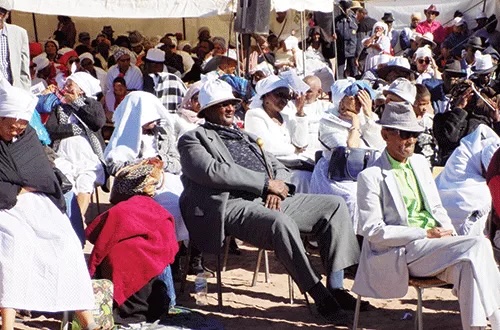

KEETMANSHOOP – Nama Traditional Leaders Association (NTLA) secretary general Deodat Dirkse said it is disheartening that Nama prisoners who survived Shark Island were reportedly kept in concentration camps at Okawayo, near Karibib, and Okanjande, near Otjiwarongo, for seven more years after the Germans closed the previous camps in 1908 and released Herero prisoners.
Dirkse made these remarks with reference to evidence contained in records of the Museum Association of Namibia (MAN).
“Evidently, Nama prisoners were only released after Germany lost colonial control over the then-Suidwes Afrika, now Namibia, in 1915,” he said.
Arguing that the extermination orders issued against the Nama people on 12 April 1893 and 22 April 1905 were never rescinded, Dirkse said the orders remain historically significant.
In light of the prolonged incarceration of Nama prisoners, he added that it is impossible for the NTLA and Nama communities worldwide to accept 28 May as Genocide Remembrance Day.
Referring to the joint declaration between the governments of Namibia and Germany, Dirkse said that Nama leaders were not involved in the process.
“Earlier briefings regarding initial engagements prior to the declaration showed Germany was looking at a special relationship between the two countries, including the elimination of visas, access to universities and a special trust fund for the Nama and Ovaherero people, without the involvement of the Swapo-led government, focusing on restorative needs identified by the affected communities themselves,” he said.
Dirkse claimed that government later opted for a broader development aid programme, which he argued would not adequately address restorative justice and would inevitably exclude Nama and Ovaherero descendants living in the diaspora.
He assured that the Nama Traditional Leaders Association remains committed to advocating for the inclusion of Nama and Herero leaders in negotiations concerning an apology and reparations for the genocide committed against the two communities.
He added that the association supports all merit-based efforts aimed at restorative justice.
In his contribution, //Haboben (Veldskoendraer) Traditional Community Gaob Dawid Gertze said previous deliberations by the Ovaherero/Ovambanderu and Nama Council for the Dialogue on the 1904-1908 Genocide agreed that the German government should formally acknowledge the genocide committed against the two communities, issue an official apology, and ensure reparations include restoration and reconstruction for affected descendants, including those in the diaspora.
“The council also agreed that continuous needs assessments should be conducted to ensure additional funding transfers by Germany. It is, therefore, an ongoing process that should not necessarily stagnate at the ceiling amount previously offered,” he added.
Gertze, who is also the governor of the//Kharas region, further argued that other communities affected during the conflict, as well as their descendants, should also be included in the discussions.
Referring to documented evidence from the meeting, he said: “A separate and unique reconstruction and development support programme will be established by both governments to assist the development of descendants of previously affected communities in line with their identified needs”.
The traditional leader added that projects under the programme would focus on sectors such as land reform, land acquisition within the framework of the Namibian Constitution, land development, agriculture, rural livelihoods, infrastructure, energy and water supply, as well as technical and vocational education and training.
Gertze explained that these projects would be implemented in the regions of Erongo, Hardap, //Kharas, Khomas, Kunene, Omaheke and Otjozondjupa, where descendants of the affected communities reside.
On reconciliation between the citizens of Germany and Namibia, he said efforts should include preserving the memory of the genocide and colonial era for future generations through remembrance initiatives, research, education, cultural and linguistic programmes, as well as exchanges between younger generations.
“Both governments further decided to jointly establish a legal structure, such as a trust fund, to select and finance projects aimed at improving reconciliation,” he said.