

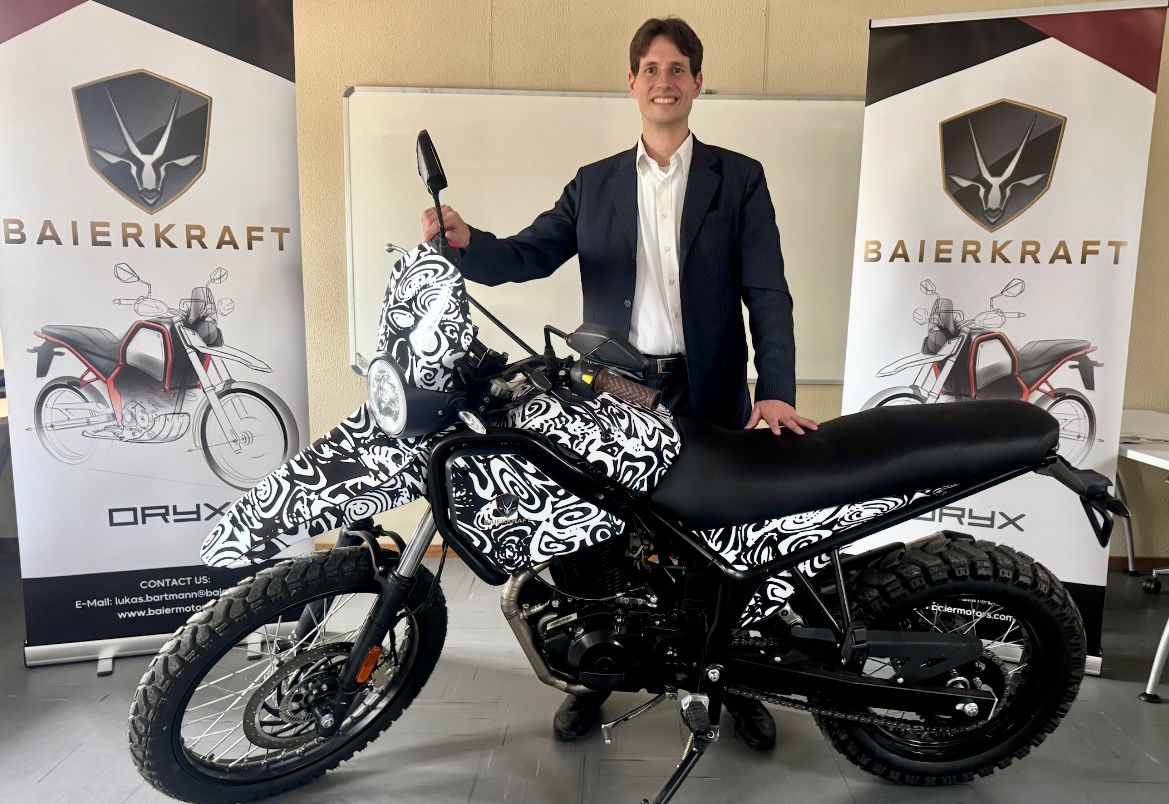

Namibia has been selected as the primary African assembly and distribution hub for a new generation motorcycle brand aimed at tackling the continent’s toughest terrain.
Motorcycle manufacturer Baierkraft announced this week that it will assemble its state-of-the-art motorcycles in Namibia, positioning the country at the centre of a venture expected to create up to 200 new employment opportunities and strengthen the local manufacturing sector.
The company, founded by engineer Torben Baier, specialises in motorcycles designed for harsh environments, including dusty landscapes, extreme heat, and long-distance travel under heavy loads, conditions common across much of Africa.
According to the company, the first pre-series motorcycle assembled in Namibia is expected to roll off the line by August this year. The project has been in development for four years since the brand was first conceptualised.
Baier explained that Namibia’s landscapes and climate played a significant role in the decision to establish the company’s African hub in the country. The challenging terrain, he explained, mirrors the conditions the motorcycles are built to withstand.
“In emerging markets, the demand for individual mobility is growing rapidly, but that market is often supplied by brands with products that do not fulfil customers’ real needs,” Baier said in a statement.
He argued that the African continent lacks motorcycles specifically engineered for local operating conditions.
“The goal of our engineering team has always been to build the perfect motorcycle for tough regions, a bike that keeps working under heavy loads, in heat and dust and over long periods of time,” Baier said.
Baierkraft plans to assemble the motorcycles locally, with what the company describes as a “high degree of craftsmanship,” while empowering Namibians to be part of the brand’s growth. The company also intends to export the motorcycles to markets in East and West Africa in the coming years.
Infrastructure and trade advantages were key factors in the decision to base operations in Namibia. Baier highlighted the country’s railway connections and access to the Atlantic through the Port of Walvis Bay as important logistical benefits for future exports across the continent.
“Namibia has excellent railroads that reach the Port of Walvis Bay, and the country also has operational trade agreements that support localisation and export,” Baier said. The company expects the venture to create significant employment opportunities, projecting that more than 200 Namibians could be employed by 2027 as operations expand.
Baierkraft is also collaborating with several academic institutions in Germany, including the University of Kiel, RWTH Aachen University and Flensburg University, which are providing technical support and research partnerships for the project.
The company’s first model, the Baierkraft ORYX 300, is expected to launch soon. The motorcycle is powered by a 300cc internal combustion engine and designed for durability and ease of maintenance.
Baier said one of the biggest challenges faced by businesses that rely on motorcycles, particularly delivery services and transport fleets, is downtime.
“Downtime costs money,” he said.
“That is why Baierkraft focuses on service from day one. Our motorcycles are designed to be easy to service and supported locally so they stay close to the people who rely on them.” The ORYX 300 platform is also designed with future technology in mind. While the first version will use a conventional internal combustion engine, Baier said the frame and platform can be adapted for different engines, including battery-electric vehicle technology.
The company’s branding draws heavily on African symbolism. The Baierkraft logo features an oryx, an antelope known for its resilience in desert environments, representing strength, endurance and adaptability. The brand’s steel and amber colour scheme is intended to reflect durability and long-lasting performance.
Baier said the motorcycles combine disciplined engineering with real-world African operating experience.
“From day one, our goal was to develop an affordable motorcycle that can truly serve the continent,” he said. “We are targeting a price that is accessible to Namibians, at a fraction of the cost of many imported alternatives.”
Baier brings nearly two decades of global engineering experience to the venture, having worked on large-scale automotive systems and previously serving as project manager on the Baierkraft A4 and A5 Facelift models.
With the first Namibian-assembled motorcycles expected later this year, Baierkraft hopes its investment will mark the beginning of a new chapter for locally assembled mobility solutions tailored to Africa’s demanding conditions.