


KATIMA MULILO – Officially inaugurated on 27 August 2025 by President Netumbo Nandi-Ndaitwah, the 320-bed Ndoro Memorial Combined School hostel accommodates 160 girls and 160 boys.
Hope is now rising following the opening of its new hostel facility, a development described by school principal Linus Sipopo as a “huge relief” for learners who once endured long and dangerous journeys to class.
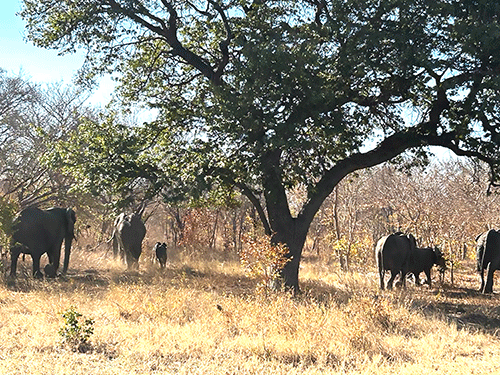
It was built to address years of hardship faced by learners from surrounding villages inside Bwabwata National Park, where wildlife and vast distances made daily school attendance both difficult and risky.
Sipopo said the hostel has already made a measurable difference.
“This has been a very good initiative. It is helping learners who used to commute long distances. They no longer must walk to and from school every day,” he said.
The school currently has 436 learners enrolled, with 288 staying in the hostel.
Before its construction, absenteeism was high, as many learners struggled with unsafe routes and harsh weather conditions.
“We experienced high absenteeism in the past because learners had to cross areas with wild animals. Our school is situated in the heart of the park, and that discouraged many of them from attending classes regularly,” Sipopo said.
He added that many families served by the school belong to marginalised communities, including the Khwe, who face socio-economic challenges.
“Most of our parents are unemployed and come from disadvantaged backgrounds. The conditions were really affecting academic performance,” he said.
The improved living conditions – including access to clean water, electricity and safe accommodation – are expected to boost academic outcomes after a difficult previous year.
“Last year, we did not perform very well academically because of the harsh conditions learners endured. Now, they are provided with everything in the hostel. We are hopeful that their academic performance will improve,” Sipopo said.
Enrolment has already increased due to the availability of boarding facilities.
The school, which serves learners from pre-primary to Grade 11, has also expanded its curriculum and now offers Afrikaans from Grade 1 to Grade 9, with plans to extend to higher grades next year.
Sipopo said the school is offering Advanced Subsidiary (AS) level as of the beginning of this year.
The education ministry has further pledged additional classrooms and science laboratories to strengthen learning infrastructure for AS level.
Despite the progress, Sipopo stressed that a major safety concern remains: the school has no perimeter fence.
While the hostel is fenced, the broader school grounds remain exposed to roaming wildlife.
“We are calling on good Samaritans to assist us with a school fence. Learners are still exposed to wild animals while studying,” he appealed.
Efforts to raise funds locally proved unsuccessful due to widespread poverty in the community.
“We tried to mobilise the community, but it is not working because most parents are unemployed. We urgently need support to secure the school,” Sipopo said.
The new hostel and 400-seat multipurpose hall mark a turning point for education in Omega 3.
Built with modern solar, water and waste treatment systems, the facility represents a long-term investment in the future of children living inside Bwabwata National Park.
For Sipopo and staff, the goal is clear: safer learning conditions, improved academic performance and expanded opportunities for marginalised learners.
“We are really pushing so that our learners can excel academically,” he said.