

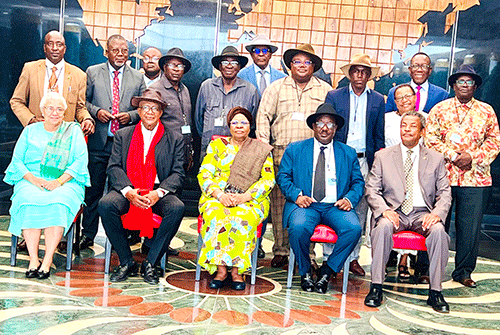

The Okandjoze Chiefs’ Assembly on Genocide (OCAG) on Monday firmly rejected the Joint Declaration (JD) between Namibia and Germany.
In no uncertain terms, they told President Netumbo Nandi-Ndaitwah that the agreement is “beyond reform” and must be abandoned in favour of a new, inclusive process.
The traditional leaders, led by Chief Rikurura Kukuri, delivered their position during their engagement with Nandi-Ndaitwah at State House yesterday.
They called for a national conference, stronger domestic memorialisation and alignment with the African Union’s Algiers Declaration on colonial reparations.
Kukuri said the assembly “unequivocally and categorically” rejects the JD.
He argued that it fails to meet international standards of reparations for the genocide of the Ovaherero, Ovambanderu and Nama people. “Our total rejection of, and opposition in principle, unequivocally and categorically to the JD remains solid, unwavering and uncompromising as we speak to you today,” Kukuri said in a statement delivered on behalf of the traditional leaders.
The chiefs’ visit comes amid renewed debate over how Namibia should pursue an apology and reparations from Germany for the 1904-1908 genocide committed during colonial rule.
Kukuri said the negotiations that led to the JD were conducted between the Namibian and German governments without meaningful participation of descendants of the genocide victims.
“We cannot but emphasise that the negotiations between the Namibian and German governments have never been about or with us as descendants of the survivors,” he said. According to OCAG, some descendants were reduced to “mere observers and spectators”, while others were excluded entirely.
The assembly described the JD as “ill-conceived” and “poorly constructed”. ‘ They said it was not based on a truthful and genuine acknowledgement of genocide.
“To us, the JD is today nothing but a relic of Namibian history. There is no way it can be fundamentally renegotiated, as it was extremely flawed from the beginning,” Kukuri said.
He added that what the agreement proposes “does not even meet the basic standards of reparations as per the 1948 UN Convention on the Prevention and Punishment of the Crime of Genocide”.
OCAG said Namibia has now reached a “crossroads” and must reconsider its approach.
Africa
The chiefs urged the government to align itself with the recently adopted Algiers Declaration of the African Union, which calls for justice and reparations for colonial crimes.
Kukuri noted that Namibia’s international relations and trade minister Selma Ashipa-Musavyi recently reaffirmed the country’s commitment to seeking accountability from Germany.
“In view of such developments, it is incomprehensible that our government is still entertaining the JD,” he said.
The assembly argued that Namibia should join what it described as a growing continental movement to declare colonialism a crime under international law, instead of negotiating in isolation with successive German governments.
“All of whom, without exception, have treated this sacrosanct issue as if dealing with a former colony rather than a sovereign equal,” Kukuri said.
However, he stressed that, in Namibia’s case, colonisation reached “the abominable extreme of genocide” – and that this must not be overshadowed by broader discussions about slavery and colonialism elsewhere in Africa.
The chiefs called for stronger domestic action, including meaningful involvement of descendants in the annual Genocide Remembrance Day on 28 May.
The assembly emphasised that descendants must play a leading role in shaping the restorative justice package.
“As descendants, we wish not only to support our cause but to give it our very best. We expect our government to stand behind us as descendants, but not to assume the role of ultimate architect, definer and arbiter of the restorative justice package,” he said.
OCAG proposed a national conference, bringing together all stakeholders to “recalibrate” the country’s approach to genocide, apology and reparations.
He reaffirmed the assembly’s “total rejection” of the Joint Declaration and its support for the Algiers Declaration as a new platform to advance the genocide cause.
Opening the meeting, Nandi-Ndaitwah welcomed the chiefs and introduced her delegation.
The President also acknowledged that OCAG had earlier requested a meeting.
“I know sometime last year you wrote a letter to me in which you requested a meeting specifically to congratulate me and to discuss other matters. Because of the hectic time of last year, I asked the vice president to receive you and to convey my congratulations. That was not unique. It does happen in matters that you really want to be dealt with urgently,” Nandi-Ndaitwah said.
“However, today we are here, and once again, I welcome you, and you have the floor,” she added.
– ljason@nepc.com.na