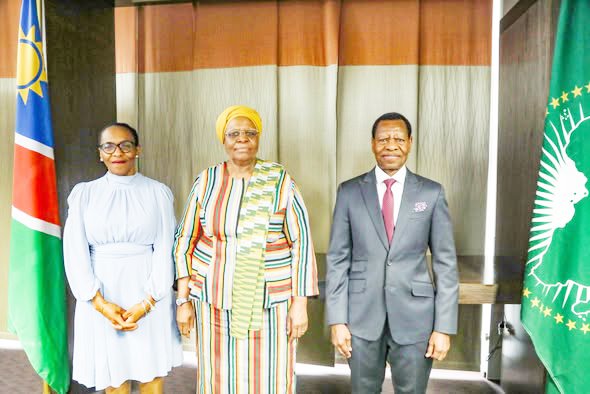

President Netumbo Nandi- Ndaitwah has raised concerns that Namibia risks losing men in the legal profession as female lawyers increasingly dominate courtrooms, academic spaces, and admissions into legal practice.
The Head of State made the remarks on Friday during her meeting with South Africa’s Lady Justice Mandisa Maya in Windhoek.
Nandi-Ndaitwah acknowledged that while Namibia celebrates women’s empowerment in the legal fraternity, there has been a decline in male representation, a concerning trend. “Our male lawyers are lagging, and they need more motivation,” she warned. She illustrated the trend with startling examples, citing that during the latest admission of legal practitioners, of the 20 candidates, only four were men.
“The number of men lawyers in Namibia is going down. I don’t know what is happening. Legal firms are receiving more female applicants, while many male graduates choose advisory work instead of qualifying to appear in court. It’s becoming a serious challenge,” she said.
Maya’s visit
Nandi-Ndaitwah said Maya’s visit could not have come at a better time, as Namibia continues to foster closer cooperation across the country’s State branches, the Executive, Legislature and Judiciary. Such collaboration, she said, is essential for strengthening the rule of law and ensuring institutions grow together, not apart. She recalled seeing the Chief Justices of Namibia and South Africa exchange documents to formalise cooperation, a moment she described as encouraging and symbolic of a Judiciary willing to build ties beyond borders.
“It is very good if all three branches of the State can find a mechanism to collaborate. I was happy when I saw you both yesterday, on the screen, exchanging those documents and congratulations,” she said.
The President applauded the partnership, saying collaboration between courts complements bilateral work done at the Executive and parliamentary levels. “
It is commendable when our Judiciary finds a way to collaborate on ensuring laws are interpreted properly. This cooperation must be strengthened,” she said. Nandi- Ndaitwah praised Maya, whom she described as a pioneer who broke barriers and opened doors for women across the continent. “You have been breaking a lot of glass ceilings, first woman here, first woman there. Some of us are making ours first because you made yours first. You opened the door for many of us,” she remarked.
Maya highlighted that formalising cooperation between Namibia and South Africa’s judicial systems had long been overdue.
The two nations, she said, already share history, friendship, and professional ties; it made sense to formalise that relationship once and for all. Maya said she believed speaking to female lawyers and students was valuable, and the session was lively with questions from young legal minds.
But she admitted she could not ignore the President’s concern about the boy child.
She supported the President’s concerns, recalling a similar trend in Jamaica where girls outperformed boys, resulting in almost no males passing matric.
She warned that if the trend deepens, societies might struggle to reverse it, and men might become scarce in professional fields.
“Out of those children who matriculated in Jamaica, only one was a boy. Good men became hard to find; many were in jail,” she said.
She emphasised that both gender empowerment and equal opportunity should move together, not replace one another.
-ljason@nepc.com.na