


Edgar Brandt
Auleria Wakudumo
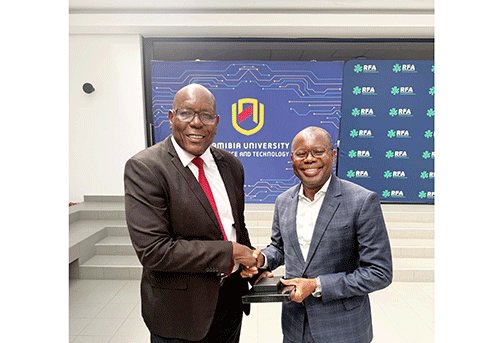
Long regarded as the gold standard for Africa’s road infrastructure, Namibia is doubling down on innovation to protect that status, as the Namibia University of Science and Technology (NUST) and the Road Fund Administration (RFA) sealed a landmark N$10 million research partnership aimed at future-proofing the country’s road network. Instead, the country is betting on research, innovation, and forward-thinking policy to ensure its roads remain not only among the best on the continent but also resilient enough to meet the demands of a rapidly changing world.
The NUST and RFA agreement, signed on 20 April 2026, will see the latter inject more than N$2 million annually over the next five years into targeted research, innovation, and capacity development. This intervention is widely seen as critical at a time when Namibia’s infrastructure crown is under increasing pressure.
For decades, Namibia has consistently ranked as having the best roads in Africa, which is a key competitive advantage underpinning trade, tourism, and regional logistics. But officials now warn that maintaining this reputation will require a fundamental shift in how roads are funded, designed, and maintained.
“This partnership reflects a shared vision between NUST and RFA to bridge the gap between academic knowledge and industry application,” said NUST Acting Vice Chancellor Andrew Niikondo.
“The University’s Directorate of Research, Innovation and Partnerships will facilitate the co-creation of solutions, applied research with real-world impact, and technology-driven innovation.”
At the heart of the agreement is a recognition that Namibia’s historically strong road network faces mounting threats from rising costs, climate change, and a widening funding gap.
The RFA estimates that the road sector faces a shortfall of approximately N$3.7 billion for the 2025/2026 financial year alone. Compounding the challenge are recent fuel levy relief measures, introduced to ease the cost-of-living burden on consumers, which are expected to reduce inflows into the national road fund.
“These are necessary interventions to cushion citizens, but they place additional pressure on our ability to fund road programmes and deliver quality infrastructure,” said Ipinge. He added that the agreement with Nust is not merely symbolic but a strategic commitment to long-term, evidence-based solutions.
The RFA CEO added that recent government interventions, such as the temporary 50% fuel levy reduction, are expected to result in an estimated revenue loss of about N$300 million over the next three months.
The road research will explore alternative revenue streams like distance-based charges and electric vehicle levies as Namibia moves toward cleaner mobility. Public-private partnerships will be considered to fund infrastructure. Additionally, climate resilience is vital. Namibia’s road network is exposed to extreme weather, necessitating new materials, smarter design, and predictive maintenance.
The collaboration will also prioritise the evaluation of sustainable construction materials and cost-effective maintenance approaches, as well as strengthening laboratory capacity and technical research infrastructure.
“The partnership represents a strategic step towards strengthening the sustainability of Namibia’s road sector,” said RFA Chief Executive Officer Ali Ipinge.
“By integrating research, innovation, and practical application, we are laying the foundation for more efficient funding models, resilient infrastructure, and informed decision-making that will benefit the country in the long-term.”
Ipinge was blunt about the urgency of reform: “We cannot continue to fund tomorrow’s infrastructure with yesterday’s mindset.”
Namibia’s road network has long enabled economic growth, supporting trade across Southern Africa and key sectors like mining, agriculture, and tourism. Its quality sets a benchmark for infrastructure development in Africa.
The partnership marks a shift to “maintenance-by-design,” embedding durability, efficiency, and resilience into infrastructure from the start, instead of reacting after deterioration. It involves better data use, improved materials, and evidence-based planning.
By integrating academic research with industry data and operational realities, the programme expects to create opportunities for students and young professionals to engage in applied research and real-world infrastructure challenges.
This aligns with Namibia’s broader ambitions under Vision 2030 to transition into a knowledge-based economy driven by innovation and human capital development.
NUST’s mandate to translate research into viable enterprises is expected to play a pivotal role, potentially unlocking new home-grown solutions tailored to Namibia’s unique environmental and economic conditions.
The partnership also reinforces the strategic importance of collaboration between public institutions and academia, an approach increasingly seen as essential to tackling complex infrastructure challenges.
As Namibia seeks to safeguard its position as Africa’s leader in road quality, policymakers’ message is that past success is no guarantee of future performance.