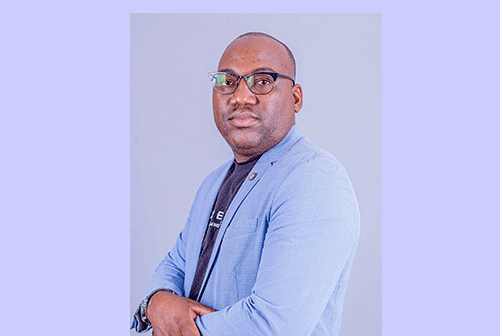

New Era’s northern-based journalist Festus Hamalwa (FH) recently sat down with the medical superintendent of Oshakati Intermediate Hospital Dr Ruben Shaanika Kanime (RSK).
During the interview, a wide range of topics were discussed.
(FH) For those who do not know you, who is Dr Ruben Shaanika Kanime?
RSK: I am a Namibian medical practitioner and healthcare leader with over a decade of experience spanning clinical practice, public health and healthcare management. Currently, I serve as the medical superintendent and accounting officer at Intermediate Hospital Oshakati, a major referral hospital serving four regions and one constituency of Kunene region.
I was born and raised in Omusati region in Omalyaadhila village under the jurisdiction of the Uukonkolokadhi Traditional Authority. Beyond my professional responsibilities, I am a published author, a proud father of three girls and one boy. I am actively engaged in various community initiatives outside my official duties.
(FH) When did you join the public service? What were you doing before joining the public service?
RSK: I began my public service career in 2012 as a medical intern at Windhoek Central Hospital, following the completion of my medical studies at Yaroslavl State Medical University in the Russian Federation. In accordance, with statutory requirements, I completed a two-year internship and was subsequently appointed as a medical officer at the same hospital, where I served for an additional two years.
In 2016, I transitioned to the private sector while simultaneously pursuing a series of postgraduate studies. Guided by the principle, ‘leaving home to change home’, I returned to my home region in 2020 and re-joined the public service as a medical officer at Onesi Health Centre.
In 2021, during the peak of the third Covid-19 wave, my leadership and management abilities were put to the test when I was promoted to senior medical officer for Tsandi District Health and Social Welfare Services. In that role, I oversaw the operations of a district hospital, a health centre and seven primary healthcare clinics. The following year, in 2022, I was further promoted to medical superintendent and transferred to Oshana region.
I have always been passionate about serving in the public sector, as it forms the backbone of our healthcare system, providing essential services to the most vulnerable members of society. Having been a beneficiary of government funding during my undergraduate studies, I consider it both a duty and a privilege to contribute to national development and to give back to the communities that shaped me.
(FH) Briefly talk to us about your position in government and your responsibilities.
RSK : My position in government is that of healthcare manager, overseeing the operations of one of Namibia’s referral hospitals. By virtue of my position, I serve as a member of the overall ministerial leadership team, actively participating in all key strategic and planning meetings. I lead the formulation and implementation of hospital strategies to ensure alignment with national healthcare priorities.
Oshakati Intermediate Hospital serves as a referral centre for 11 district hospitals, catering to a population of nearly one million people. I oversee the management of more than 1 600 staff members, ensuring effective operations and optimal service delivery.
My key responsibilities include financial management, oversight of planning and budget execution as well as directing the provision of comprehensive hospital services encompassing clinical, administrative and operational functions. I also act as the principal liaison between the hospital, ministries, regional structures and other stakeholders to ensure effective communication and coordination.
Additionally, I initiate, contribute to and implement healthcare policies aimed at improving institutional efficiency and performance.
(FH) What do you find most challenging about your work?
RSK: The most challenging aspect of my role is managing a large and diverse team, many of whom were employed long before my tenure. They come from varied backgrounds, experiences and qualifications. It is my responsibility to motivate and guide them toward consistent productivity. I am accountable for their physical, emotional and mental well-being, ensuring a safe and supportive work environment where no harm comes to themselves or others.
Additionally, I must ensure that all staff perform their duties in full compliance with relevant legislation and institutional policies. This requires a thorough understanding of the rights and obligations of employees, the institution and the unions. Ultimately, I am tasked with leading and bringing out the best in my team, even during moments when they may act unpredictably or resistively.
Another significant challenge lies in managing a large institution with limited resources while still being expected to deliver results that exceed capacity and expectations.
(FH) What do you find most satisfying about your job?
RSK: The most rewarding aspect of my job is witnessing tangible transformational changes within the institution. Over the past three years, we have significantly expanded and enhanced the scope of our services through creativity, innovation and strategic partnerships. I take great pride in milestones such as the opening of a modernised senior citizens’ pharmacy, the successful establishment of a 12-bed dialysis unit, the creation of a vision centre and the recruitment of the hospital’s first optometrist.
We are also nearing completion of a 17-bed intensive care unit, alongside the renovation of several wards. Upcoming capital projects include the conversion of the famous Covid-19 tent into a low-care ward for transit and decanting purposes, as well as the construction of the new operating theatres and a Central Sterile Services Department (CSSD). These developments are phase two of what will be known as Intensive Care Unit, Theatre & CSSD Complex.
In terms of equipment, we have strengthened our service delivery capacity through the acquisition of new dental chairs for both clinical use and training, as well as advanced radiological equipment, including a Mammography machine for breast cancer screening and a new Computerised Tomography (CT) scanner.
Additionally, we procured new theatre lights, sleeper couches for caregivers in our paediatric wards and improved the security of our general store by installing CCTV cameras, among other enhancements.
On the human resource front, the staff establishment has expanded from 1 605 to 2 049 positions, a remarkable achievement, although the challenge of securing adequate funding for these posts remains. With this improved establishment, we successfully recruited over 40 medical doctors in February to meet service demands.
Our bed capacity has also grown from 750 at inception in 1966 to 1 089 currently, maintaining an average monthly admission rate of 60-65%. Furthermore, we were able to recruit critical specialists such as an audiologist, one of the professional cadres we had struggled to attract for decades.
In addition, the hospital has successfully entered into strategic memoranda of agreement with various partners and institutions. These collaborations have strengthened service delivery, supported capacity building and enhanced the hospital’s ability to align with national healthcare priorities while promoting innovation and sustainability.
We are busy constituting a hospital advisory committee in alignment with the Hospital Quality Standards Implementation Framework, which seeks to enhance patient, carer and community participation in health-service planning, policy development and quality improvement.
(FH) Please share work-related accomplishments or memorable moments that you are proud of.
RSK: In addition to my medical degree, I have advanced my expertise through several postgraduate qualifications, including an Master of Business Administration in healthcare management (UCAM, Spain), a Postgraduate Extended Diploma in Global Healthcare Management (Cambridge International Qualifications, UK), a Postgraduate Diploma in Preventative Cardiovascular Medicine (University of South Wales, UK), a Postgraduate Diploma in HIV/AIDS Management (Stellenbosch University, South Africa) and a Higher Certificate in Healthcare Services Management (Regent Business School, South Africa).
Building on this academic foundation and my professional experience, I have contributed to various national health programmes and initiatives. I served as the founding coordinator of the National Medical Outreach Services (NMOS), I was a member of the Namibia Medicines Regulatory Council (NMRC) for three years, and I participated as a technical working group member during the development of the Universal Health Coverage (UHC ) policy. Currently, I serve on the Professional Conduct Committee of the Medical and Dental Council under the Health Professions Councils of Namibia (HPCNA).
(FH) There is a big misconception that civil servants are unproductive and inefficient. Do you agree with this sentiment?
RSK: Public servants are often undervalued, despite facing immense challenges driven by the high demand for their services compared to the private sector. Yet, even under difficult circumstances, they continue to demonstrate excellence and dedication. Without the steadfast commitment and presence of the public sector, many of the most vulnerable members of our communities would be deprived of essential services.
(FH) What is on your wish list for the years to come both professionally and individually?
RSK: In the coming year, I hope to see significant improvement in the execution of procurement processes both internally and externally, so that healthcare workers are no longer deprived of the essential supplies needed to deliver critical services. On a personal level, I look forward to pursuing further studies in health economics.
– fhamalwa@nepc.com.na