
When any season comes to an end and the final whistle has been blown, and as the cheers have faded, a sobering reality sets in for many of our athletes and sports administrators.
For them, the transition from the field of play to the field of employment is fraught with obstacles, not from a lack of skill or passion, but because our system is fundamentally misaligned.
Our labour laws and educational pathways, designed for traditional industries, are failing the very people who drive our vibrant sports sector.
The core of the problem is a profound mismatch; we are trying to force unique, dynamic, and often non-linear careers into a rigid labour framework that does not fit.
Let’s look at the elite athlete. The Labour Act, in its current form, recognises formal qualifications and continuous employment. Still, it overlooks the decade of disciplined training, strategic thinking, and leadership under pressure that an athlete embodies.
An Olympian typically takes between four and 10 years to win or qualify for a podium position. This is the same time that a psychotherapist, a doctor, or a professor takes to be able to be accredited as a practitioner, while for an Olympian, this is not recognised by our own education framework.
For those in sport, this massive investment in human capital that remains largely uncredentialed and unrecognised by the formal job market is underrated by our own systems.
Sport administrators who operate in high-stakes environments, managing event logistics and multi-million-dollar budgets through project-based roles that don’t conform to a standard career ladder. They experience a similar bias as the work they do, which does not remunerate or compensate the skill and competence they embody.
Due to the lack of a sport-specific framework, the current system fails to quantify this expertise, leaving these professionals at a severe disadvantage. Even those in the mainstream market are forced to bring their skills as “so-called volunteers.”
The existing Labour Act is a square peg being forced into a round hole. These legislative frameworks, which require standard working hours, overtime, and contract types, are ill-suited for athletes with anti-social and seasonal schedules, coaches whose work peaks around competitions, and event managers who work around the clock.
For instance, Alina, who plays active rugby, is paid for match day only, and the days she spends training are not taken into consideration as work by her club, which is her so-called employer.
Which means the time she puts in training is not regarded as work, as far as the legislation is concerned.
This has led to both athletes and administrators being forced to look for alternative conventional employment to be able to sustain their work in sport.
The only alternative these sports people have is to squeeze themselves into a conventional employment box, which will lead to informal work, a lack of job security, and the erosion of the very workers’ rights the legislation is meant to protect.
To fix this, we need a dual strategy. First, we must revolutionise sports education by redesigning curricula in direct consultation with both regional, continental, and international sports bodies.
This means creating integrated sports programmes that combine sports science with business, offering micro-credentials in high-demand areas like sports analytics, and formally credentialing the “soft skills” of leadership and resilience inherent in athletic performance.
Second, we must advocate for a “Sports Industry Specific” labour framework. This supplementary regulation would provide flexible, yet protected, contracts for seasonal work, portable benefits that follow the individual, and a formal system for Recognising Prior Learning to certify the skills gained through experience.
This would provide the likes of Peter Shalulile, Brave Warriors captain, and others with an opportunity to come and share their knowledge within the education sector, without the fear of being branded as not having a degree.
Our athletes and sports administrators are not asking for special treatment; they are asking for a system that recognises their unique form of excellence.
Let’s create a labour framework that fits the sports sector’s rhythms.
We can unlock a vast reservoir of talent, drive economic growth, and finally grant our sports professionals the secure and respected careers they deserve.
The game has changed; it’s time our rules did too.
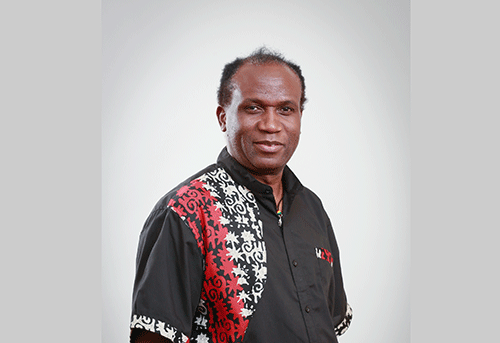
*Mathew Haikali is a sports consultant and managing member of Just Imagine Sports.