
Namibia’s reputation for a world-class road network is undergoing strain as the Road Fund Administration (RFA) continues to confront a widening gap between infrastructure ambition and fiscal reality. RFA’s Business Plan for the 2026–2031 notes that what is at stake is not only the condition of Namibia’s roads, but the country’s broader economic competitiveness and standing as a regional logistics hub.
Despite significant funding constraints, the RFA has demonstrated notable financial resilience. Revenue for the 2024/25 financial year reached N$3.74 billion, marking a two percent year-on-year increase. The growth was driven largely by stable fuel levy collections and improved compliance with Mass Distance and Cross-Border Charges, underscoring the importance of effective revenue administration.
However, these gains are insufficient to close the widening funding gap the RFA is experiencing. According to the RFA’s Integrated Strategic Business Plan (ISBP) for 2024–2029, revenue generated through the Road User Charging (RUC) System was projected to cover only 46% of national road maintenance needs in the 2025 financial year. Urban roads face an even starker picture, with a 30% funding shortfall.
The numbers tell a grim story: a funding deficit of N$3.6 billion is projected for FY2025 alone, ballooning to N$15.3 billion over the next five years if structural reforms are not implemented.
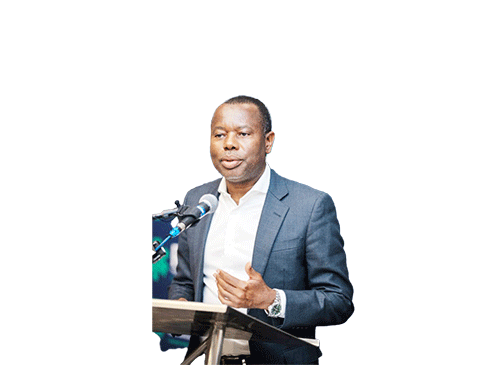
Speaking at a recent engagement, RFA chief executive officer Ali Ipinge confirmed that the institution has realigned its strategic direction to support the implementation of National Development Plan Six (NDP6) and to shift its focus to inclusive growth, rural access, and climate-resilient infrastructure.
“As part of our alignment to NDP6, the RFA will support key road and logistics objectives, including enhancing connectivity for rural communities through the development of feeder roads,” Ipinge said.
However, behind the strategic optimism lies a sobering financial reality. While Namibia continues to enjoy one of the best road networks on the continent, declining political and financial support and escalating maintenance demands are placing the system under severe pressure.
The ISBP, developed in line with the Road Fund Administration Act and the Public Enterprises Governance Act, outlines the RFA’s financial, operational, and strategic priorities over the next five years. It builds on earlier strategic plans dating back to 2013 and aligns Namibia’s transport ambitions with Vision 2030, the Harambee Prosperity Plan II, and NDP6.
Beyond road funding, the plan reflects the RFA’s expanded mandate, which now includes support for traffic law enforcement, traffic information system management, and broader road infrastructure financing. It introduces new vision and mission statements underpinned by the organisation’s core values.
Meanwhile, investment priorities remain firmly anchored in economic impact. The RFA continues to channel funding into the rehabilitation of national corridors, upgrades to urban roads, and environmentally sensitive projects such as the upgrading of roads in Etosha. These interventions aim to improve accessibility, while safeguarding fragile ecosystems.
To address the structural funding imbalance, the RFA is advocating for phased annual adjustments to Road User Charges and exploring tolling options on strategic corridors. The objective, Ipinge said, “is to ensure a fair contribution from all road users while securing the long-term sustainability of the road network.”
The ISBP also calls for a gradual increase in funding for both national and urban road maintenance, supported by capacity-building initiatives within the Roads Authority and local authorities. Importantly, traffic law enforcement is identified as a function better funded through direct public allocations to shield it from fluctuations in road user revenue. Operationally, the plan sets out a robust framework that includes financial forecasts, risk management measures, and a clear implementation roadmap supported by a strategy map and balanced scorecard. Key objectives include strengthening financial sustainability, improving operational efficiency, increasing stakeholder value, and promoting innovation and environmental responsibility.
Moreover, Ipinge has issued a clear warning and a call to action. “Namibia’s road sector stands at a crossroad between fiscal reality and infrastructure ambition… Bridging this gap demands collective effort from all our stakeholders,” he said.
He added that with infrastructure underpinning trade, tourism, and social development, the choices made now will determine whether Namibia’s roads remain a competitive advantage or become a bottleneck to growth.
-ebrandt@nepc.com.na