

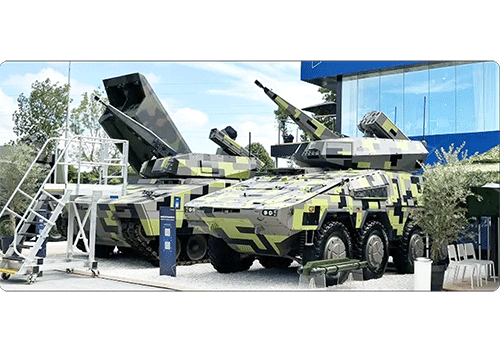

FRANKFURT – German defence giant Rheinmetall on Wednesday forecast even faster growth this year after record earnings in 2025, with Europe racing to re-arm as it contends with a hostile Russia and turmoil in transatlantic ties.
Moscow’s 2022 invasion of Ukraine spurred a drive on the continent to rebuild long-neglected militaries, with the trend picking up speed after the return of President Donald Trump to office last year shook Europe’s confidence in US security commitments.
This has meant a jump in business for Rheinmetall, which has been thrust into the public eye after spending years keeping a low profile in a country with a strong pacifist leaning, due to its dark World War II history.
For 2026, the group is predicting a jump of up to 45% in sales to a maximum of 14.5 billion euros (US$16.9 billion), after sales rose almost 30% last year.
“The world is changing rapidly, and Rheinmetall is well prepared,” said CEO Armin Papperger, whose firm makes products ranging from ammunition to artillery and military vehicles. “We are needed when it comes to increasing the defence capabilities of Germany and Europe and creating an effective deterrence.”
In 2025, the group’s core profit jumped by a third to a record 1.8 billion euros. Its order backlog also rose by 36% to a new record of 63.8 billion euros.
Rapid expansion
The Duesseldorf-based group has benefited in particular from greater defence spending in Germany, where Chancellor Friedrich Merz has vowed to turn the Bundeswehr into Europe’s largest conventional army.
Its rapid growth is set to continue in the coming years, according to a company-provided poll of analysts; sales will top 42 billion euros by 2030.Growing demand has boosted the entire defence sector in Europe’s biggest economy; Germany overtook China to become the world’s fourth largest-arms exporter in 2021-2025, with 5.7% of global exports, according to the SIPRI research group.
But it is a tough task for European countries to rebuild militaries that had shrunk dramatically since the end of the Cold War, with soldiers frequently facing issues from poor living conditions to ageing equipment. Efforts are, however, picking up speed — the continent has more than tripled arms imports over the past five years, according to SIPRI. Many European countries have also committed to raising military spending in response to Trump’s pressure on NATO allies to cover more of the cost of their own defence. For Rheinmetall, new business has driven a vast expansion.
It has opened new munitions plants across the continent, including the largest in Europe in northern Germany last year, which will be able to produce 350 000 artillery shells a year by 2027. It has also taken over a German warship builder, Naval Vessels Luerssen (NVL), marking a major expansion into naval defence. The firm has, however, decided to put its automotive business up for sale at a time when Germany’s flagship carmakers are struggling and focus purely on defence. -Nampa/AFP