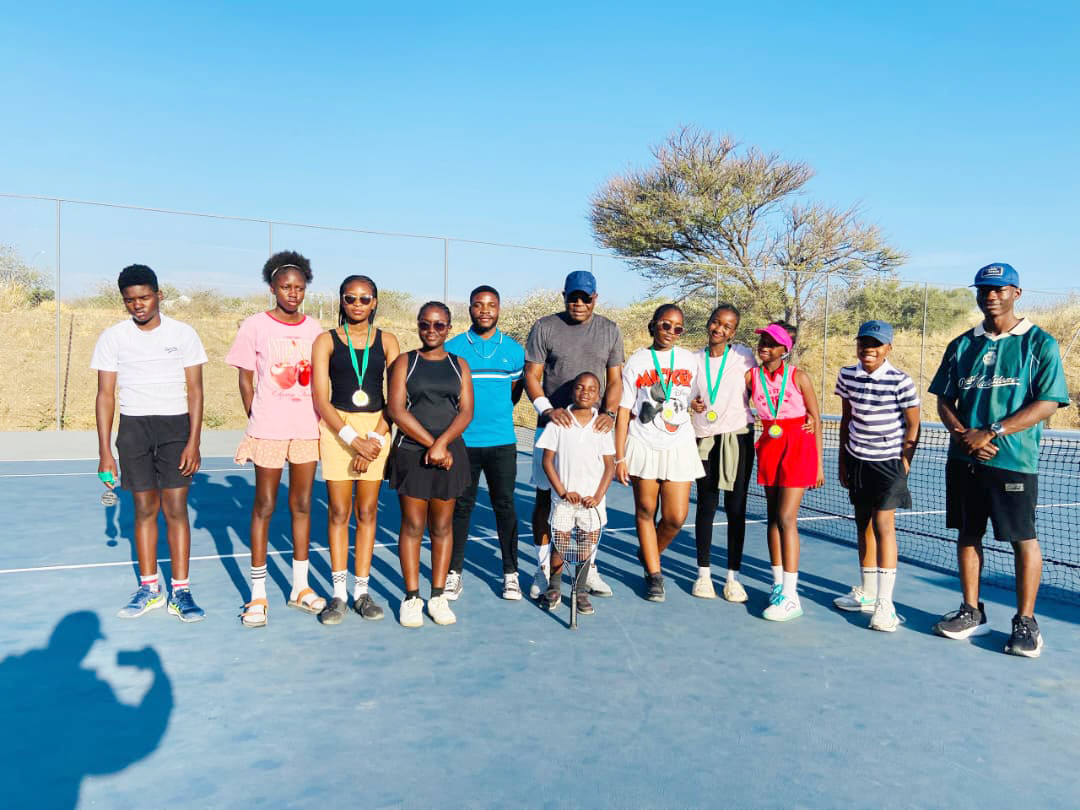

In a town where football has long dominated and sports facilities remain scarce, a determined group of tennis enthusiasts in Rundu is steadily changing the narrative.
What began as a casual pastime for one individual has evolved into one of northern Namibia’s most promising tennis club, Rundu Tennis Club, which is now producing players who are competing and even winning in major national tournaments.
Founded in 2019, the club was born from humble beginnings. “It was first started by a foreign coach here in Rundu who played tennis for fun,” said the club’s head coach Mike Kambonde.
“After he left, I decided to continue and formally registered the club with the Namibia Tennis Association (NTA). That’s how our journey in talent development began,” he said.
Affiliated with the NTA and based in Kavango East, the club focuses on identifying and nurturing home-grown talent with the dream of elevating local players to national and international levels. “The only sport I ever knew was football, but when I first saw tennis being played by a friend, I knew this was something special. I realised we could change the sporting landscape in the region by bringing something new,” he explained. The club which started with less than 20 players in a year in its early days, is now home to more than 70 active members, a number the coach describes as “beyond expectations.”
“We’ve grown into one of the biggest tennis clubs in the north. Players and even community members are now approaching us to join, which shows how much impact we’ve made,” he said.
Kambonde credited the club’s growing popularity to its recent success stories. “Our top player, Ilen Aisindi, has been unbeaten in his category for the past three national finals and has reached nine finals in total. He’s currently ranked 10th in Namibia, which is a huge achievement for a player from Rundu,” the coach said.
The club has also made deliberate efforts to increase female participation. “We’ve registered more young ladies in our teams and structures. It’s important for us to grow inclusively,” he added.
However, the journey has not been a walk in the park. “The biggest struggles are funding and equipment. Our members contribute from their own pockets to cover trips and other needs. Thankfully, we do get some assistance from the NTA and the Ministry of Sport, Youth and National Service, especially with transportation,” he explained.
Looking ahead, the club has its sights set on even greater heights. “We want to continue growing both here at home and nationally. There’s so much untapped talent in the region, and we want to nurture it. We truly appreciate the community for rallying behind us,” he concluded.
NTA president Sam Kaulinge applauded the club for the major role the club has played in talent development. “Yes, they are with us and they have had players partaking in tournaments in Windhoek and Swakopmund. This is mostly in the junior stages and as the governing body, we are proud of the work the club has done,” he said.