


Eba Kandovazu
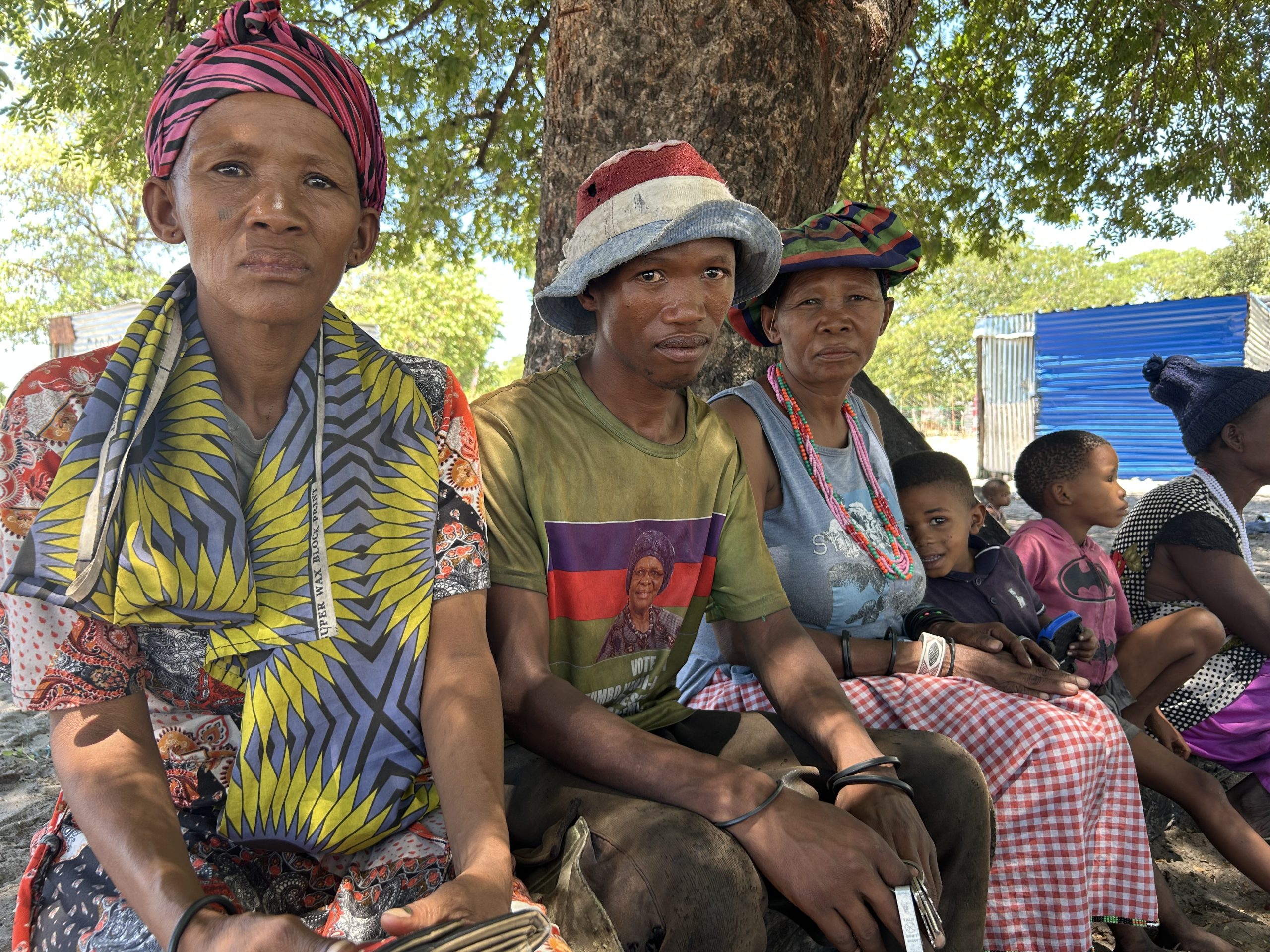
EENHANA – Under a large tree on the outskirts of Eenhana, in a settlement called Opalasa, a San family of more than 30 people begins and ends every day in the same fragile space they call home.
With no proper rooms and only makeshift structures known as ‘Omapundo’, built from sticks, wood, and plastic bags arranged around the trunk of a tree, the house shelters children, parents, grandparents, and great-grandchildren, all sharing the crowded and unstable living space.
Seventy-year-old Helena Ekondo sits quietly beneath the tree, watching her family move around her. Her voice is steady, but heavy with exhaustion. “We are not happy. We fight snakes and scorpions. When it rains, water comes into our homes. We don’t have blankets. We struggle to sleep,” she said.
The tree offers shade during the day, but no protection from hunger, cold, or flooding at night. “We want the government to do something. We are suffering. We have no jobs, no means of survival,” Ekondo said.
However, beyond food support, efforts are being made to improve access to education. Ohangwena regional development planner for marginalised communities in the Office of the Vice President, Thomas Puleinge said government transport over 60 children from Opalasa to Ohayinyeko Combined School and Ekoka Combined School in Okongo, which is about 90 kilometres from Eenhana. These children are in boarding school according to him.
Puleinge added that coordination with other government ministries remains key in addressing long-standing challenges faced by marginalised communities.
“We are working closely with the Ministry of Health and Social Services and the Ministry of Home Affairs, Immigration, Safety and Security, particularly on the issuing of national documents,” he said.
Life
Beside her sits her grandson, 24-year-old Eino Paulus, who describes how daily life unfolds for young people in the settlement. He speaks about informal survival around nearby shebeens in the Opalasa location.
Work is neither formal nor stable. It comes in small, uncertain tasks.
“Someone sends you to fetch water with a 20-litre container. When you return, they give you tombo or maybe N$2 for vetkoek,” Paulus explained. For him, survival is not only about overcoming poverty but also about fighting exclusion. He also points to another barrier – lack of identity documents.
“Some of us don’t have national documents. Without them, you cannot get grants or jobs. Employment is just a dream,” he said.
Looking toward nearby settlements, he speaks with frustration.
“In Ouholamo, they’ve got shacks, water and electricity. In Omundaungilo, San communities were given houses. Why are we left out?” Not far from Ekondo’s family in Opalasa, 42-year-old Erastus Monica recalled promises she says were made years ago.
“We signed ourselves up. The government knows our situation. They promised housing, water and electricity. But until now, nothing has changed,” she said. For 20-year-old David Paulus, survival has already become routine.
“We go to shebeens to look for tenders,” he said. “Sweeping, carrying water, running errands in town and walking kilometres earn you less than N$10,” he explained.
He pauses, then adds quietly, “I am young. I want more for my life. This cannot be all there is.”
Omundaungilo
In Omundaungilo, about 40 kilometres outside Eenhana, the story shifts slightly.
Julia Thomas, a pensioner, sits outside a shack provided through a government housing intervention. She expresses gratitude for the structure, which replaced earlier makeshift shelters that once left her exposed to rain and danger.
“We were given houses. I am grateful, but survival has not become easy. My family is big. I have many grandchildren and children,” she said. The challenge now is electricity.
“We have no means to buy units,” she said.
Although electricity has been installed, it remains largely unused due to a lack of income. “The government connected us, but buying electricity is a struggle. I cannot even remember the last time we had units, and I have been living here for years,” she said.
Life has adapted around this limitation.
According to Ohangwena chief regional officer Filippus Shilongo, more than 3 000 San households are spread across Ondobe, Oshandi, Eenhana, Epembe, Omundaungilo and Okongo. Many live in resettlement areas, while others remain in informal settlements near towns. Shilongo confirmed that 3 056 households are registered for drought relief support, receiving food assistance through structured distribution systems.
He, however, also acknowledged that living conditions remain difficult.
“In reality, many are in deplorable conditions. Some of these living spaces are not suitable for human habitation, especially during the rainy season,” he said.
He explained that while some communities have received housing or infrastructure in certain areas, support has not been uniform across all settlements.
Challenges include adaptation to new housing, lack of income, and the long-term sustainability of assistance.
Puleinge, who said there are plans underway to relocate the Opalasa San community to the Ekolola settlement, also within Eenhana. “The town council has already allocated three hectares of land, and the Office of the Vice President will build houses for them in this financial year,” he told Nampa in an interview. Puleinge noted that a full assessment is still pending to determine how many houses would be constructed, but indicated that the Opalasa community currently consists of more than 100 people.
In the meantime, he said the government continues to provide monthly supplementary food, including maize meal, canned fish, canned beef, salt, cooking oil, sugar and beans.
Puleinge explained that a joint outreach programme conducted last year brought home affairs officials directly into the communities, with some requirements waived to ensure more people could be registered.
“We make sure all the children are registered,” he said. Health interventions have also formed part of the outreach.
“We work with the ministry of health on providing education, especially to reduce home [baby] deliveries, which are risky, and to emphasise the importance of antenatal care,” he said.
He added that collaboration with the Ministry of Gender Equality and Child Welfare also ensures that children are registered for national documents and social grants. -Nampa