

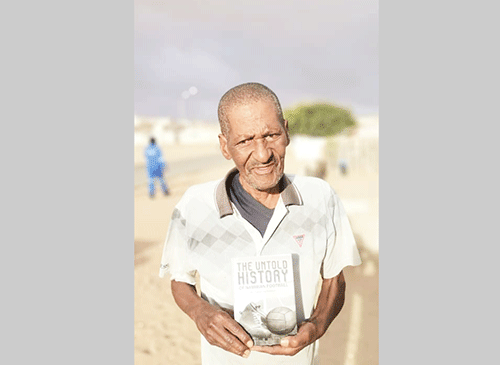

Born and raised in the remote Southern harbor town Luderitzbucht in 1951, Walter Khosan Sokupa was a rare gem, indeed a phenomenal footballer who made it his soul’s beat to constantly terrorise and bamboozle robust defenders with sheer speed, football arrogance, amazing skill, and dribbling tricks second to none. The flying winger started playing competitive football for Benguela outfit Flying Eagles Football Club alongside other greats from that neck of the woods. The slightly built tallish attacker operated across all positions in the firing line.
Despite being gravely isolated from her inland counterparts, the unique compact mountainous harbor town Luderitzbucht, with her hard-to-ignore old-fashioned German architecture buildings, has given birth to a significant chunk of great athletes not only on the football pitches but in other spheres as well.
Lest we forget, one of the greatest sprinters of all time, Benedictus Botha, is a product of Luderitz. The town is also home to noted academics and prominent personalities in the following sequence: Idah Jimmy, Clement Daniels, Tim Ekandjo, Sidney Martin, Isaac Hamata, John ‘Ayeb’ English, Jimmy Pickering, ‘Rampie’ Links, and Norman Victor, to mention but a few. The town was also home to some of the greatest live music performing bands in years gone by; Wolves, Rampages, and the colourful three-piece rock band Osibisa springs to mind.
On the football front, the town unleashed the following remarkable footies spearheaded by the famous de Gouveia brothers Ivo, Carlos, and Luis; tailed by Leo Shimbulu, Immo Steffens, Jean Martin, Page Ananias, Hare Carew, James ‘Ballack’ Sokupa, Doc Shiimi, Mark Isaacs, ‘Boeta’ Sekhobo, Leonard Kwambi Stanley, ‘Pietie’ van Wyk, Eusebio Fredericks; and lately Mukuture Kouja. The latter signed a professional contract with Italian lower division campaigners Frediano FC.
Regrettably, most of the talent from the coastal town went to waste because of the long-distance proximity separating Luderitz from other towns. National selectors never bothered to scout raw talent from the harbor town, let alone at school level. As fate would dictate, when SWA Bantu Football Federation conducted trials to select a team for the prestigious South African Inter-Provincial Impala Cup in Johannesburg in 1974, Khosan happened to be in the city of bright lights, Windhoek, on vacation.
The lanky winger from the ‘Bucht’ was at the trials by default, training with the team during the drills at the old Katutura Stadium. His football artistry caught the eyes of the selectors under the stewardship of Meester Phillipus Tsuseb, a popular schoolteacher and sport mentor at the revered Augustineum Secondary School at the time.
Khosan was hastily drafted into the traveling entourage and wheeled across the Orange River for the interprovincial spectacle. The star-studded team rewrote the history books by winning its first major interprovincial title. Khosan was an unused substitute in the final against Free State, which the boys from the desert country won 3-1.
Former Orlando Pirates flying winger Willem ‘Fosbury’ Eichab netted a brace for SWA, with African Stars midfield ace Oscar ‘Silver Fox’ Mengo also registering his name on the score sheet.
Back home in his native town, Luderitz, Khosan continued from where he had left off, running rings around bemused defenders in the process, making his markers run like headless chickens while banging in goals at will as if the art of goal scoring were going out of fashion.
A highly talented speedy forward, Khosan could have gone very far with his amazing football artistry had he lived inland. We could be talking about one of the greatest footballers to have ever graced Namibian football pitches of all time.
Nevertheless, the tallish forward etched his name in the history books by becoming the Impala Cup Champion. That prestigious gold medal will remain amongst his most treasured assets, and nobody can take that away from him. Khosan also enjoyed successful stints with Ramblers Katutura (Ramkat) and coastal giants Blue Waters Football Club during his time at Rossing Uranium Mine in Arandis.
Lone Wolf: Life After Football
After hanging up his trusted togs, Khosan lives a quiet life at his tiny house in Lüderitz’s largest populated residential area, Benguela, specifically designed to provide shelter for native Bantus during the era of enforced puke-inducing racial segregation.
New Era Sport visited the now-retired flying winger at his residence for an exclusive interview about his unsaid football journey. However, the brother cut a lonely figure; frail, he came across much older than the 75 summers clocked behind his back, a sign of an abandoned figure who has experienced few hard knocks along the way.
This once again opens the long-overdue debate about the plight of citizens of remarkable pedigree who have made significant contributions, let alone massive sacrifices, towards the overall growth of their motherland without compensation or recognition in one way or the other. In developed nations or better-organised structures, Khosan would have been accorded permanent hero status (knighted), complemented by few tangible benefits for basic needs as recognition for bringing honour to their motherland.
Now please school me here. How does one explain to your grandchildren one day that this man is the proud custodian of a gold medal, having played a significant role in Namibia’s first-ever silverware of the people’s game at the inter-provincial level?
It goes beyond any form of comprehension as to why someone armed with such a remarkable resume has not been honoured with at least a street name in his native town or any other form of recognition for his astonishing achievement.
Truth be told, history is going to judge us harshly if we continue turning a blind eye to those who have made significant contributions towards the development of sport, football in particular. Let us give flowers to our heroes while they are still breathing and not after they have gone the way of all flesh.