


Today, the world gathers once again to celebrate World Micro-, Small and Medium-sized Enterprises (MSME) Day. This annual event, declared by the United Nations General Assembly in 2017, is more than just a symbolic occasion. It is a global call to recognise the indispensable role of MSMEs in job creation, economic growth, innovation, and sustainable development.
For Namibia, a nation forged in unity and freedom since its independence in 1990, this day carries particular resonance as we reflect on our journey and the ongoing work to empower local enterprises.
As a proud member of the United Nations, Namibia benefits from access to global platforms, networks, and frameworks that promote inclusive economic development. MSME Day is one such opportunity. It reminds us that although we operate within our own national context, we are also part of a broader movement to transform economies from the ground up by strengthening the backbone of all communities, small businesses.
Namibia’s commitment to MSME development, however, has not always been structured. While informal support and fragmented initiatives have existed for decades, it wasn’t until the introduction of the National MSME Policy 2016-2024 that the country took a more coordinated approach. This policy marked a turning point, building on lessons from both international best practices and past shortcomings in the Namibian support system.
In recent years, significant progress has been made in strengthening support for MSMEs in Namibia. Many organisations, including government agencies, ministries, academic institutions, and development partners, have actively launched various initiatives to promote entrepreneurship and investment.
A notable contributor to this momentum is the Namibia Investment Promotion and Development Board (NIPDB), which has introduced targeted interventions to ensure the voices and needs of MSMEs are acknowledged and addressed.
However, a key lesson emerging from both past and ongoing efforts is that many programmes have been developed based on assumptions rather than through direct consultation with business owners. This often leads to well-intentioned initiatives that do not fully align with the real, day-to-day challenges faced by entrepreneurs.
Recognising this gap, several organisations, including the NIPDB, have made deliberate efforts to engage directly with MSMEs across the country. Through regional missions and on the ground consultations, these engagements have provided invaluable, first-hand insights. Having personally participated in some of these missions, I witnessed the importance of this inclusive, participatory approach. Particularly impactful were the engagements held from 24 May to 05 June 2025.
Before the northern mission, we visited Swakopmund, where we explored an MSME project focused on iron extraction using renewable energy, the first of its kind in the world. The innovation was inspiring, showcasing what is possible when local ingenuity meets enabling support. But it was our stop at Hafeni Tourism, a small business in the tourism sector, that brought the national MSME reality into sharp focus.
“My business has proven itself, but I can’t get funding to grow,” said Henrich Hafeni. His frustration echoes the voices of thousands of entrepreneurs across the country from tourism operators in the coastal regions to informal traders in the north.
These experiences confirm that MSMEs are not asking for complicated solutions. What they need are straightforward, accessible programmes, equipment support, seed capital, and grant based financing, without being burdened by endless paperwork or unrealistic loan conditions. Concept notes, not business plans. Trust, not red tape. And most importantly, funding that does not treat small businesses as high-risk experiments, but as foundational pillars of Namibia’s economic future.
These enterprises have the potential to put Namibia on the global map, not just as a tourist destination or mineral rich economy, but as a hub of innovation and entrepreneurship. By raising public awareness of the vital role MSMEs play in sustainable development, we can begin to shift national priorities towards more targeted, outcome-driven support. One thing became clear: we must do more. A reactive approach is no longer sufficient.
The current MSME policy must evolve into a pragmatic, action-oriented strategy that is closely aligned with the Swapo Manifesto Implementation Plan (SMIP) and the broader Government of the Republic of Namibia’s (GRN) MSME development agenda.
If they say they need training, we must bring practical, sector-specific skills development closer to their communities. The way forward requires translating policy into real, tangible interventions that directly respond to the needs on the ground, in line with national priorities.
We are encouraged by the bold and timely announcement by President Netumbo Nandi-Ndaitwah, regarding the establishment of the Youth Fund, which will be capitalized with more than N$250 million. This is a significant step toward empowering youth-led businesses. To build on this momentum, Namibia should seriously consider the creation of a dedicated MSME Agency, one that is well-resourced, independent, and driven by a clear, results oriented mission.
This agency must move beyond simply ticking donor boxes or meeting international expectations. It’s time to put our money where our mouth is.
We must stop chasing unicorns or looking only for “safe bets” and start funding the businesses that are already creating impact, no matter how small.
As we mark World MSME Day 2025, Namibia must renew its commitment to real, transformative support for its small business sector. This is not just a moral or political imperative, it is an economic necessity. Our entrepreneurs are not waiting for charity; they are waiting for opportunity. And if we can create the right conditions, support mechanisms, and funding pathways, there is no doubt that Namibian MSMEs will rise to meet and exceed global standards.
In celebrating this day, we celebrate resilience, innovation, and ambition. Let us not stop at celebration. Let this be a national call to action — one that ensures MSMEs in every village, town and city across Namibia, are empowered to thrive.
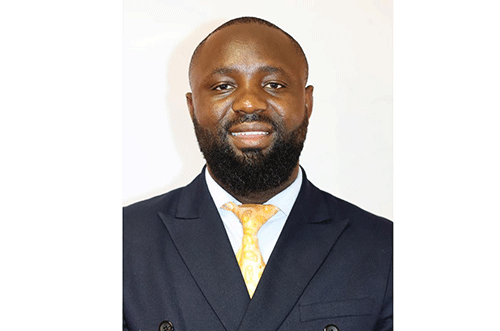
*Hasekiel Johannes has over 12 years of experience in MSME development and business innovation.