

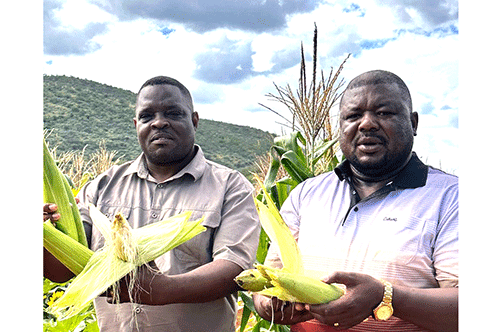

In the heart of Omaheke region, Farm Gross Osombahe thrives under the dedicated stewardship of Peter Shimii. His three-hectare horticulture project flourishes with maize, tomatoes, green peppers, sunflowers, spinach, and beans.
Shimii donated his first harvest to Otjivero Combined School in Omitara, providing nutritious meals to 602 learners and inspiring the entire community.
Chairperson of the Omaheke Regional Council, Ignatius Kariseb, and regional councillor for the Okorukambe constituency Rocco Nguvauva, recently visited the farm to explore its innovative food security initiatives, joined by chairperson of the Osombahe Farmers Cooperative, Willempie !Haoseb.
Shiimi’s farm boasts sustainable practices, such as water-efficient irrigation and crop rotation and plans to establish the farm as a pilot training hub.
This initiative will empower farmers across Omaheke with skills to increase yields, diversify crops, and foster self-reliance.
This project aligns with Namibia’s national vision for food security, championed by President Netumbo Nandi-Ndaitwah, who emphasises agriculture’s role in reducing the country’s food import bill by 80% by 2029.
Nandi-Ndaitwah has set out a vision to promote sustainable farming and to ensure all Namibians have access to nutritious food.
Shimii’s farm exemplifies sustainability and community spirit. His recent donation to Otjivero Combined School underscores agriculture’s power to nourish both bodies and minds.
“Farming is about building a future,” Shimii shared during the visit, adding that he looked forward to sharing his experiences with other farmers in the region to encourage similar initiatives.
On his part, Kariseb echoed his sentiments, saying, “Gross Osombahe proves what’s possible when we unite for food security.”
The Council’s plan to scale this model across Omaheke supports the national goal of empowering small-scale farmers with training and modern tools.
Nguvauva noted that “we are proud to support farmers like Peter, who are leading the charge through grassroots efforts and bold leadership, Omaheke is sowing the seeds for a food-secure Namibia.”
National effort
Nandi-Ndaitwah’s call for Namibia to expand agricultural production and strengthen food self-sufficiency was also recently heeded by the line ministry, which has committed to develop a 140-hectare irrigation project at Ekoka Village, east of Okongo in the Ohangwena Region.
During a site visit, the ministry’s executive director Ndiyakupi Nghituwamata reaffirmed the government’s commitment to transforming underutilized land into productive agricultural hubs that generate employment and improve local livelihoods.
To ensure the success and long-term sustainability of the scheme, securing a reliable water supply remains a key priority.
Accordingly, a targeted geophysical investigation was conducted in August 2025 to identify suitable drilling sites capable of providing good-quality groundwater — the most feasible and cost-effective source for this vital development.
Drilling activities commenced on 28 October and are expected to continue until around 20 November 2025. As of 1 November 2025, the first borehole had reached a depth of approximately 180 metres, successfully intersecting the Ohangwena-I aquifer at 151 metres.
The drilling team continues advancing toward the anticipated depth of the Ohangwena-II aquifer with optimism and determination.
The boreholes are designed to target the Ohangwena-II aquifer, located beneath the Ohangwena-I aquifer.
In this area, the Ohangwena-I aquifer occurs at approximately 150–180 metres below ground level (mbgl), while the Ohangwena-II aquifer is expected to lie between 200–400 mbgl, based on geophysical data and the understanding that the aquifer system deepens eastwards. The maximum drilling depth has therefore been set at 300 metres.
This initiative forms part of the ministry’s broader efforts to ensure that every region contributes to national food production, strengthens community resilience, and moves Namibia closer to becoming a nation that feeds itself.
-ohembapu@nepc.com.na