


Andreas Thomas
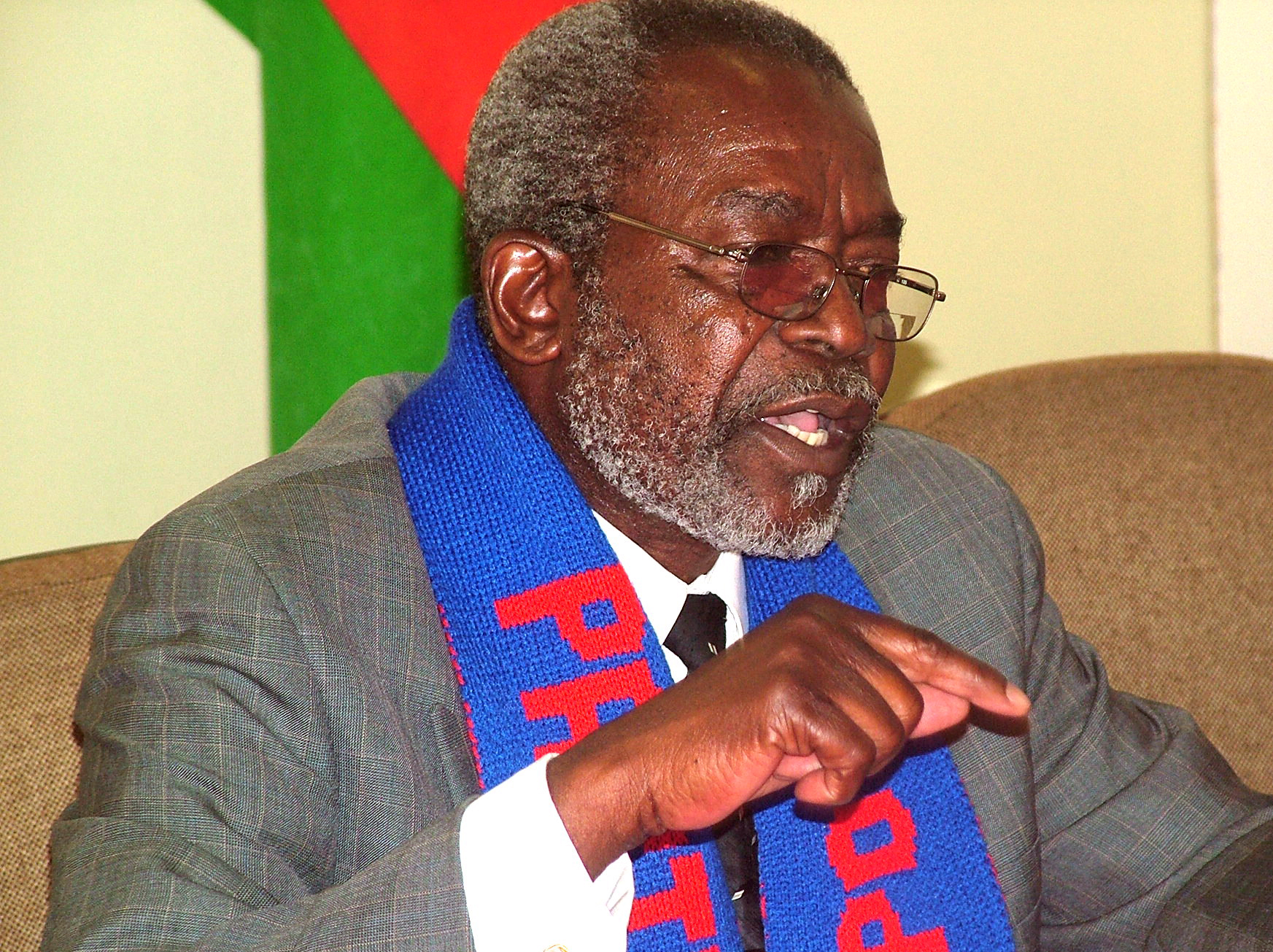
EENHANA – As Namibia continues to reflect on the meaning of its independence more than three decades after political liberation, the death of Mathias Kanana Hishoono has cast a sharp light on a fading generation whose legitimacy was forged in sacrifice rather than symbolism.
Hishoono, one of the last surviving pioneers present at the birth of the national liberation movement, was laid to rest on Saturday at the Eenhana Memorial Shrine, following his death on 14 January 2026 at the age of 89.
His burial marked not only the end of a long personal journey, but also the steady closing of a formative chapter in Namibia’s political history.
Namibians from across the country gathered at Eenhana, the capital of the Ohangwena region, to honour a man whose life spanned the earliest stirrings of resistance against South African colonial rule, the trauma of repression and exile, and the demands of nation-building after independence.
Hishoono belonged to a small and diminishing group of leaders who witnessed and helped shape the formation of the South West Africa People’s Organisation (Swapo) in April 1960.
Alongside fellow pioneers such as 96-year-old Helao Vinnia Ndadi and former president Hifikepunye Pohamba, who turns 90 this year, Hishoono helped lay the organisational and ideological foundations of a movement that would later govern an independent Namibia.
The beginning
Born on 24 November 1936 at Ongula ya Netanga in today’s Omulonga constituency, Hishoono’s political consciousness was shaped early by the injustices of colonial rule.
Like many of his generation, he entered political activism while working as a migrant labourer in South Africa’s gold mines in the late 1950s, where mobilisation among Namibian workers intensified.
Within the liberation movement, Hishoono came to be regarded as both an organiser and a living archive. He was among the early leaders of the Ovamboland People’s Organisation (OPO), founded in Windhoek in 1959, which later evolved into Swapo.
His role as a mobiliser was widely acknowledged, with many crediting him for recruiting Namibians into the movement and facilitating their passage into exile during the early 1960s, including the late president Hage Geingob.
Tributes following his death consistently returned to his discipline, humility, and commitment to collective leadership. For many within the ruling party Swapo, his passing symbolised the loss of a generation whose authority was rooted in lived experience rather than political office.
Brother
Veteran liberation stalwart Helao Vinnia Ndadi, himself one of the last surviving pioneers, described Hishoono as “almost my brother”. The two worked closely while employed at the Tsumeb copper mine in the early 1960s, where Hishoono served as Swapo secretary for the Tsumeb branch.
“We stayed together, and we worked together,” Ndadi recalled. “That is how I got to know him. To me, Kanana was like a brother and a comrade in arms in the struggle for the liberation of Namibia.”
Ndadi’s recollections highlighted the personal risks faced by early activists. Hishoono was first arrested in 1964 in Tsumeb, detained for four months, and deported to his village in Ovamboland.
A second arrest followed in 1966 in Rundu after he and Ndadi walked for two days from Onambutu, fleeing intensified persecution of OPO and Swapo members in northern Namibia.
According to Ndadi, the two were attempting to join migrant workers recruited for South Africa’s mines when a South African police agent recognised Hishoono, leading to his arrest.
He was taken to Ondangwa, where he was tortured, before being transferred to Pretoria in January 1967. There, he spent a year in solitary confinement before standing trial alongside Andimba Toivo ya Toivo in 1968. He was later acquitted and returned to Namibia.
“That suffering itself was a contribution to the liberation struggle, because he was ready to sacrifice his life,” Ndadi said.
Former president Pohamba, who worked closely with Hishoono during his presidency, described him as “a liberation hero of uncommon courage, a principled leader and a steadfast champion of justice, unity and human dignity”, referring to him as a trusted political adviser at State House.
Namibia’s fourth president, Nangolo Mbumba, noted that Hishoono occupied a central place among the pioneers of the liberation struggle, recalling that it was Hishoono who facilitated Swapo membership cards for early cadres.
Former Cabinet minister Helmut Angula echoed this assessment, describing Hishoono as “a fearless patriot, an uncompromising cadre, and a dedicated son of the Namibian soil.” Reflecting on their time studying in Cuba in 1979, Angula added that Hishoono “was a man of warmth and depth, full of stories, humour, and revolutionary wisdom.”
After independence in 1990, Hishoono transitioned into party leadership and mentorship. He served as Secretary of the Swapo Party Elders Council from 1997 for two decades. He became a member of the Swapo Central Committee in 1992.
He also played a role in establishing the Swapo Party School, where he lectured on party ideology and constitutional principles.
Swapo secretary general Sophia Shaningwa highlighted that cadres like Hishoono were instrumental in securing international recognition for the liberation struggle and mobilising global opposition to apartheid.
After independence, she said, Hishoono guided a Swapo-led government that “rolled out many developmental projects designed to bring services closer to the people in sectors such as education, healthcare, water, electricity, and housing.”
At the regional level, Oshikoto Swapo coordinator Armas Amukwiyu described Hishoono as “one of the living libraries that we have.”
“We have lost one of our elders who believed in the principles of unity,” Amukwiyu said.
President Netumbo Nandi-Ndaitwah accorded Hishoono a State funeral with military honours.
Hishoono is survived by his wife, Ndeshipewa Elina Hishoono, seven children, 50 grandchildren and 28 great-grandchildren. Remembering him as a family man, his widow said he avoided conflict and valued dialogue.
-Nampa
Photos: Nampa/MICT