


Matheus David
The Namibia National Students Organisation (Nanso) said the 2025 results of Namibia Senior Secondary Certificate Ordinary (NSSCO) and Advanced Subsidiary (AS) national examination results exclude learners living with disability.
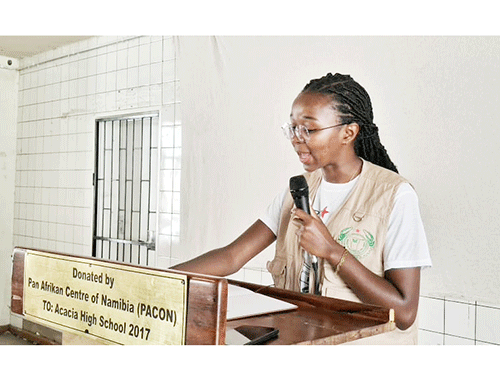
Learners with disabilities are still invisible in national reporting, Nanso said. Presenting Nanso’s official position at a media engagement recently, the organisation’s secretary for basic and secondary education, Lavinia Leonard, said the education ministry has once again released examination results without including disability-disaggregated data.
“For the second consecutive year, results have been reported by region, gender, school type and candidate status, yet remain entirely silent on disability,” Leonard said.
In response, the ministry’s spokesperson, Esther Angula, said,
“Our approach was to report on all candidates collectively, as this reflects an inclusive reporting framework rather than separating learners with special needs. Reporting separately could itself have been interpreted as exclusionary.”Additionally, the ministry would have welcomed the opportunity to engage with Nanso directly.
“They were free to visit the offices or formally request clarification or specific data relating to learners with special needs. Unfortunately, no such request was made prior to the concerns being raised publicly,” Angula continued. According to Nanso, this omission is deeply concerning because it undermines inclusive education accountability and contradicts Namibia’s constitutional values, national education policies and international obligations. Leonard claims that when learners with disabilities are not reflected in national data, their educational realities are effectively ignored.
“The system cannot credibly claim equity when it fails to measure inclusion,” Leonard said.
The student body warned that the absence of disability data is not a minor technical gap but a serious systemic weakness that limits meaningful intervention and planning. Without clear data, it becomes impossible to assess whether learners with disabilities are accessing, remaining in, and succeeding within the education system, it said.
In their statement, Nanso called for the immediate inclusion of separate disability data in all future NSSCO and NSSCAS examination reports. The organisation further demanded the publication of a supplementary report to address existing data gaps.
Leonard said inclusive education cannot remain rhetorical. “It must be measurable,” she said.
Nanso reaffirmed that education is a constitutional right, a public good and a collective national responsibility. Leonard said the organisation will continue to monitor implementation, hold authorities accountable and advocate for an education system that delivers equity, quality and dignity for every learner.
For learners with disabilities, she said, “being counted is the first step toward being included.”
Meanwhile, Angula reiterated:
“We remain committed to transparency, inclusion and constructive engagement with all stakeholders, and we are always open to providing clarification when approached.”