

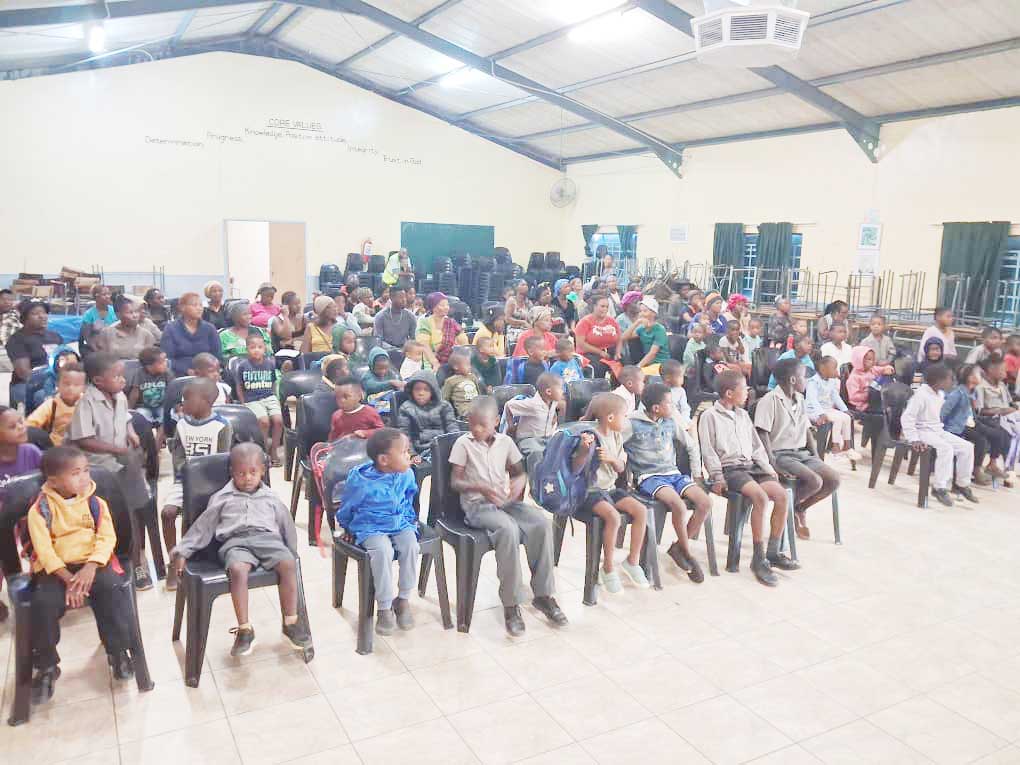

After over a decade of absence, the Khoekhoegowab language is set to return to Moses Garoëb Primary School in Windhoek’s Hakahana informal settlement.
This follows an intervention by the education ministry.
It came after an education inspector in Khomas, Hoster Simasiku’s visit to the school and directed management and key stakeholders to reopen two classrooms offering Khoekhoegowab, a language predominantly spoken by people of Hakahana and the surrounding areas.
Speaking at the gathering yesterday, Simasiku said the ministry heard of the community’s cries.
“Parents, we were told of all your complaints and grievances. But we are here to tell you today that all children in Namibia are valid, and they will be granted two classrooms to teach their home language,” he said.
He said the ministry will direct the construction department in the ministry to construct two classrooms that would offer the language.
“We are going to deliver tables, chairs, chalkboards and all other important materials needed to commence with classes,” he said.
Simasiku further said is important for learners to study their home language at an early stage, as it helps them articulate and preserve culture.
“It’s important that we do everything possible to preserve our languages. All Namibian languages are important, and everyone should be allowed to study their home language. And we want these kids to do their home language until grade 12,” he added.
For years, the school only offered Oshindonga, despite the school being in an area largely populated by Khoekhoegowab-speaking families.
As a result, many learners from other indigenous ethnic groups were forced to adopt Oshindonga as a medium of instruction to remain enrolled at the school, even though it was not their home language.
Namibia’s education language policy promotes the use of the mother tongue as the medium of instruction in Grades 1-3 to strengthen foundational skills and cultural identity, transitioning to English-medium instruction from grade 4, said activist Shaun Gariseb, who is an advocate of indigenous languages. He indicated that there’s a need to assist the Rukwangali community also, “because it is disturbing that their children sit in an Oshindonga class while they can constitute a class and learn of their own; things must be fair.”
One parent who spoke to this publication said the situation had negatively impacted academic performances and self-confidence, as their kids struggle to learn in a language that they are not familiar with.
Reacting to the new development, Valerie !Gaoases, a parent whose child was forced to stay at home for a month due to the language not being offered at a nearby school, says that it’s crucial for Khoekhoegowab to be taught in schools. “We are proud of our mother tongue being taught in schools again. Because our people and kids will continue the preservation of our language,” she added.
Shirley Gannes shared similar sentiments, saying she feels proud because her children will learn Khoekhoegob in schools. “It’s hard to learn other people’s languages. This is a huge step forward in ensuring that our people get to decide what to do in school rather than being forced to take up a language that they don’t understand,” she added.