


Auleria Wakudumo
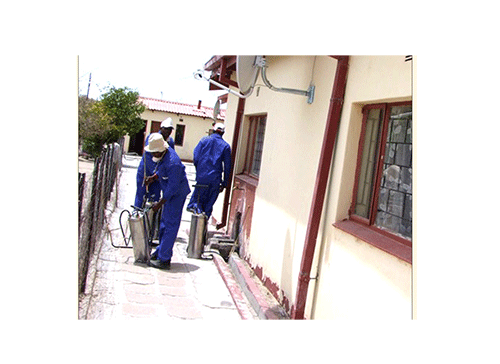
The health ministry says some community members are choosing to use mosquito nets instead of allowing indoor residual spraying (IRS) in their homes.
Health executive director Penda Ithindi said the resistance to indoor spraying is mainly caused by myths and misunderstandings.
“Some people believe mosquito nets work better than spraying, while others think mosquitoes do not die from spraying. In some areas, when spray teams arrive, households lock their structures and refuse access without giving reasons,” Ithindi said.
He said this resistance is not new, but it has become more common in recent years.
Reasons given for refusing spraying include traditional beliefs, preference for mosquito nets, doubts about the effectiveness of spraying and calls for the ministry to employ people from local communities to carry out the spraying.
Despite these challenges, Ithindi said indoor residual spraying is still very important in preventing malaria, especially in high-risk areas.
“Community involvement is very important for the success of indoor spraying and other malaria control programmes,” he noted. He said the ministry has strengthened its community outreach by working with traditional leaders, community members, community health workers and local councillors to raise awareness about malaria prevention. He added that the ministry has increased health education in communities.
Community health workers now give information to households before spraying starts, explaining why IRS is important and safe.
Education programmes are also being used to correct wrong beliefs while respecting cultural practices.
He said regions with high malaria risk, including Kavango, Zambezi and Ohangwena, are receiving special attention.
These regions are being supported with indoor spraying, larviciding and the distribution of mosquito nets.
The ministry is ensuring equal access to health services even in hard-to-reach areas.
“We have funds and transport to reach all malaria-affected regions,” he said.
While many people prefer mosquito nets, the ministry has reminded communities that nets should be used together with other prevention methods.
Ithindi called on communities to cooperate with malaria prevention efforts, saying working together is key to reducing malaria in the country.
The need for effective malaria prevention comes at a critical time. Earlier this month, health minister Dr Esperance Luvindao,highlighted a malaria outbreak in Namibia.
From 1 to 25 January 2026, the country recorded 8 760 confirmed malaria cases.
This is a 68% increase compared to the same period in 2025. There were 604 malaria-related hospital admissions and 11 deaths.
The ministry detected 20 health districts that have surpassed the epidemic threshold and are experiencing malaria outbreaks.
The affected districts include Andara, Nyangana, Ncamagoro, Nkurenkuru, Eenhana, Engela, Okongo, Grootfontein, Katima Mulilo, Rundu, Tsumeb, Otjiwarongo, Omuthiya, Tsandi, Outapi, Okahao, Opuwo, Oshikuku and Oshakati.
The majority of patients with confirmed malaria were reported from Katima Mulilo district, with 1 448 cases, accounting for 17%, followed by Outapi district, with 1 287 cases, accounting for 15%.
– awakudumo@nepc.com.na