


Petrus Muronga
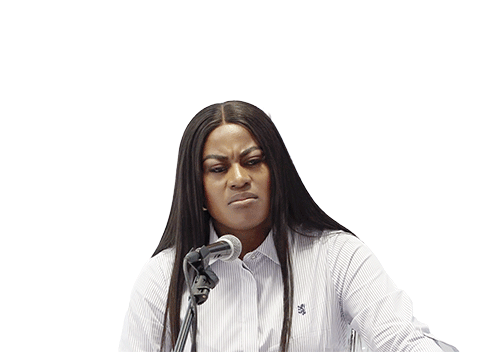
Health minister Dr Esperance Luvindao has warned that poor leadership and weak management systems affecting service delivery across the country will not be tolerated.
Luvindao made the remarks during a ministerial planning and financial management meeting held in Otjiwarongo this week.
“There is no culture of accountability, and that often leads to underperformance, which in turn leads to more underperformance, and ultimately, videos circulating on social media. Accountability is that procurement officer who processes an order for life-saving antibiotics today, not next week, because they understand that a stock-out means that a child will go untreated,” Luvindao said.
She added, “Accountability as a fleet manager, ensuring that an ambulance is not idle for five years because it doesn’t have a tyre. And these are the realities on the ground. These are the realities that we are seeing on a day-to-day basis”.
The youthful minister emphasised that accountability begins at the operational level, citing instances where procurement officers delay processing orders for life-saving antibiotics, resulting in stockouts that leave patients, particularly children, untreated.
She also highlighted inefficiencies in fleet management, pointing to ambulances that remain idle for years due to minor mechanical issues such as missing tyres.
Luvindao also met with regional leadership, including the governor John Julius /Khamuseb and Otjiwarongo mayor Leonard Shimushi, where she revealed that most of the concerns raised by the governor, nearly 95%, were not matters requiring intervention from her office or the executive director.
Instead, she described them as failures of local leadership and management.
Among the complaints was the absence of a basic queue management system at health facilities, where patients wait in line all day only to return the next day without priority.
The minister said implementing such systems does not require approval from the national office but rather decisive leadership at the regional level and raised concerns about reports of doctors arriving late and leaving early, despite repeated complaints to regional authorities.
“That’s a basic queue management system. But we have local leaders, we have regional leaders, and yet the gap is so widely felt that the governor must raise this with the minister. To introduce a queue management system, you don’t need the permission of the minister, and you don’t need the permission of the executive director. You need accountability. You need to take responsibility, she said.
Another complaint raised was doctors leaving, arriving at any time and leaving at any time.
“[They] arrive way past the time that work starts, and then they leave way before their shift ends. And from what I’ve been told from the regional governor, this has been raised with the regional director on multiple occasions, and yet what the regional director says is that nothing has been done,” reiterated Luvindao.
The minister further cautioned against shifting blame solely to budget constraints, saying that while the ministry continues to advocate for more funding and resources, managers must also optimise what is already available.
On procurement, she disclosed that the ministry nearly returned funds to the Treasury intended for essential medical equipment due to administrative delays.
She revealed that without intervention from her office and the executive director, money allocated for equipment would have been sent back, while facilities such as Okahandja Hospital remain without an ECG machine.
The minister described this as unacceptable and a clear example of systemic inefficiency, in which she concluded by calling on all levels of leadership within the ministry to take responsibility for improving service delivery, emphasising that accountability is non-negotiable.
She also noted that strengthening accountability mechanisms will be central to improving healthcare delivery and restoring public confidence in Namibia’s health system.
* Peter Murongo is an information officer at MICT Otjozondjupa.