


As a young learner at Munzii Combined School in Ikaba, I was taught about World War I and World War II as if they were distant legends, dramatic stories of empires, trenches, bombs and broken alliances.
By then, they felt remote, detached from our calm Southern African reality.
I memorised the facts for examinations, but I never truly understood the destructive force of war.
Today, watching the escalating confrontation between Iran and Israel, I finally grasp what those history lessons failed to make real: war does not simply destroy armies, but it dismantles economies, fractures institutions and can erase decades of national progress in a matter of weeks.
Many Namibians may believe that conflicts in the Middle East or Eastern Europe have nothing to do with us.
We are geographically distant, politically neutral and peaceful, but history repeatedly proves that distance does not equal safety.
The lesson emerging from the Iran-Israel conflict is not about ideology or allegiance.
It is about preparedness.
Modern warfare is no longer fought only with boots on the ground.
It is fought with missiles, drones, cyberattacks, intelligence systems and economic leverage.
It is fast, technologically advanced and unforgiving to those who are unprepared.
Nations that treat security as an afterthought often learn the cost too late. In Namibia, defence spending has become a recurring subject of controversy.
Over the years, for example, the national defence budget has increased steadily. Critics argue that the billions should instead be used to address housing shortages, high unemployment, healthcare challenges and education reform.
To me, these concerns are legitimate and emotionally compelling.
However, my experience taught me that none of those sectors can function in an unstable environment.
Infrastructure built over decades can be reduced to rubble in weeks.
Investor confidence evaporates at the first sign of insecurity.
Tourism collapses overnight, insurance risks escalate and currency values fluctuate.
I cannot emphasise enough that security is not a luxury expense.
It is the foundation upon which all other development rests.
Namibia is entering a new era. The discovery of offshore oil and gas reserves and the global interest in our green hydrogen potential have elevated our strategic importance.
Adding to my experience, during my security course, we were reminded that resource wealth has historically attracted foreign interest, and not all interest is benign.
Across different regions of the world, energy discoveries have often preceded geopolitical competition, influenced campaigns and caused internal destabilisation.
To assume that Namibia is immune simply because we have enjoyed relative peace after independence in 1990 would be dangerously naïve.
In an age of cyber warfare, economic sabotage and hybrid threats, conflict does not always announce itself with tanks at the border.
It can emerge quietly through digital systems, financial manipulation or internal political interference.
Some of the parliamentary resistance in Namibia to increasing defence allocations reflects understandable domestic pressures, yet strategic foresight demands a longer-term perspective.
We need to understand that, at all costs, defence procurement and capability development cannot be reactive.
This is because advanced systems require years of planning, acquisition, training and integration.
I, therefore, conclude that falling behind is not merely a budgetary delay.
It is a strategic vulnerability.
The Iran-Israel confrontation demonstrates that deterrence depends heavily on technological superiority and readiness.
Countries that invest consistently in defence signal resilience, and those that hesitate signal weakness.
This may sound unsettling, but Namibia cannot afford complacency.
Security must be viewed not as an optional expenditure but as national insurance.
As I reflect on those childhood history lessons, I now understand that war is never just a story from elsewhere.
It is a reminder of how quickly stability can unravel.
Namibia has worked tirelessly to build democratic institutions, attract investment and position itself as a stable African state.
All that progress rests on one fundamental pillar: security.
The unfolding Iran-Israel conflict is not merely foreign news but a warning.
Peace is not maintained by hope, but it is protected by preparedness.
Namibia must decide whether to invest in resilience today or face regret tomorrow.
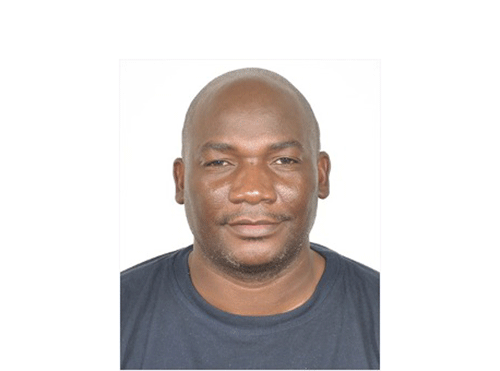
*Dr Kennedy Mabuku is a criminal justice lecturer at NUST with a master’s degree in security and strategic studies. These are his personal views. He can be reached at kennedymabuku@yahoo.com.