

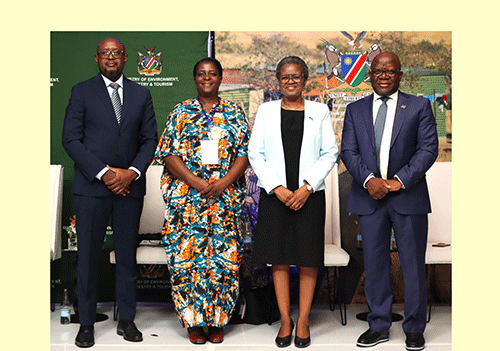

Adolf Kaure
The National Conference on Community-Based Natural Resources Management (CBNRM) generated a total of N$109 million for the Namibian economy in 2025. The programme was recently launched in Windhoek.
The minister of environment, forestry and tourism, Indileni Daniel said the CBNRM programme aims at promoting sustainable rural livelihoods while having regard to the sustainable use of the country’s fragile natural resource base.
Daniel attributed the community-based natural resources management programmes’ injection into the Namibian economy to the formation of crucial public-private partnerships. “The CBNRM programme is the manifestation of the strong partnership and collaboration between government; civil society, represented through the Namibia Association for CBNRM Support Organisations; the private sector; traditional authorities; and the community-based organisations,” said Daniel. She added: “It is because of this partnership that we have been able to record achievements in this programme.”
The minister added that while the CBNRM programme mainly aims to empower rural communities, its overall economic influence on Namibia’s gross domestic product is significant.
“Community conservation has boosted the national economy through tourism, conservation hunting, timber and non-timber forest resources, and other natural resource management enterprises,” Daniel said.
Additionally, the ministry’s executive director Sikongo Haihambo explained how Namibia’s internationally acclaimed CBNRM programme is working towards restoring the link between conservation, rural development and achieving biodiversity conservation within the framework of national development plans and poverty reduction strategies.
“Through the CBNRM programme, Namibia can restore, secure and enhance the biodiversity and ecosystem processes that support sustainable benefits to conservancies. Much of the tourism to Namibia is based on wildlife viewing, our forestry, beautiful landscape, wetland areas, culture and enjoyment of the country’s wide-open spaces. CBNRM, therefore, plays a major role in our conservation and tourism in our country,” said Haihambo.
To date, 87 communal conservancies and 48 community forests have been registered.
They employ over 2 591 employees, including the game guard programme which employs 742 game and forest guards. They play a significant role in collecting data and monitoring wildlife resources and other natural resources.
CBNRM programme helps to better position communities in their management of conservancies, community forests and community associations for improved benefits.
As of 2024, communal conservancies cover 186 000 km², which is about 60.7% of all communal land. It is also estimated that 244,000 residents, of which 7 384 residents supported by the Kyaramacan Association live in Bwabwata National Park and 468 residents supported by the ≠Aonin Community Association live in the Dorob and Namib Naukluft National Parks, while 900 residents supported by the Gobaob Hai//om Community Association lives in the Etosha National Park, and the Aus Community Association.
Legal framework
Daniel further highlighted the importance of community empowerment and promoting community ownership over their natural resources, saying it remains a strong policy foundation on which the CBNRM policy is premised.
“Since its inception, the devolution of rights to communities at birth through the legislative amendment in 1996 remains the cornerstone of the Namibia CBNRM programme.
We have witnessed remarkable wildlife recovery in our rural areas. We continue to witness the return of iconic species such as cheetahs, elephants and black rhinos which were in some areas previously decimated by drought, poaching and the lack of incentives to local communities,” Daniel emphasised.