

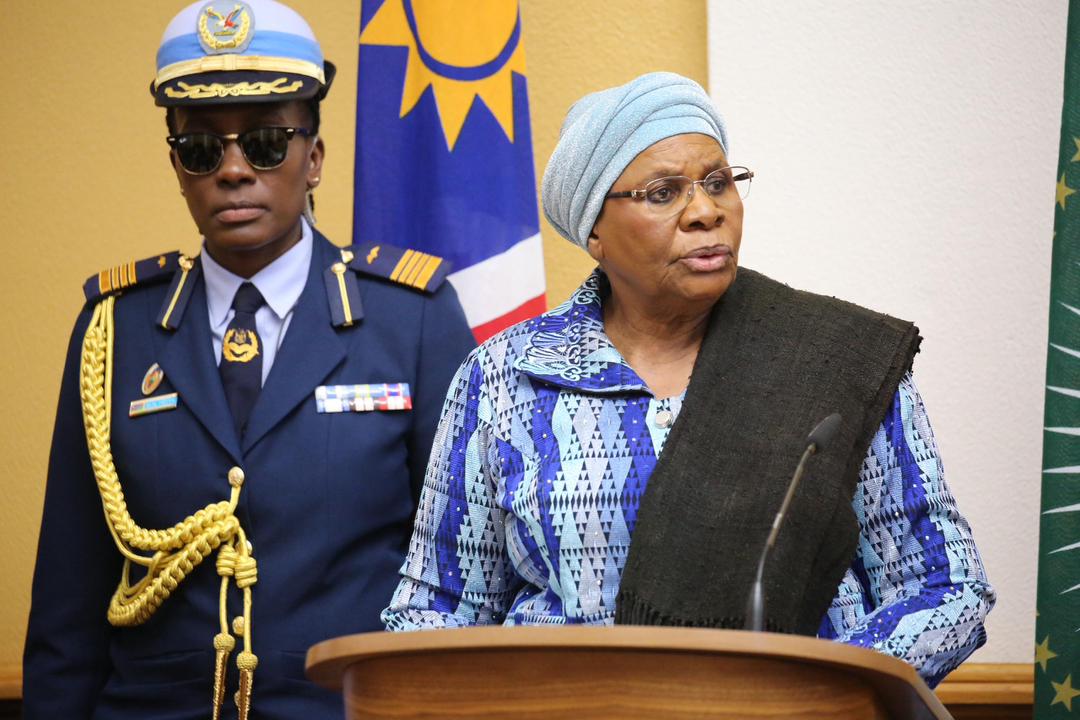

Rudolf Gaiseb
President Netumbo Nandi-Ndaitwah says that the reportedly disappearing funds at the Government Institutions Pension Fund (GIPF) and losses reported at the Bank of Namibia (BoN) are “smelling of corruption” and must be investigated.
Nandi-Ndaitwah said this during the questions and answers sessions, shortly after delivering her State of the Nation Address (SONA).
She re-emphasised to the parliamentarians and the citizenry that corruption should be equated to treason, citing that it undermines Namibia’s development and threatens peace and stability.
“The fight against corruption is not only that of the government but a collective responsibility for all Namibians. Let us join hands in the fight against this social ill,” she said.
“Pension money just disappears, worth billions of Namibian dollars… money of workers’ pensions,” he said.
Affirmative Repositing leader Job Amupanda noted the central bank again, also for “unexplained reasons”, made a loss close to a billion dollars.
Local reports indicate, indeed, the bank lost N$892 million for the year 2025.
What is peculiar, though, is BoN recently paid a N$200 million dividend to the government, calling the credibility of some of these reports into question.
“It appears as if we don’t have a problem with money in the country; there’s plenty of it except it goes into the wrong holes,” Amupanda said.
Amupanda suggested that those involved should be held accountable.
Meanwhile, official opposition leader Immanuel Nashinge was among those who called for more funding for the Anti-Corruption Commission (ACC). The president argued that “millions and millions” in funding would not work without a “serious psychological and mental reform” among citizens and officials.
The session was governed by parliamentary standing rules, with questions generally grouped into sets of four to allow the president to respond systematically.
Additionally, Popular Democratic Movement president McHenry Venaani pushed for an irrigation policy and industrialised agriculture to solve youth unemployment.
In response to this, Nandi-Ndaitwah highlighted the acquisition of a “super farm” and the intention to move toward agro-processing to create sustainable jobs.
Venaani also criticised the German government for practising what he termed “apartheid atonement”, noting they pay significantly more to Jewish victims than what is proposed for Namibians.
The president responded that the Joint Declaration had been reviewed to ensure it remains “open”, allowing for continued negotiation rather than “closing the chapter”.
Namibia and the German government have been negotiating genocide, apology, and reparations for the 1904–1908 Ovaherero and Nama genocides for 10 years.
A conclusion is now within reach, possibly before the year’s end, the president noted.
Resettlement
The resettlement programme was described by Swanu MP Evilastus Kaarando as a “big fat joke” due to underutilised farms.
Kaaronda has emphasised the need for “genuine structural change” in the economy, arguing that 36 years after independence, land reform has not sufficiently addressed poverty and inequality, leaving many Namibians in the subsistence sector.
He urged that the resettlement process should not just grant land but also empower farmers to be productive, suggesting a need for better post-resettlement support.
The president acknowledged that individual resettlement had proven more successful than group resettlement and promised to review specific cases of damaged infrastructure.
In this regard, 24 farms were purchased in the 2025/26 financial year at a cost of 238 million.
Ten farms for the National Resettlement Programme, 11 farms for generational farm workers and farmers in corridors, 2 farms for the resettlement of Batswana of Namibian descent and 1 farm in the vicinity of the Neckertal Dam.
Fifty-two people were resettled during the period under review.