


Iuze Mukube
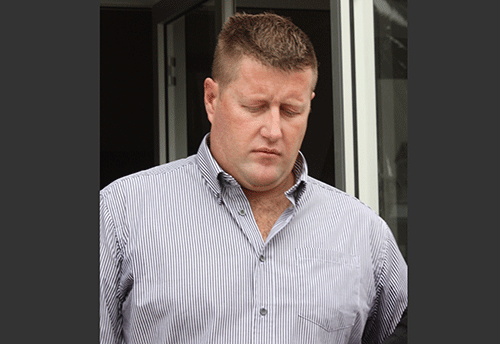
Contending that a different court may come to a different conclusion against his conviction, convicted murderer Jandre Dippenaar is seeking leave to appeal to the Supreme Court.
He became the first in the country to be convicted and sentenced for murder because of dolus eventualis, instead of culpable homicide, in a case resulting from a motor vehicle collision.
In his heads of argument, Dippenaar argues that there are reasonable prospects that another court could arrive at a different finding, particularly in relation to the evaluation of the evidence and the inferences drawn during the trial.
He is, therefore, seeking leave to challenge a High Court judgement that denied his appeal for both the conviction and sentence, which was handed down in the Swakopmund Regional Court.
Like the grounds in the appeal, he contends that the court ignored, rejected or attached less weight to the evidence of expert witnesses as opposed to eyewitness testimonies.
Dippenaar contends that the application is directed principally at the High Court’s approach to “the evaluation of defence expert accident-reconstruction evidence on point/place of impact (including gouge/scuff/physical indicia) vis-à-vis eyewitness accounts”.
Additionally, it is based on the approach to “whether, on the facts properly evaluated, the State proved murder with dolus eventualis beyond a reasonable doubt and whether another court could reasonably come to a different conclusion”.
He argues that the dilemma which confronted the regional court was that it was not privy to the two drivers’ view of the unfortunate event, as the applicant, who survived, has amnesia and the other passed away. However, the evidence that was in the trial court from the State and the defence witness pointed in opposite directions of what really happened that day.
Dippenaar added that, despite the State’s allegation, it led to no evidence depicting a particular state of mind pointing to a possible motive of suicide on his part.
He argued that what rendered the State’s being more problematic is that it had to show that the cause of the accident was indeed what it suggested, including that the applicant intended to commit suicide, beyond a reasonable doubt.
Therefore, the State had to show that the defence’s version without a reasonable doubt could not have been the cause of the accident.
The State’s case relied heavily on eyewitness testimony to support the charge of reckless driving against the appellant, alleging that his driving of the FJ Cruiser on 29 December 2014 contributed to the fatal collision on the Swakopmund-Henties Bay road.
However, the applicant argues that the single witness on this count was unreliable, as his testimony was riddled with significant discrepancies.
The same was said of various witnesses, particularly the testimony of Antonia Joschko, the sole survivor of the other vehicle in the collision accident.
Dippenaar argues that while Joschko testified that her father was driving carefully that day, video evidence shows that her father was swerving across lanes, entering the incorrect lane at bends and driving at a speed of more than 100 km.
Dippenaar argued that Joschko’s testimony is unreliable due to her concussion, emotional bias to protect her father’s memory, and contradictions with objective evidence.
“The gouge mark, confirmed by defence experts as the point of maximum engagement, is in the northbound lane, indicating the Ranger [vehicle driven by her father] was in the wrong lane at impact,” he said.
This contradicted her testimony that the Cruiser [driven by the appellant] caused the accident by speeding into the Ranger’s southbound lane.
Dipenaar added that this was also contradicted by photographic evidence, the gouge mark’s location in the northbound lane, defence expert testimony and Tracker data, rendering it unreliable for establishing causation.
He contends that the court erred in relying on Joschko’s inconsistent testimony over objective evidence, including the gouge mark’s location, Tracker data showing the Ranger’s excessive speed and lane deviations, and photos disproving a hill, all suggesting the Ranger’s position caused the collision.
“Speculation, mere theories, or hypothetical suggestions cannot avail the State in that what is suggested by the State as a probable cause of the accident cannot even be a possibility having regard to the real evidence,” he said.
Dipenaar requested for leave to be granted because there are reasonable prospects that another court may find that “there was a material misdirection in the approach to expert evidence versus eyewitness evidence on the critical hinge fact – the point of impact/lane of travel at impact”.
In addition, it may find “that the inference of subjective foresight and reconciliation (dolus eventualis) was not the only reasonable inference on the proven facts”.
In this premise, he submitted that another court may conclude that he cannot be convicted, beyond a doubt, on any of the remaining charges and be acquitted.
Dippenaar was represented by Albert Strydom, and the State by Ethel Ndlovu.