

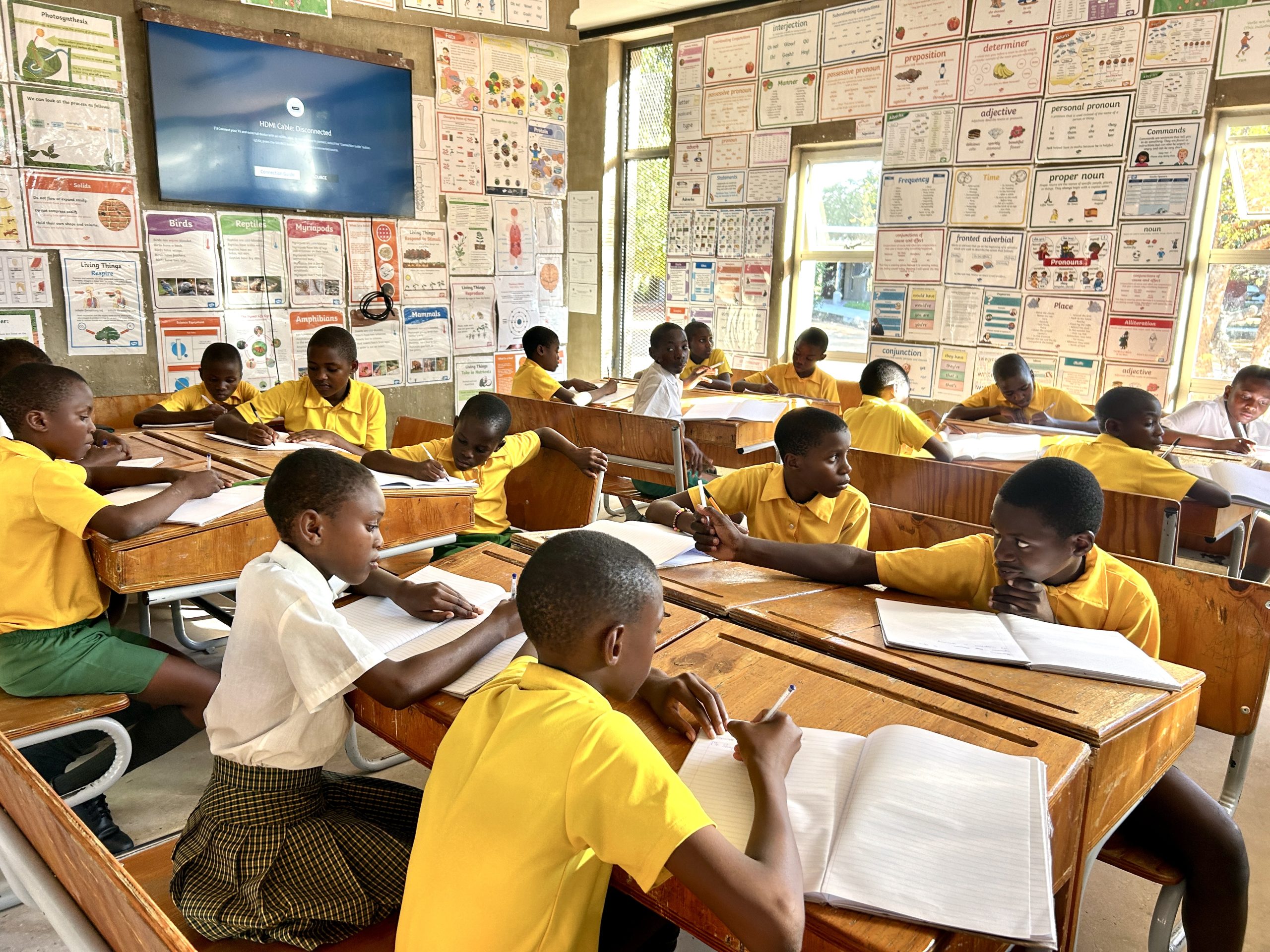

BUNYA – The Rossing Foundation invested over N$14.7 million in education and community projects in 2025.
The funds were aimed at supporting learners from disadvantaged backgrounds and helping communities improve their living conditions.
The funding was used on several completed projects, including N$1 million for scholarships at institutions such as Namibia University of Science and Technology (Nust), Namibia Institute of Mining and Technology (NIMT) and University of Namibia (Unam); N$2 million for private school support, including Nakayale Academy; N$900 000 for assistive technologies; N$154 000 for science laboratory equipment; N$100 000 for science fairs; N$200 000 for regional awards and N$74 000 for teacher support.
Other completed projects include N$2.6 million for solar-powered water systems, N$43 542 for cleaning campaigns, N$100 000 for youth awards, N$250 000 for food production, N$50 000 for farmer support, N$250 000 for research, and N$539 522 for a mobile science laboratory.
Rössing Foundation spokesperson Laina Hakweenda said the aim is to support children and communities in a practical way.
“We are working to improve the lives of children from disadvantaged communities by giving them access to education. We also support communities so they can work for themselves and improve their lives,” she said.
Hakweenda added that the foundation has always made it a priority to reach the most remote and marginalised communities.
“Rössing Foundation has always made it an aim to scope out the most remote and marginalised territories and communities whose lives we can transform. Our efforts in 2025 are continuous, and as we move into 2026, we have expanded our work towards Nakayale [private school], and Bunya combined [school],” she said.
Nakayale Private School in Ruacana is a unique institution that caters mainly to orphans and children from disadvantaged and marginalised communities.
Due to the vast and rocky landscapes of parts of Kunene and Omusati regions, where access to schools is limited or non-existent in some areas, Nakayale has become a refuge for many children.
The school has a high number of learners from marginalised ethnic groups, particularly Ovazemba and Ovahimba communities, who often travel from remote settlements where educational facilities are scarce.
Many of the learners at the school have no stable homes, and some were identified and placed there based on their living conditions.
School head Veronica Nambondi said the school depends on such support.
“We are a private school, and we largely depend on scholarships and donations from NGOs and partners such as the Rössing Foundation. The N$2 million we received has helped us in many ways, from food, clothing and accommodation to maintaining the school and taking care of the children,” said Nambondi.
She said that for many learners, the school is their only home.
“Some of these children call this place home. They do not go anywhere during holidays because they have nowhere else to go. We take full responsibility for their wellbeing, their education, behaviour, and overall development,” she added.
Nambodi said the school continues to perform well academically.
“Our results are very good, and we are proud of what these children achieve. After Grade 9, we place them at private schools such as Oshikuku Private and Oshigambo Secondary, and we continue to support them,” said Nambondi.
The school environment reflects this care, with clean facilities, organised hostels and disciplined learners.
Pupils reflect
For learners, the support has changed their lives.
“I lost my parents, and this school took me in. I am very lucky to be here. I have everything I need, and I am learning at one of the best schools. If I were not here, I could have been on the streets,” said one of the learners.
Another learner from a marginalised community said education has opened new opportunities.
“Where I come from, education is not taken seriously. Now I am in Grade 7, doing well, and I am proud of myself. I am not like many children back home,” she said.
While such support is making a difference in some schools, challenges remain in others.
At Bunya Combined School in Kavango West, some learners are facing serious difficulties.
The school is overcrowded, with too many learners in one classroom, and many walk long distances of 30 to 35 kilometres from and back to school every day.
Bunya principal Wellem Kotokeni said the situation is difficult.
“Our school is overcrowded, and we need more classrooms. We also need a hostel for learners who walk very long distances,” he said.
The long distances affect learning and some learners arrive late, especially during tests and exams, said the principal and added they get tired, and it affects their performance.
Kotokeni said the school has tried to assist some learners during exams.
“We accommodate some of them at school using tents, with help from parents, and this has helped improve their results,” he said.
Kotokeni added that they appreciate the support from the foundation.