


Dmitry Lobach, Ambassador of Russia to Namibia
9 May is one of the main public holidays in Russia marking the victory of the Soviet Union over Nazi Germany in the Great Patriotic War 1941-1945. It is a tribute to the 27 million Soviet citizens – those who perished in the battlefield, starved to death in besieged Leningrad, and were burned in concentration camps by Germans and their collaborators. This is the day, when heroic deeds of multinational Soviet people are remembered and honoured in Russia and around the world.
The Great Patriotic War constituted the principal theatre of World War II. 80 per cent of Germany’s military forces fought against the Soviet Union. This fact alone indicates that there can be no doubt about the decisive contribution of the Soviet people to the victory over Nazis.
The Soviet Union’s long road to victory, culminating in the fall of Berlin in May 1945, was paved with the lives, sacrifice and heroism of the Red Army soldiers and officers. We may recall the defence of the Brest Fortress in June–July 1941, the stand of the legendary 28 soldiers of General Panfilov’s division who stopped 18 enemy tanks from breaking through to Moscow in November 1941, the feat of Alexander Matrosov, who closed the embrasure of an enemy firing point with the body to enable his unit to advance, and countless other examples of courage.
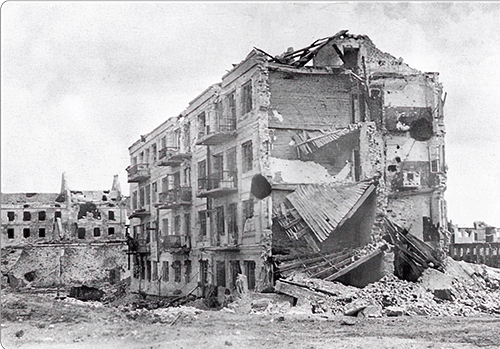
Among them, the heroic defence of Pavlov’s House during the Battle of Stalingrad in autumn 1942 is of particular importance. The battle itself marked a turning point in the Great Patriotic War.
There was fierce fighting for every inch of land, every building and even every floor in Stalingrad. The Red Army platoon under the command of Sergeant Yakov Pavlov defended a four-storey building surrounded by superior enemy forces. Their mission was to prevent German troops from advancing towards the Volga River. The loss of the position would have opened the way to the capture of the whole city.
For several weeks, 31 fighters of various Soviet nationalities — Russians, Ukrainians, Georgians, Uzbeks, Kazakhs, Tajiks – held the line. The building was transformed into a fortified stronghold. The Germans launched repeated assaults supported by tanks, artillery, mortars and air raids. The defence lasted for nearly two months.
Marshal Vasily Chuikov, commander of Soviet forces in Stalingrad, noted that the defenders of Pavlov’s House destroyed more Nazis than Germany lost during the battle of Paris in 1940. For comparison, France resisted the Hitler troops for 42 days, while the defence of this single building in Stalingrad lasted for 58 days in a row.
This episode remains an enduring symbol of the resilience and courage of the Soviet and Russian people, testifying to an unbreakable will to win, as well as national unity and patriotism. The building, scarred by shelling, has been preserved as a memorial and continues to inspire future generations today.
The Soviet victory in Stalingrad came at an enormous human cost: half a million Soviet soldiers lost their lives, and many more were wounded. Yet it proved to be a decisive turning point in the war, marking the moment when Hitler’s war machine was broken. The German army backed by Italy, Romania, Hungary and Croatia troops suffered immense losses with hundreds of thousands killed, wounded, or taken prisoner.
Outcome of the Battle of Stalingrad had a huge impact on World War II. In particular, Japan had to change its plans to enter the war against the Soviet Union on Germany’s side, while the anti-Hitler coalition further consolidated.
In Russia, we remember and honour all those who fought against Nazism for the liberation of the whole world — including soldiers of the US, the UK, members of the European Resistance, Yugoslav and Greek partisans, and others who contributed to the defeat of Nazi Germany. However, it is widely acknowledged that the victory of 9 May 1945 would not have been possible without sacrifice, endurance, and heroism of the Soviet people.
The victory over Nazism transformed the world order – the UN was established, laying the foundations of the modern system of international relations. The post-war period witnessed the rapid dismantling of colonial regimes and the emergence of a large number of independent states across Asia, Africa and other regions.