

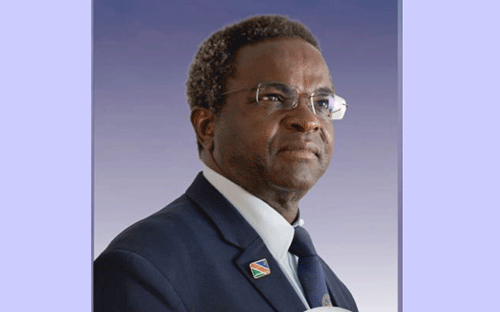

Rudolf Gaiseb
Andreas Thomas
Independent Patriots for Change leader Panduleni Itula has rejected the Petroleum Amendment Bill and called for its immediate withdrawal.
Petroleum governance must be built on constitutional accountability not Presidential centralism, Itula said.
It is also Itula’s conviction that, “Our duty is not merely to pass bills in the August house, but to build a legacy of transparent, accountable and sustainable resource management for generations of Namibians.”
Itula yesterday said that Namibia is on the cusp of becoming a petroleum-producing nation and must avoid well-documented failures.
Last week, mines and energy minister Modestus Amutse dismissed prevailing fears that placing the oil and gas sector under the Office of the President will weaken his ministry or concentrate excessive power in the hands of the president.
The Petroleum (Exploration and Production) Amendment Bill seeks to transfer core upstream petroleum powers from the responsible minister to the president as well as the control of the Upstream Petroleum Unit.
“We need not look only to other countries for warnings. Namibia’s own experience in the fishing sector shows what happens when oversight fails and decisions are made behind closed doors. Our duty is not merely to pass a bill but to build a legacy of transparent, accountable, and sustainable resource management for generations of Namibians,” he said. Itula then implored all lawmakers, irrespective of their political parties or ideologies, to reject the bill in its entirety. Moreover, Itula noted that investors price political and regulatory risks, and if Namibia shows that upstream governance can be structurally reshaped without clear reasons, safeguards, and accountability, capital will hesitate, projects will slow, jobs will disappear, “growth will be delayed, and our economy will stagnate.”
Itula said that a system where licensing administration and strategic upstream policy are tied to direct presidential control increases the risk of arbitrariness, politicisation and costly legal contestation.
“The Bills make the true decision-maker vague and weaken parliamentary oversight,” he noted. Itula then called on parliamentarians to withdraw and seek a legal opinion in addressing questions around the bill’s constitutionality and its implications, if any, on the separation of powers doctrine.
He also urged the lawmakers to provide a governance model that preserves a clear and accountable line-ministry mandate, professional upstream administration under ministerial responsibility, and transparent appointment, reporting, and review mechanisms consistent with the Constitution.
Defence
Meanwhile, Amutse also dismissed prevailing fears that placing the oil and gas sector under the Office of the President will weaken his ministry or concentrate excessive power in the hands of the president.
Instead, he argued that the move is aimed at strengthening governance of a strategically important part of the emerging oil and gas industry.
“Definitely, the objective of the new bill is an amendment to the Petroleum Act, and that amendment is seeking to transfer certain powers of the Minister of Industries, Mines and Energy to the petroleum unit, which is actually the upstream unit,” he described.
Amendments
However, opposition lawmakers have warned that the amendments risk undermining accountability and upsetting the balance of power between the executive and legislature.
Official opposition party leader Imms Nashinge supports Namibia becoming a petroleum-producing nation but stands indifferent with the administration on the matter of power transfer that “may corrupt systems”.
“Our first and most fundamental concern is the constitutional principle of the separation of powers… While framed as creating efficiency, this consolidation risks creating a regulatory monolith where technical oversight, political authority, and commercial negotiation become dangerously intertwined,” he said.
Popular Democratic Movement president McHenry Venaani also expressed agitation over the “executive” president mingling with investors. He noted that this proposition negates the power and function of ministers and may create a legislative overhaul where the president of the country may minister in the country’s ministries.
“Let’s not give the power that belongs to ministers to the president. The president doesn’t need it. The president is the executive power of this country. She does not need legislation to be an executive power of this country. The country has given her that power,” he debated.
He added that the architecture of the system is an embedded system and does not need to change.
“Tell us what is wrong with the oil being under the ministry of mines and energy. We have appointed someone whom we want to appoint as the director general. Do you want us to go toe-to-toe? Does the person know the oil industry? Can that person go to OPEC and go and articulate the Namibian position openly?” he questioned.
Additionally, Swanu lawmaker Evilastus Kaaronda agreed that the proposed bill has far-reaching repercussions and needs a robust interrogation before the proposed powers are handed over.
Unshaken
Amutse, however, insisted that the fears are misplaced and that Nandi-Ndaitwah will not be involved in the day-to-day management of the sector.
He said operational authority would rest with the Upstream Petroleum Unit, established through legislation and led by a director general and deputy director general.
“The functions of the unit will be actually vested in the director general, deputy director general and their staff,” Amutse said.
“The unit is going to be transferred to the director general of the upstream unit, who will then report to the president, just like all director generals do and the ministers do.”
– Nampa