

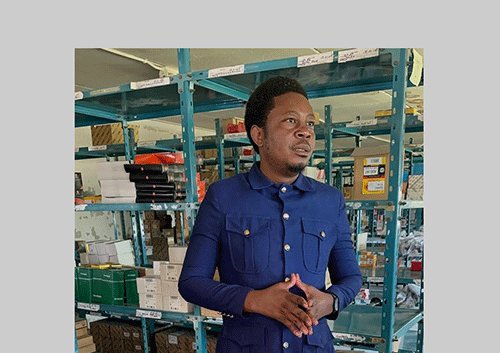

ONDANGWA – Deputy Minister of Works and Transport Hans Haikali has renewed calls for stronger collaboration between government garages and vocational training institutions, urging practical partnerships that directly benefit young Namibians entering the job market.
Speaking during a visit to the government garage in Ondangwa last week, Haikali emphasised the need to bridge the gap between training and employment through structured, hands-on exposure.
“We must ensure that our young people are not only trained in theory, but are also given real opportunities to apply their skills in working environments,” he said.
Haikali highlighted the role of the Namibia Training Authority (NTA) in coordinating vocational education and aligning training with national development priorities.
He said collaboration between the NTA and government workshops can strengthen technical competencies while improving graduates’ readiness for the labour market.
“Government garages should not operate in isolation. They must become active training spaces where students gain experience that prepares them for employment,” he added.
Haikali further encouraged the absorption of graduates from Vocational Training Centres (VTCs) into government systems, describing them as a valuable pool of skilled labour.
“These graduates are already equipped with practical knowledge. What they need is opportunity and exposure to contribute meaningfully,” he said.
The deputy minister reaffirmed that government remains committed to strengthening such partnerships.
“We are determined to align training with the needs of our economy and ensure that no young person is left behind when it comes to skills and opportunities,” he said.
Two students currently undergoing practical exposure at a private company, M-fire Investment cc, welcomed the initiative, saying such opportunities would provide critical industry experience, but it is just that it is not that easy to get an opportunity at government garages.
A second-year automotive student, Maria Nakale, said the programme has improved her confidence.
“Being here has taught me things we do not always cover in class. I now understand how real workshop operations work,” she said.
Another trainee, Paulus Amutenya, noted that working alongside experienced technicians has sharpened his skills.
“We learn faster when we are in a real environment. It prepares us for what employers expect,” he said.
A graduate from Rundu VTC, Johannes Shilongo, who recently completed his training in diesel mechanics, said access to such opportunities could ease the transition into employment.
“After graduation, it is not easy to find work without experience. Programmes like this can help us prove ourselves,” he said.
The NTA, established to regulate and promote vocational education and training in Namibia, plays a central role in creating pathways for skills development.
Through accreditation of training institutions, funding support, and industry partnerships, the authority has been instrumental in expanding access to technical education and improving the quality of training across the country.
Over the years, the NTA has prioritised work-integrated learning, encouraging institutions to partner with both public and private sectors to ensure trainees gain relevant, practical experience.
Its initiatives aim to address the country’s skills shortage while creating employment opportunities for youth.