

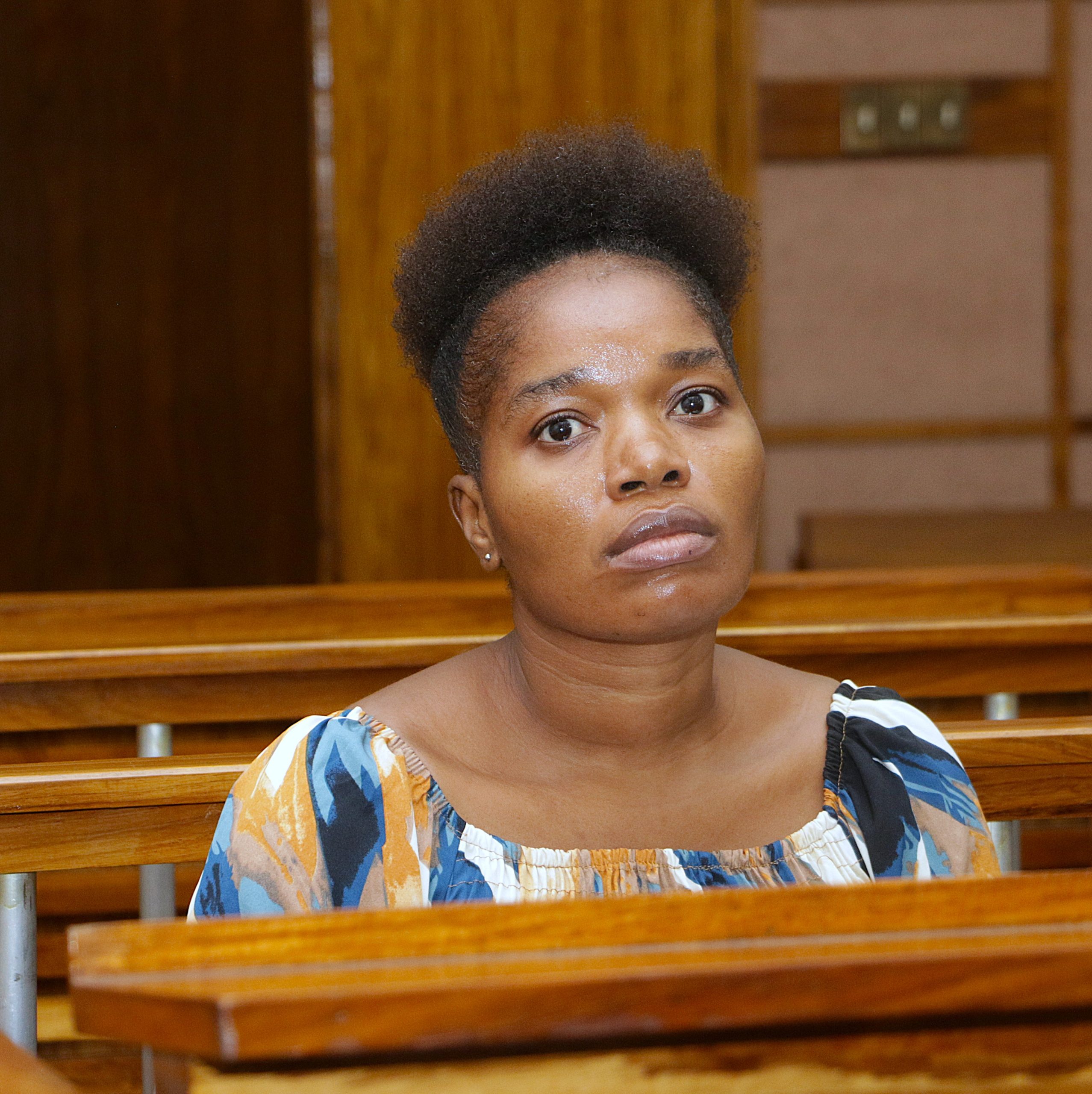
Iuze Mukube
The disclosure of additional evidence in the trial of three people accused of murdering, dumping and burning the body of a nine-year-old child has attracted
strong objections from the defence.
Defence lawyers Milton Engelbrecht, Mbanga Siyomunji and Joseph Andreas objected to the introduction of the evidence on Tuesday, arguing that it was disclosed late and could prejudice the accused’s right to a fair trial.
The lawyers represent Caroline Nkata, her husband Edward Nkata and Rachel Kureva, respectively.
The Zimbabwean couple and the biological mother of the deceased face charges including murder, violating a dead body, defeating or attempting to defeat the course of justice, and fraud; alternatively, uttering a forged document, forgery and contravening the Immigration Control Act.
The charges are in relation to the death of Akundaishe Natalie Chipomho in Windhoek between 23 and 25 January 2020.
The matter arose from the State presenting additional documentation in support of its intention to introduce data extracts and communication from the cellphones of the accused persons as evidence.
The additional documentation includes a calibration certificate and operator certificate relating to the extraction of cellphone data.
Engelbrecht, representing Caroline, stated that the State potentially evoked an incorrect section of the Criminal Procedure Act for cellphone date extraction.
Engelbrecht added that the core issue is not singularity but also whether the defect taints the legality of the search and admissibility of the evidence.
The lawyer added that the unlawfulness stems from a defective search warrant, issued under an incorrect statutory provision and in a manner that failed to comply with the mandatory safeguards as prescribed by law.
He submitted that the evidence obtained under an incorrect statutory provision is unlawful and inadmissible under constitutional standards.
Consequently, Engelbrecht stated, the entire search or process becomes a nullity, adding that the admission of such evidence would render the trial proceedings unfair and in breach of the accused’s fundamental rights. Edward, represented by Siyomunji, shared the same sentiments.
Siyomunji opposed the extraction analysis in respect of the Samsung cellphone of his client. He argued that extraction was done without his clients’ consent and obtained without a court order.
Andreas, representing Kureva, also objected to data extracted from his client’s cellphone on the ground of the authenticity of the data extracts report.
Firstly, the warrant officer was not the author of the document, and the State did not establish the proper chain of custody in relation to the confiscation of the cellphone and the SIM cards of Kureva, to the point of data extractions.
Andreas contended that the State cannot account for how the warrant officer came into possession of the SIM cards.
The State additionally did not disclose to Kureva the operator’s certificate and calibration certificate of the device used to extract data from her SIM cards, the lawyer said.
It is also Andreas’ fervent position that the State must prove that the device is properly approved in accordance with the law and that it became clear there was no such evidence.
He further argued that there is no evidence that the qualification of the operator is accredited or recognised by the Namibia Qualification Authority.
He added that there is no reason provided by the State as to why they withheld the calibration certificate and operator’s certificate from Kureva, and as such, it will be unfair to disclose any certificate at this stage of the trial.
He further added that his client’s right to privacy was violated because the state did not have a search warrant or the accused’s consent as per the Criminal Procedure Act.
He added that for the State to use a “wrong section” means that the warrant officer did not have authority in law to pass on lawful instructions to the operator of the device.
He submitted the data extract report to be ruled inadmissible.
While the State maintained there was no need for the matter to descend into a trial within a trial, the defence argued that it was necessary, saying that they could not allow the court record to be contaminated with inadmissible evidence.
They further argued that the State cannot disclose additional information after the trial has already commenced.
Yesterday, Judge Philanda Christiaan ruled that the matter will descend into a trial within a trial to determine the admissibility of the evidence.
The matter was postponed to 3 June 2026 to determine dates for the trial-within-a-trial.
–mukubeiuze@gmail.com
Photo: Heather Erdmann