

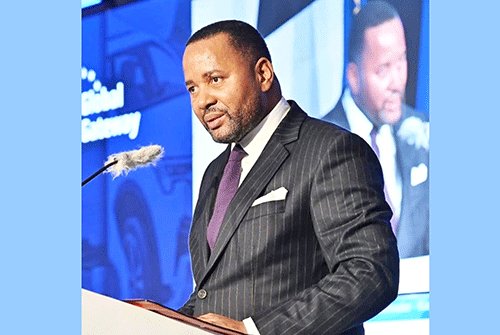
The 2nd Namibia–EU Business Forum, held in Windhoek last week, underscored a deepening and strategically reoriented partnership aimed at steering Namibia’s economy “Towards Stronger, Greener and More Diversified Economies.” The forum highlighted Namibia’s deliberate pivot from primarily exporting raw materials to developing value-added industries, building on established trade links that saw Namibian exports to the European Union reach US$1.26 billion (more than N$20 billion) in 2025.
Organisers and speakers positioned last week’s forum as a platform for accelerating investment, industrial cooperation and skills development, signalling a mutual commitment to sustainable growth.
High-level attendance and keynote interventions reaffirmed political support on both sides for a cooperation agenda that moves beyond commodity exports toward manufacturing, technology transfer and job creation across multiple sectors.
The outcome of the 2nd Namibia–EU Business Forum will ultimately be judged by tangible follow-through in terms of investment commitments, joint ventures, technology transfers and measurable job creation. With both political momentum and clear sectoral priorities, Namibia and the EU have signalled a shared intent to broaden and deepen their economic partnership, aiming to convert historical trade ties into a forward-looking agenda for industrialisation, green growth and inclusive employment.
Alfredo Tjiurimo Hengari, Namibian Ambassador to the EU, framed the event as a continuation of earlier engagements, from COP27 to the first EU–Namibia Business Forum in Brussels in October 2023, and emphasised that the partnership is increasingly shaped by investment, industrial cooperation, innovation and vocational skills development.
“Crucially, our partnership is increasingly being shaped by investment, industrial cooperation, innovation and skills development. The programme ahead reflects these shared ambitions. Over the coming days, discussions and engagements will focus on green hydrogen and renewable energy, critical raw materials, agribusiness, automotive manufacturing, culture and creative industries, vocational education and training, investment promotion, and industrialisation”, said Hengari during the opening of the forum.
The traditional trade landscape underlines why the EU remains central to Namibia’s strategy. In 2025 Namibia’s exports to the EU represented a substantive portion of the country’s export earnings.
The majority of EU-bound Namibian exports are channelled through a handful of member states, notably Belgium, Spain, the Netherlands, France, Italy, Germany and Portugal, reflecting concentrated market linkages that both sides are now seeking to broaden and deepen through diversification and value-addition.
Moreover, last week’s forum’s discussions and matchmaking sessions were squarely focused on translating political will into commercial outcomes.
Delegates and panellists stressed that success will be measured by deals struck, investments unlocked, industries created and skills developed.
Namibia’s leadership signalled that the country is open for business, but that future engagement must deliver structural transformation rather than business as usual.
For investors, the forum spotlighted opportunities in emerging green sectors as well as processing and downstream activities related to critical raw materials and agribusiness.
For policymakers and development partners, the event underscored the urgency of complementary reforms, workforce training and infrastructure investments required to convert interest into sustainable industrial projects.