
Thirty-five years after independence, Doreen Muhau Kuwaya still stands as a liberation icon and heroine from Sibbinda Village in the Sikosinyana District of the Zambezi region, remaining steadfast in preserving the Swapo membership.
Kuwaya was born on 19 May 1945, into a family of four siblings — two sisters and two brothers — in Sikaunga Village in Sikosi District. Sikosi and Sikosinyana were sister districts under a joint jurisdiction at that time, maintaining close ties until Kurt Streitwolf, the first German resident commissioner of the then Caprivi Zipfel in 1909, divided the two districts against the will of the people. This division negatively affected both communities, a situation still evident today in the Sikosinyana District, where two opposing factions now contest the Sikosinyana leadership that Streitwolf imposed. The historical bond between the two districts led Kuwaya’s father, Solomon Kuwaya Chakondwa, to move from Sikaunga to Sibbinda. It is also worth mentioning that her grandfather, Sikosi Kuangamiza, was a former joint administrator of both Sibbinda and Sikaunga, alongside his cousin Nanjala, before the arrival of the Germans.
Western-style schools were rare, so Kuwaya did not have the opportunity to attend any formal education at a young age. Nonetheless, she left Namibia in 1968 during the liberation war between South African Security Forces and Swapo’s Plan fighters. Kuwaya and others crossed the Kwando River on foot at night until they reached Imusho in Western Province of Zambia. From Imusho, the Zambian army transported them to Kalongola from where they crossed into the Nangweshi refugee camp located near the town of Senanga.
She stayed at Senanga for two weeks before leaving for Mayukwayukwa, another refugee camp under the escort of the Zambian army. She remained there for three years, from 1968 to 1971, before moving on to Maheba Refugee Camp.
In 1973, she was assigned to another Swapo camp, Old Farm, near Lusaka, where she served as a cook for students and fighters. Kuwaya stayed at Old Farm for two years, and in 1976, she moved to Nyango, which she and other freedom fighters built from the ground up.
In August 1980, she was among those who left Nyango for Angola. Upon arriving in Angola, she was sent to Tratando, where she was responsible for caring for and cooking for children. She stayed at Tratando for a year, and in 1982, she was transferred to Shinghunghu to cook for the elderly.
In 1983, she moved to Lukunga, where she stayed for two years. She was then transferred to Lubango, to a camp called Mulamba, where she remained for six months before being appointed a political commissar at Shinghunghu.
She held that position until 1989, when she and others were repatriated to Namibia following the implementation of the United Nations Security Council Resolution 435, which led to Namibia’s independence on 21 March 1990. This appointment was significant and a rare achievement within the political hierarchy and the life of any revolutionary independence movement.
Kuwaya could have easily advanced in the political ranks and been appointed to senior positions within the government and party, but she was not given such an appointment.
Kuwaya had eleven children, five of whom have passed away. She currently lives in Sikosinyana District, where the government built her a house. The path taken by Kuwaya was indeed dangerous, unlike others like her half-brother Boniface Sikendwa Lukato (alias Chasunda), who sacrificed his life during the struggle.
For some Plan fighters like Lukato, there is little remembrance attached to their names, as their contributions have been forgotten in the history of liberation. Even their children have not benefited from veteran funds distributed by those with connections in government. Heroes Day celebrations come and go every year, yet other heroes and heroines, including Lukato and Kuwaya, are never mentioned during these events.
It is ironic that some beneficiaries of veterans’ funds were never close to the frontline nor did they contribute to the liberation war. In fact, some of these beneficiaries dined with the South African regime and turned into spies, selling sensitive Plan information. Therefore, the blood of some heroes and heroines that ‘waters our freedom’ has been betrayed, as their sacrifices are not recognized.
Although Kuwaya has remained committed to the principles of the liberation struggle, she seems to be marginalised from receiving other benefits reserved for veterans, such as project funding.
One might expect a heroine like Kuwaya to be well cared for by the authorities, considering her significant contributions to Namibia’s liberation. Ironically, many heroes and heroines are treated unfairly, despite their efforts in Namibia’s liberation war.
It is unfortunate that those who do not deserve such benefits are actually receiving them, in the eyes of the authorities. The current government should be praised for revisiting the veterans’ status issue, but it must do so quickly and transparently.
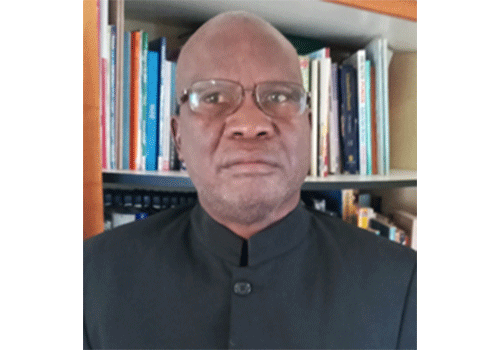
*Prof. Makala Lilemba is an academician, author, diplomat, researcher and scholar.