


The release of Namibia’s 2025 provisional NSSCO and NSSCAS examination results has reignited debate about the state of education.
According to the Ministry of Education, Innovation, Youth, Sports, Art and Culture, 36% of full-time NSSCO candidates qualified for progression, up from 29% in 2024.
While this improvement is encouraging, most learners remain unable to advance.
International benchmarks confirm the depth of the challenge. The Southern and Eastern Africa Consortium for Monitoring Educational Quality (SACMEQ) reported that Namibian Grade 6 learners average 514 in reading and 517 in mathematics, both below the minimum competency benchmark of 550. These figures show that many learners enter secondary school without mastering foundational skills, making exam success unlikely.
Much of the public conversation has focused on summative assessment, the end-of-course examinations that certify achievement. Summative assessment is vitally important, but it has limitations: it measures what has been learned, yet it does not provide opportunities for intervention.
Once results are released, learners cannot benefit from corrective action.
By contrast, formative assessment is a pedagogically effective practice and can be embedded within the teaching process.
Formative assessment monitors learning as it happens, identifies gaps, and allows teachers to adjust instruction in real time. This distinction is critical. While summative assessment certifies achievement, formative assessment has the potential to actually improve achievement.
If Namibia continues to emphasise summative results alone, learners will remain trapped in cycles of underperformance. Formative assessment, when thoughtfully implemented, empowers teachers to intervene early, supports learners in mastering concepts, and ensures weaknesses are addressed before they become entrenched.
As an early childhood educator, I see clearly that the roots of Namibia’s learning challenges lie in the early years.
Early childhood education is the cornerstone of literacy and numeracy. Research consistently shows that children who master reading fluency and basic math before age eight are far more likely to succeed later. Conversely, learners who fall behind in the early years face challenges catching up, no matter how many interventions are applied at the secondary level. The first five years are decisive for cognitive growth. High quality early childhood development and care programmes reduce disparities, ensuring that all young children have a strong foundation in early childhood learning. Without strong early foundations, even the best formative assessment strategies at later stages cannot fully close gaps.
Namibia must seize this moment to invest in early childhood education by establishing centres that integrate play-based learning, literacy, numeracy, and social-emotional development.
Teachers should be trained to embed formative assessment practices in classrooms during the early years, using both formative assessments for learning rather than only summative assessments of learning. National policy emphasis must shift from exam results alone to classroom-level interventions.
Educators, parents, and caregivers must also be encouraged and supported to reinforce early literacy and numeracy at home.
Namibia’s improved exam results are commendable, but they mask deeper systemic issues. Summative assessments provide snapshots of achievement, yet they cannot rescue learners who have struggled for years. Formative assessment, combined with strong early childhood education, offers the most promising path to sustainable improvement. By investing in its youngest learners and equipping teachers with tools to assess learning, Namibia can build a future in which exam results reflect genuine mastery rather than systemic deficiencies.
If we get the foundation right, Namibia’s learners will soar.
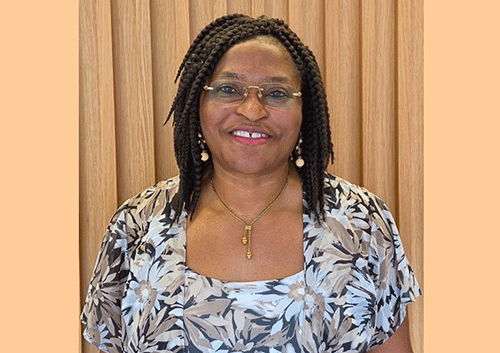
*Dr. Martha Baiyee, a U.S. Fulbright Scholar at the University of Namibia on a ten-month fellowship funded by the US government and supported by the US Embassy in Namibia, is a professor of teacher education at Eastern Michigan University. Her research concentrates on early childhood education, curriculum development, and assessment.