

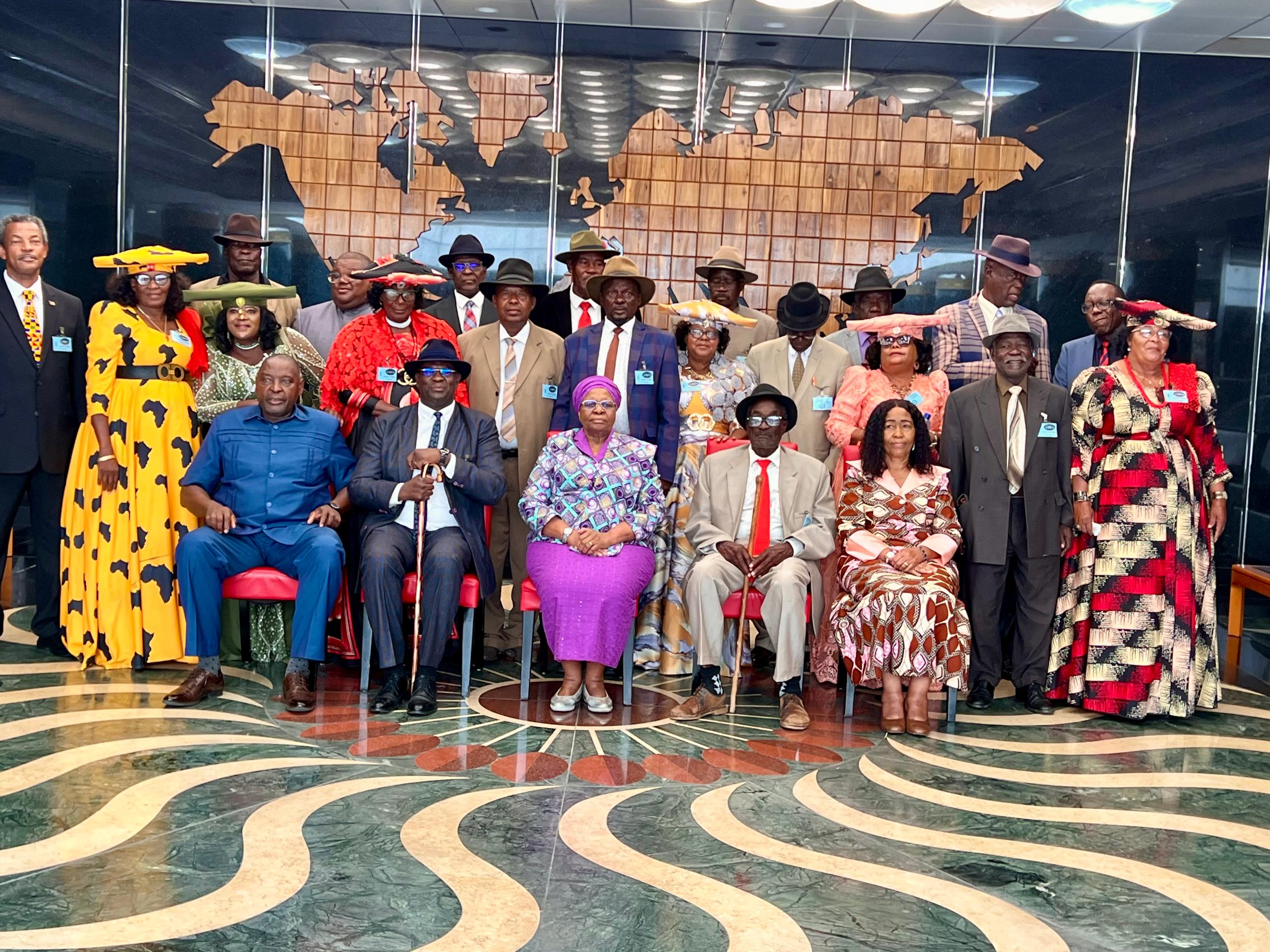

The Ovaherero Traditional Authority faction led by academic Hoze Riruako yesterday met President Netumbo Nandi-Ndaitwah at State House.
High on their agenda were calls for a quota-based land allocation system for historically dispossessed communities, restitution of ancestral land rights and renewed negotiations with Germany over genocide reparations.
Shooting from the hip, Riruako said the meeting focused on concrete proposals the Ovaherero community wants the government to consider, particularly on ancestral land, recognition of early liberation fighters and the long-running campaign for justice over the 1904–1908 genocide.The meeting lasted nearly two hours.
Chiefly, Riruako said most Ovaherero people remain without land despite the country having large tracts of unused land.
“It was very important to have this meeting to calm the fears of all Namibians, whether white or Black, who are not Hereros, because the whole issue of ancestral land is misunderstood… people think that we are going to go the Zimbabwe style and grab everybody’s land. That is not what we are saying,” Riruako said.
Instead, he postulated, the Ovaherero want the land question answered through Namibia’s own development policies and legislation rather than relying solely on external forces and instruments.
“What I was telling the president is that instead of us putting all our eggs in one basket waiting for Germany to pay reparations, we want to see something reflected in our own National Development Plan,” he said.
He continued: “That system should allow those who have been completely disenfranchised of their land to get a piece of land and ensure that some form of restitution is built into our own system.”
Negotiations
The meeting also addressed the ongoing negotiations with Germany over reparations for the genocide committed against the Ovaherero and Nama people between 1904 and 1908.
Riruako said the campaign for justice has been pursued for decades and was first raised internationally by early Ovaherero leaders.
He credited Hosea Kutako for bringing the issue before the League of Nations in 1944, laying the groundwork for what later became a decades-long push for international recognition and compensation.
“The process has been going on for 88 years,” Riruako said.
However, he indicated that the financial offer currently under discussion should still be negotiated further.
“The amount that has been offered is something that I want us to still engage the Germans on,” he said.
He noted that historical records show that about 85 000 Ovaherero people were killed during the genocide, while about 10 000 Nama people also died.
Riruako added that other Namibians were also affected during the colonial wars.
“How can a bullet choose between a dark-complexioned Ovambo like you or a Herero like me?” he asked.
“So there are people who fought and died in those skirmishes, including the San and other Namibians.”
Despite the painful history, he stressed that the issue should not divide the country.
“This is not the time for bigotry, racism or tribalism. It is about bringing back the idea of one nation, one people,” he said.
Recognition
Another issue raised during the meeting was the recognition of liberation fighters who were sent abroad for military training during the early years of the struggle for independence.
Riruako introduced one of the surviving members of a group of 155 Namibians who were sent for training through the efforts of Chief Kutako.
He said many of these fighters were never formally recognised as liberation veterans.
“Unfortunately, the number has been dwindling. Only five of them are left. That is why I brought him to the president. The last justice we can do is to recognise the contribution of the 155,” he said.
Concerns
Riruako also raised concerns about the recognition of traditional leaders, saying some leaders who represent large communities remain unrecognised by the government.
Although the traditional authority he leads is recognised, he said he personally has not received official recognition.
However, he insisted that this would not prevent him from continuing to serve his people.
“I want to make it very clear that I do not need recognition to do the work of my people,” he said.
Despite the outstanding issues, Riruako said the Ovaherero leadership remains committed to working with the government to resolve historical grievances.
“Namibia is an independent country, and I am prepared to work with any government of the day to make sure that they speak our language,” he said.
He also urged members of the Ovaherero community not to allow the debate to be driven by anger or division.
“Don’t be fooled by the doomsayers and those who still want to drink from the cup of hatred and bitterness,” he said.
President Netumbo Nandi Ndaitwah welcomed the delegation of 16 traditional leaders to the Statehouse.
“And once again, on behalf of all of us, you are welcome to State House and your delegation,” she said.
– ljason@nepc.com.na