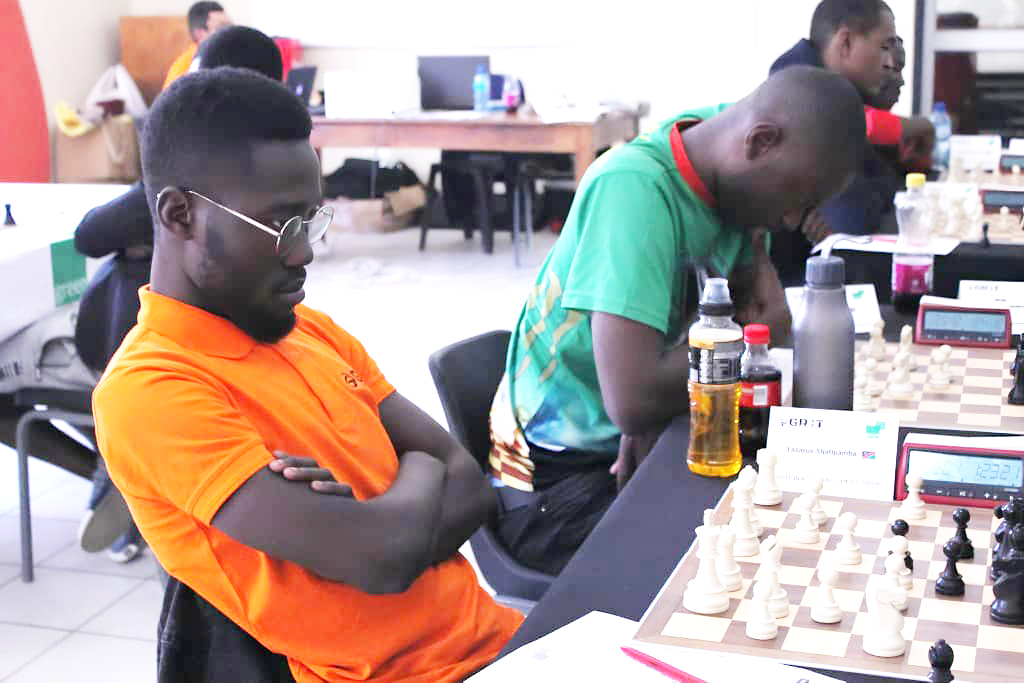

Lazarus Shatipamba has been playing chess for 12 years and currently holds an International Chess Federation (FIDE) rating of 1764.
His journey with the sport began in 2014 at Jan Mohr Secondary School, where he joined the school’s chess club after watching some of his classmates play. What started as curiosity quickly grew into a deep passion for the game.
Shatipamba describes chess as a discipline that sharpens decision-making.
“The better I am at it, the better I will be at making decisions in life. Or at least, that’s the plan. Sometimes it fails spectacularly,” he explained.
His first competitive experience came just weeks after learning how to play, at the 2014 National Schools Teams Championships in Gobabis. It was there that he realised chess was not merely about moving pieces, but about thinking ahead, maintaining focus, managing time effectively and remaining calm under pressure.Shatipamba describes his playing style as hypermodern and counter-attacking, with a dash of dynamism. Among his many proud moments, one achievement stands out: drawing against former World Championship challenger Grandmaster Nigel Short.
“Even though it was only a simultaneous exhibition game, I still could not believe I pulled off such a fantastic feat. That result boosted my confidence and self-belief. I have improved significantly since then, so I can’t help but think that was a pivotal moment in my career,” he said.
However, his journey has not been without painful lessons. One of his most memorable losses came against a cadet (U/12) player, Sibusiso Angula. After arriving late at the venue due to poor planning, Shatipamba smiled when he saw he had been paired against a young opponent, assuming the game would be easy. Five moves later, he was down two pawns.
That humbling experience taught him never to judge a book by its cover.
Before matches, Shatipamba practises mindfulness, using deep and attentive breathing to relax his body and clear his mind. This routine helps him block out distractions and focus fully on the game, putting him in the right mental state to find the best moves.
Currently, he is working to strengthen his psychological approach and improve his endgame technique.
Balancing chess with school, work, and other life commitments requires discipline, which he maintains through time-management tools such as the Eisenhower Matrix and time-blocking techniques to prioritise tasks and stay productive. Shatipamba’s journey has been strongly influenced by former national champion and Candidate Master Goodwill Khoa, a former coach of the Jan Mohr Chess Club. Khoa encouraged him to join the club and helped lay a solid foundation through weekly training sessions.
Chess has helped Shatipamba develop strategic thinking, patience, and resilience. He says it has taught him the importance of thinking several steps ahead in life, waiting for the right moment rather than rushing, and understanding that even after losing a “piece” or facing a setback, it is still possible to win if one maintains composure.
To further test himself, Shatipamba hopes to one day face Norwegian Grandmaster Magnus Carlsen.
“I would love to see how long I can hold my own against his impeccable memory and unparalleled understanding of the game’s inner workings,” he said.
Over the next few years, Shatipamba aims to break the 1800–1900 FIDE rating barrier. Beyond the numbers, he hopes to remain a personality in the sport, inspiring the next generation of Namibians to see chess not just as a game but as a powerful tool for empowerment.