

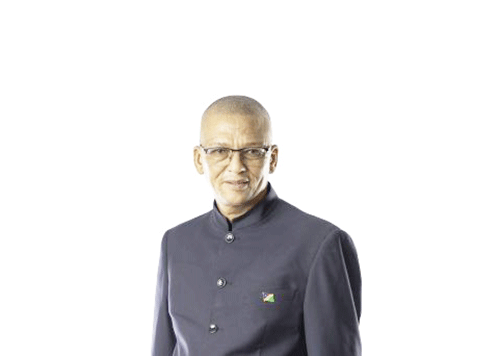

Popular Democratic Movement (PDM) Member of Parliament Diederik Vries has criticised the 2026/2027 national budget “for neglecting service delivery”, citing inefficiencies in the current system.
Vries cautioned that high operational costs and debt servicing in the budget hinder essential economic development, limiting capital project funding due to heavy emphasis on operational spending, particularly on recurrent costs like salaries and debt interest.
“A budget must be judged not by the promise it contains, but by the realities it creates for the people.
The sad reality for many Namibians today is deeply concerning,” he said.
During his budget contribution in the National Assembly on Thursday, Vries addressed issues such as high youth unemployment, struggling small businesses, unaffordable housing, and weak economic growth. He emphasised that while the budget intends to prioritise “people, productivity and prudence”, it may instead result in pressure, stagnation and increased debt.
“Allocating 61.7% of spending to the social sector may sound impressive, but if poverty remains widespread in Namibia, if the world with a Gini coefficient inequality remains among the highest above 0.59, and if unemployment remains stubbornly high, then clearly the system is not delivering productivity and inclusive growth,” he remarked.
Vries highlighted concerns about the agricultural budget, noting its importance in supporting 70% of rural livelihoods in Namibia and lamenting its insufficient funding.
“Let me remind you all that agriculture is one of the most important sectors for food security and poverty reduction in Namibia. Therefore, the allocation of N$1.8 billion to agriculture and land reform is modest when compared to the scale of the challenge,” he noted.
To enhance food security and economic growth in Namibia, Vries advised that investments should focus on expanding irrigation, promoting climate-resilient farming, advancing agro-processing, and supporting small-scale farmers.
He further criticised the N$17 billion allocated for safety and security, emphasising that Namibia cannot solely rely on policing to solve unemployment, poverty, and inequality.
He stressed the importance of economic opportunities for stability, citing Rwanda, Kenya, and Singapore as examples.
According to Vries, these nations made strategic investments in agriculture, which reduced extreme poverty, while also enhancing public services in housing and digital platforms for financial inclusion, ultimately transforming lives by aligning budgets with measurable outcomes. -Nampa