

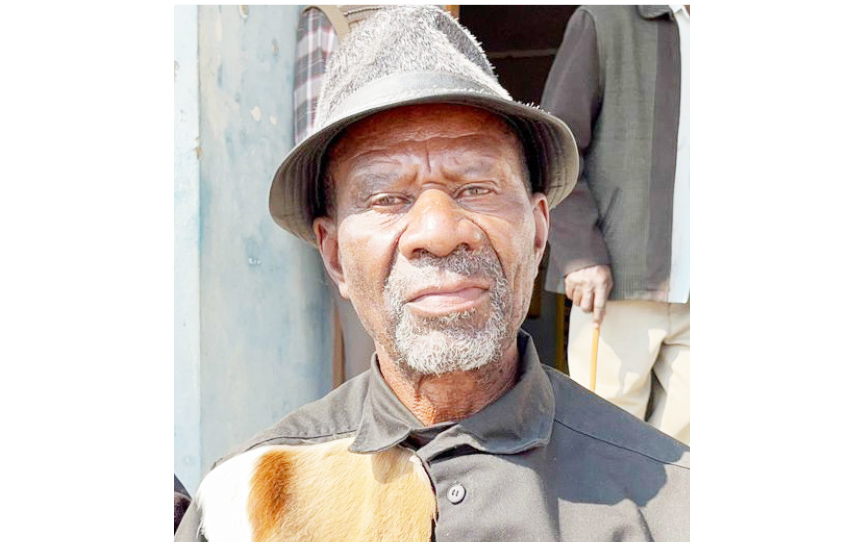

UIS – The Dâure Daman chieftaincy remains engulfed in controversy, despite the recent election and appointment of Issakar Tourob as the new chief.
The spokesperson of the Dâure Daman Traditional Authority, Martin Matsuib, insists that Chief Zacharias Seibeb still holds his position, despite the election results.
Tourob was elected following interventions by the Minister of Urban and Rural Development, James Sankwasa, who met with the concerned Dâure Daman group and Seibeb during a consultative meeting on 4 June in Windhoek.
The meeting aimed to address ongoing disputes over the succession process after the passing of the late Chief Elias Taniseb.
The Dâure Daman chieftaincy is determined through an electoral process rather than by nomination or inheritance through a royal bloodline.
Sankwasa, in a letter, stated that while the Thaniseb nominated Seibeb as his potential successor, the nomination was not binding under the customary law.
“For a nomination to be valid, it must be submitted to the community for approval and acceptance – a step that was allegedly not followed, leaving Seibeb’s appointment procedurally incomplete,” Sankwas said.
Therefore, the current designation of the chief was not carried out according to proper customary procedures.
As a result, Sankwasa recommended that the traditional council and the elders council revisit the matter and implement the designation process in full compliance with Dâure Daman customary law, ensuring transparency, legitimacy and community consensus.
Elders then decided to vote, choosing Tourob as their new chief. Speaking to New Era on Thursday, Matsiub said the elections were not legitimate but rather a misunderstanding caused by misinterpreting the minister’s meeting outcome.
“The election comes from a misunderstanding of a group of people regarding the outcome letter that the minister wrote after the meeting,” he stated.
He added that the customary procedure for appointing a chief involves three steps: the sitting chief appoints a successor, the elders council endorses the appointment, and finally, the successor is presented to the community for acceptance.
“In cases where a chief dies without appointing a successor, the elders council selects a candidate. Only if the elders cannot agree that an election is held among the community,” Matsuib said.
He insisted that the appointment process for Seibeb was properly followed, with documentation and minutes at the regional governor’s office confirming community acceptance.
Seibeb’s chieftancy
However, one of the elders who led the election, Amigo Napuka, claimed Seibeb had stopped being a chief long before the elections.
He recalled that they removed Seibeb before the minister even made the recommendations.
Napuka added that the customary law states that anyone aged 60 or older automatically qualifies as a member of the Elders’ Council, and there is no need to “create” one.
Explaining the process, he said the elders gathered in Uis after councillors failed to act on requests from the minister.
He said they called all elders from the Uis district, giving 14 days’ notice.
On 28 June, they gathered in the community hall.
Seibeb and his team did not attend. During the meeting, he said the minister’s letter and the elders’ powers were read aloud.
Three candidates were nominated by 58 attending elders.
In addition, seven representatives, five men and two women, were chosen to notify other regions for further nominations.
He is adamant that the Tourob is their new chief.
-edeklerk@nepc.com.na