

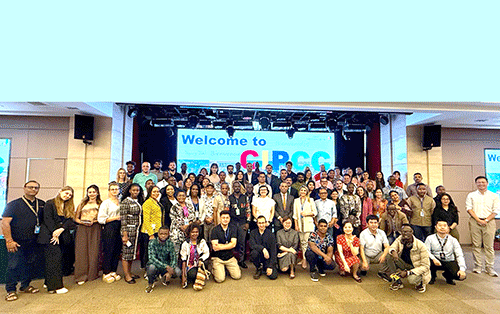

BEIJING – Over 100 journalists and media professionals from around the world have gathered in Beijing for the China International Press Communication Centre (CIPCC) programme to gain exposure to intricate Chinese affairs.
The initiative, which first kicked off in 2014, has brought over 100 journalists from more than 90 countries.
It runs for the next four months.
During their stay, journalists will visit several sites in and outside Beijing.
Additionally, they will attend lectures on China’s development and short-term media exchange programmes.
Speaking during the opening ceremony over the weekend, Yao Baike, CIPCC’s assistant, provided a detailed overview.
“Since 2014, CIPCC has served as a vital bridge, connecting international journalists with the Chinese society. Over the years, more than 700 journalists from over 100 countries have participated in this programme, producing thousands of reports that help global audiences understand contemporary China. As our 2025 participants, you’ll continue this tradition of cross-cultural storytelling with enhanced access and resources,” Baike said.
The CIPCC has established six regional press communication centres.
The African Centre was the first to be set up.
Over the years, they expanded to include additional centres, covering the Asia-Pacific, Latin America and the Caribbean, Eurasia, and the Arab region as well as Europe.
Each centre is supported by its own dedicated director and assistants.
“They will be your strong local partners here in China. While many of our events are organised jointly across centres, some are tailored specifically to individual regions. No matter what, we ensure every journalist has meaningful opportunities to connect and engage,” she stated.
Over the next few months, the journalists will get an in-depth understanding of China’s truth – its socialism with Chinese characteristics, the transformative power of artificial intelligence (AI), the vision behind the Belt and Road Initiative as well as the role of dialogue at a time when the world confronts a myriad of geopolitical tensions.
“When you return [to your respective countries], we sincerely ask you to carry this truth home – to your families, your friends, your countries. As journalists, educators, scientists and future leaders, you owe the world something precious: the truth. In an era overwhelmed by propaganda, fake news and disinformation, you are the ambassadors of what is real,” said Baike.
For this year’s programme, Namibia is represented by New Era’s editor Edward Mumbuu.
On the sidelines, we caught up with some journalists to gauge their expectations.
One of them was Netsanet Kinfe, a seasoned journalist with the Ethiopian Broadcasting Corporation.
“I think this is a good opportunity for all of us. Personally, I think it gives us a big chance because I will explore a lot, knowing that China is the second largest economy in the world. So, we can share cultural experiences and economic ways of doing things,” Kinfe said.
Another participant was Rethabile Majara from the Kingdom of Lesotho.
Majara wants to learn as much as possible.
“For me, it’s a great opportunity. It’s a game changer and a noteworthy opportunity, which is not to be missed. I have been here for a few days. I can say the Chinese people are friendly and the place is eco-friendly.
“The transport system is advanced, as well as the infrastructure. I want to take home many things from here. I will go back and share with my colleagues the technological advances here,” Majara said.
Meanwhile, Nilton Dimande from Netsanet Kinfe, a journalist with Mozambique’s Sociedade do Noticias, said, “I am here to learn about the culture of the Chinese people and share some of the content with my country about the Chinese people, to have exchange programmes and to write reports about communities and neighbourhoods here”.