

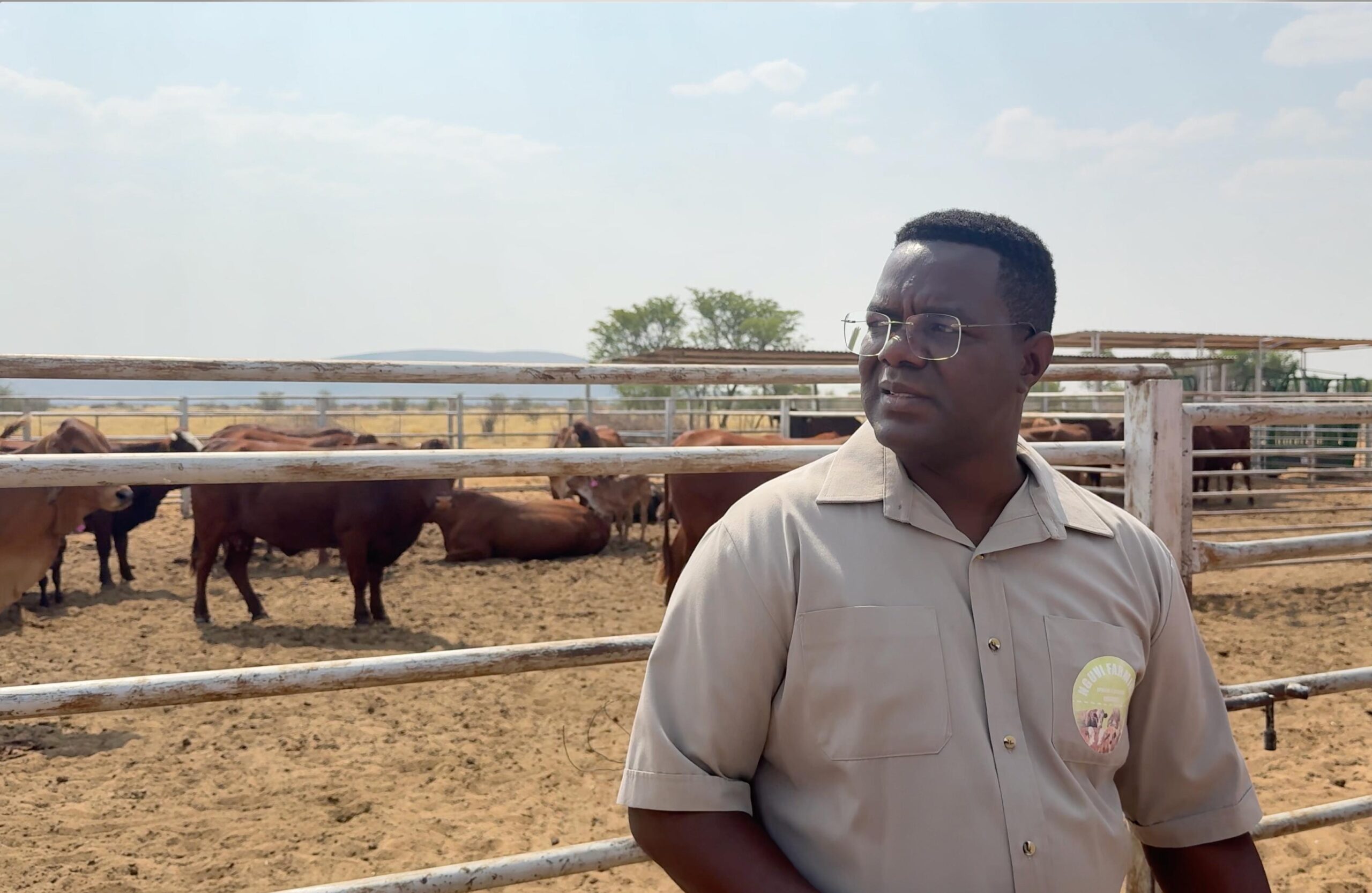

Lahja Nashuuta
Farm Rustig, located near Dordabis in the Khomas region, has emerged as a model of success under Namibia’s land resettlement programme, demonstrating the true benefits of the programme.
Once a vast stretch of undeveloped land, Farm Rustig has now been turned into a productive operation, with visible infrastructure, healthy livestock, and motivated farmers. Nguvitjita Kapere, who manages Unit C of Farm Rustig (2,219 hectares), is one of the farmers who have turned this bare land into a thriving operation. “When we moved here in 2020, there was nothing. It was just open land. We had to develop everything from scratch,” Kapere recalls. Today, Kapere runs a farm stocked with about 250 cattle and nearly 600 small stock (sheep and goats), supported by a modern auction facility equipped with weighing equipment and loading space. He is also a certified Brahman breeder.
“I don’t transport my livestock to auctions anymore. Buyers come here, we weigh them and load them right on the farm. This saves me money and makes business easier,” he explained.
Kapere employs five full-time workers and emphasises the importance of hard work and reinvestment. “It’s one thing to be given a farm, but it’s another thing to make it productive. We must meet government halfway and farm as a business, not just as a tradition,” he stressed.
A dream realised
Another beneficiary, Joolokeni Kamati, allocated Unit A (1,848 hectares) in 2020, says Farm Rustig has allowed her to fulfil a lifelong dream.
“I developed a love for farming as a child when I used to herd my parents’ livestock,” Kamati said. “I applied for resettlement in 1997 and finally succeeded years later. Many people give up after the first attempt, but I never lost hope.”
Today, Kamati, a single mother of two, manages an impressive herd of 240 cattle (including Brahman), 130 goats, 200 sheep, and 37 pigs.
Despite her successes, Kamati admits the journey has not been without obstacles. Stock theft and lack of water remain her biggest concerns.
“Water is not really a big challenge, but theft is. This year alone I lost 11 cattle to theft,” she revealed, adding that such losses are not only financially devastating but also discouraging for farmers who work tirelessly to build their herds. To stay afloat, Kamati sells livestock twice a year to keep her numbers sustainable and reinvests into her farming operations.
Kamati also urged women to break the stereotype that farming is a male-dominated field. “Agriculture is the future. If we are serious about food security, then more women must take up farming,” she said.
Speaking during a familiarisation visit to resettlement farms on Friday, Khomas governor Sam Nujoma said he was impressed by the transformation at Rustig, which was allocated to three beneficiaries in 2020. “Success stories like Rustig show us that resettlement works when beneficiaries take ownership and treat farming as a business. This is the way forward for Namibia,” Nujoma said.
He continued: “Farm Rustig is very impressive. The livestock are healthy, the infrastructure is in place, and in many ways, it resembles a commercial farm. This is exactly the kind of success we want to see from our resettlement programme.”
The governor emphasised that the government’s land reform policy is not merely about redistributing land but about empowering Namibians to become productive contributors to the economy. He stressed that when farms are used effectively, they generate jobs, improve livelihoods, and strengthen national food security.
“Land on its own will not change lives,” Nujoma emphasised. “It is the effort, commitment, and vision of the farmer that turns hectares into prosperity. Resettlement is an opportunity, not an entitlement, and we must use it wisely. Government will provide the land, but farmers must bring dedication and sweat equity. Farm Rustig is proof that when both sides meet halfway, the results can be remarkable.”
Nujoma said the lessons from Farm Rustig must be replicated across the country. While acknowledging that some resettlement farms face challenges such as water shortages and poor management, he insisted that commitment and accountability from farmers remain central to progress.
“We want to see all resettlement farms being used productively. Where there are struggles, government will see how best to assist, but farmers also need to invest their own effort. No policy will succeed if people fold their arms and wait. We must all pull in the same direction,” he said.
– lnashuuta@nepc.com.na