

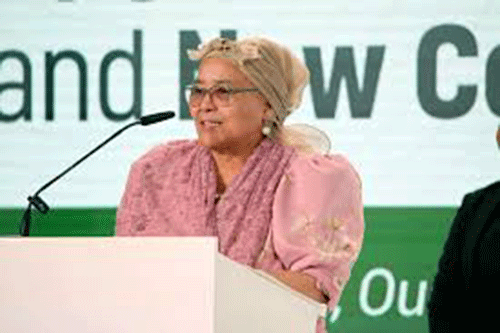

Lahja Nashuuta
Namibia is set to enact the Persons with Disabilities Act.
It is aimed at providing comprehensive protection for persons with disabilities, though key gaps remain.
The announcement comes with the release of the Five-Year National Disability Policy and Implementation Plan (2025-2030).
The new policy, which is yet to be gazetted, aims to promote inclusion, protection and equal rights for individuals with disabilities in Namibia.
The policy, signed by Vice President Lucia Witbooi and presented in Parliament by Prime Minister Elijah Ngurare, states that passing the Persons with Disabilities law is crucial to ensure legal protection and promote inclusive, disability-aware systems.
In her foreword, she highlighted that, despite existing legal and policy frameworks such as the Constitution, the National Disability Council Act, the Child Care and Protection Act, the Affirmative Action (Employment) Act, the Public Enterprises Act and the Communal Land Reform Act, persons with disabilities remain among the most marginalised members of society.
She noted that more needs to be done to enhance the efficiency of these frameworks, ensuring inclusion and accommodation.
“Namibia’s commitment to the promotion, protection and fulfilment of the rights of persons with disabilities is evidenced by, among other things, the adoption of policies and enactment of legislation focused on the wider inclusion and protection of the rights of persons with disabilities,” Witbooi said.
The policy, approved by Cabinet on 8 July, replaces the 1997 National Policy on Disability and brings Namibia in line with international standards, including the United Nations Convention on the Rights of Persons with Disabilities (CRPD).
In her foreword, Witbooi said the policy demonstrates the government’s strong commitment to ensuring that persons with disabilities are included in every aspect of national life.
“This policy is not just a document. It is a promise. A promise that persons with disabilities will be seen, heard and included in all aspects of our society. It is grounded in human rights and development, focusing on breaking down barriers that prevent people with disabilities from living full, independent lives,” she said.
Statistics
The 2023 National Population and Housing Census states that around 4.4% of Namibia’s population – about 10 992 people – live with some form of disability.
The prevalence is higher in rural areas (5.8%) than in urban areas (3.2%), with Omaheke (6.1%) and Kunene (5.8%) recording the highest numbers.
The policy highlights the many challenges faced by persons with disabilities, including limited access to buildings, transportation and education as well as stigma and discrimination.
“Persons with disabilities continue to face physical, communication, attitudinal and institutional barriers that hinder their full participation in society,” the policy reads.
To address this, the government plans to improve access to quality education and vocational training for learners with disabilities, strengthen the National Sector Policy on Inclusive Education (2013) and ensure training centres are fully accessible.
The policy also aims to improve living conditions for persons with disabilities by creating employment opportunities, enhancing social grants and ensuring access to affordable housing and healthcare services.
“The Government shall sustainably provide funding to support programmes that improve the living conditions of persons with disabilities,” the document reads.
The government will update the National Disaster Management Strategy to protect persons with disabilities during emergencies and develop a Sexual and Reproductive Health Strategy to improve access to healthcare and family planning services.
The policy emphasises improved data collection and research to understand the needs of persons with disabilities better.
It also commits to supporting Organisations of Persons with Disabilities (OPDs) through training and funding to enhance advocacy for disability rights.
International commitment
Namibia ratified the CRPD in 2007 and submitted its first national report in 2020.
The new policy reaffirms the country’s commitment to international standards.
“The Government of Namibia shall align national frameworks with international disability instruments to strengthen cooperation and promote the rights of persons with disabilities,” the policy states.
-lnashuuta@nepc.com.na